
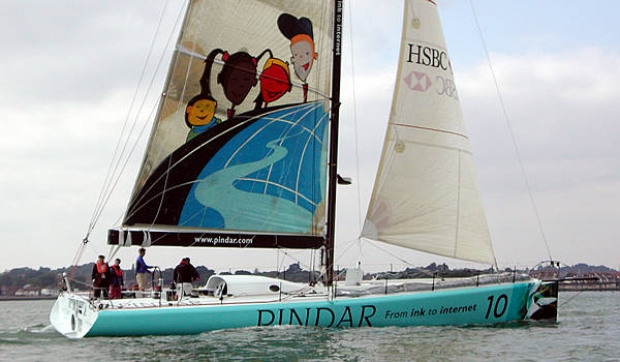
Introducing the new Pindar
Tuesday September 23rd 2003, Author: James Boyd, Location: United Kingdom
Emma Richards and her new Kiwi shore team of David Endean and David Duffy have been in Cherbourg for the last few months beavering away transforming Graham Dalton's sorry dismasted Open 60
Hexagon, into the gleaming new ocean racer
Pindar.
The boat arrived in Gun Wharf Quay, Portsmouth last week after Richards and Mike Sanderson, her newly appointed co-skipper for November's Transat Jacques Vabre, had completed their obligatory 1,000 mile qualifier for the race.
While out of the water at the JMV Industries shipyard, the hull and deck have been repaired following the loss of the boat's rig during Around Alone. Aside from wiping out half the stanchions and lifelines, the dismasting also created a number of holes down one side of the hull and destroyed both rudders, when the broken rig folded under the boat. In addition to this they have removed all of the NKE electronics on board and replaced it top to bottom with state of the art Raymarine.
Although pale blue in our eyes, the hull's new colour is officially Mediterranean Green, the official corporate hue of Richards' Scarborough-based sponsor.
The main modification has been her new rig. She now sports a new Southern Spars mast - the same section as a VO60 - and one of the more surprising aspects of the new Pindar is that she now has a conventional boom arrangement.
Traditionally Open 60 booms attach to the deck just aft of the mast. This has a number of advantages such as removing boom compression from the mast, creating a more angled boom that prevents the crew from being wiped over the side during manoeuvres and which in the event of a dismasting can be hoisted rapidly to act as a jury rig.
The downside of this arrangement is an inadequate vang. Deck stepped booms have a vang comprising a line running along the bottom of the boom. This is then hauled down to various points on the deck depending upon the point of sail. (See the example the rather substantial tackle Bernard Stamm's Bobst Group-Armor Lux has for this purpose here).
"Everytime you ease the boom, basically your vang is down to the deck," explains Richards of the problems associated with deck-stepped booms. "So if you ease a little mainsheet the boom is always going to come up. You’re never going to keep the boom at the same height - so you are not just easing mainsheet you are easing vang as well.
"If you have a conventional vang you can continue to trim it properly and play it all the time, particularly if you are doublehanded. When you are upwind you don’t use it and when you’re downwind you’re not going to have a lot on. The biggest part is that you’re going to play it when you are reaching."
She adds that the new Pindar is primarily set up for reaching and the Transat Jacques Vabre in particular is a reaching race, so having good vang control could provide an added performance bonus. The new arrangement has required 12kg of additional strengthening in the mast to take the compression loads from the boom. The vang itself comprises a simple and lightweight block and tackle system (see below).
On the qualifier, they set off in a hurry, Sanderson having jetted in from Bermuda, where he'd temporarily left Mari Cha IV on which he is Racing Skipper. "It was fantastic considering we’d only been sailing on the boat a couple of times," says Richards of their trip. "We went right across Biscay to La Coruna and back. Conditions-wise we had a bit of everything from 35 knots down to nothing, upwind and downwind and we were able to try every sail except one." At present the original Hexagon suit of Doyle Sails are on board, with the exception of a new staysail that sailmaker and shorecrew David Duff knocked up. A new suit from North NZ is on its way for the TJV.
The new Pindar, Richards says, is vastly different to the Groupe Finot design she sailed in Around Alone. "You can feel the speed difference. Having said that, I haven’t sailed that boat since May. This boat has wheels instead of a tiller - everything about it feels different." The boat also has a canting keel rather than a fixed keel and water ballast.
Having a wheel makes helming the boat more enjoyable and there is no precarious perching on the aft deck to operate the windward tiller. "You can stand square in front of a wheel and you have more power," says Richards.
Following the TJV, the boat will be heading for the Caribbean where they will sail in events such as the BVI Spring Regatta and the St Maarten Heineken Regatta before returning to the UK for the OSTAR. The principle reason for the Caribbean tour is that it will provide Pindar with an opportunity to use the regattas for corporate entertainment. "At the end of the day I wouldn’t be able to do any of this without Pindar," admits Richards. "So there is the publicity from races, but you also need something touchable, bringing it down to a level where people can see it is real and not cruising around the world."
After the OSTAR they are also considering entering the boat in the fully crewed Quebec-St Malo race in which, we are reliably informed, sponsor Andrew Pindar will be part of the crew following his debut in this year's Round the Island Race.
In the short term Pindar is due in Scarborough at the end of this week for her official launch ceremony before returning to Portsmouth.

Most Read
Most Commented
Comments
Businesses


Pro businesses
Editor's choice
Member blogs
-
 Ned Collier Wakefield: MOD70 round BarbadosWell that was intense. 12 hard fought for seconds for the win. In idyllic conditions, Tony Lawsons MOD ...
 -
 Mini Transat leg 2 reportThe second leg of the Mini Transat started on 31st October, just over a month after ...
 -
Leg 1 reportI’ve been working towards the Mini Transat now for three years. In 2013 I was part ...
Business blogs
-
 The Island Sailing Club in Cowes, Isle of Wight, is delighted that Prince Michael of Kent ...
 -
Peta Stuart-Hunt chats with the 25 year-old British solo sailor Lizzy Foreman before she sets sail ...
-
The 2015 Student Yachting World Cup (SYWoC), an ISAF-recognised event hosted and run by students for ...
Editor's Choice
All time favourites...
-
 Three legs down into Ian Walker’s
 -
 Winning all but two races at
 -
 For the first time in its
Latest Comments
Add a comment - Members log in