
IRC Weapon
Thursday June 12th 2003, Author: Andy Nicholson, Location: United Kingdom
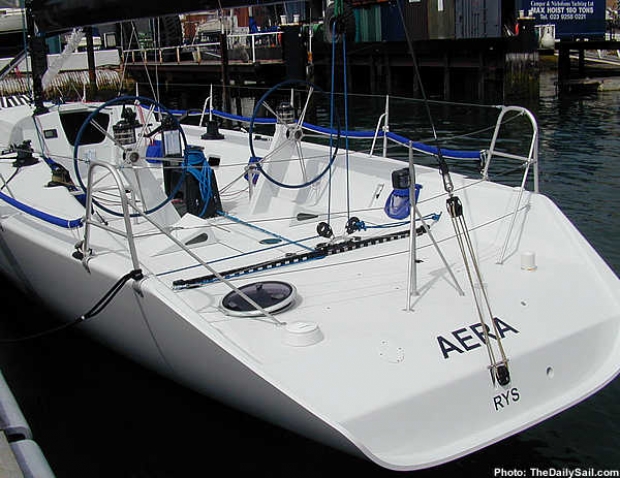
One of the most exciting boats to arrive in the Solent this year has been the new 55 footer
Aera.
The past few weeks have seen her blow the IRC fleet apart. On her first outing Aera won RORC’s Myth of Malham offshore race and then she took the battle inshore by winning the IRC nationals in IRC Super Zero by 12 points and victorious in six of the races in the process. And the highlight of her year has still to come.
In July Aera will be raced the Admiral's Cup by the King of Spain in a formidable team alongside the Rodman 42 Telefonica Movistar, skippered by Pedro Campos.
The new Aera holds considerable significance for her young hot shot designer Jason Ker. With the rig problems of his earlier boats behind him, Ker has become a leading exponent of the IRM rule with his string of 9, 10 and 11 point somethings. Aera sees Ker design specifically for the IRC rule for the first time.
Many eyebrows were raised when the Ker design office announced the commission of 'their first big boat' last year. Now following Aera's success so far the only eyebrows being raised are Ker’s own as the phone rings again…another serious race boat owner inquiring about How? and How much?
Asking Ker what issues he faced making the size jump his first response was: “Well, it all looks the same size on the computer screen”.
Aera has been built for a UK based owner who has had a string of racing boats of the same name. What he wanted this time was something to take to the major regattas around the world in a four year programme. One of the first design considerations was that the boat could get places without shipping. "We needed a boat that could travel a lot of the time on it’s own bottom rather than having to be shipped," says Ker. "So that’s why it has two watertight bulkheads and is a practical boat to look after."
The intended programme of the boat decided the size as Ker explains: "It needed to be big enough to do the regatta circuit, but still with a manageable crew size. Also small enough to have good racing with boats that already exist - we didn’t want to do a 60 or something, when you end up racing yourself. The obvious boat to go and race against was the [Farr] 52s”.
The boat does have IMS capability, by changing the keel, but racing in the Med is only seen as a small part of the programme. The Caribbean and Australia (via ship) are the main destinations, along with a significant UK event schedule.
IRC was the main focus for the boat and Aera is the first yacht designed by Ker specifically for this rule. Last summer the project underwent tank testing at Southampton Institute, using the proposed Aera model up against an interpretation of the Farr 52, "as much as anything to convince the owner that it was going to be fast" says Ker.
This provides a little banter between us, and the yacht’s builder Richard Acheson:
Richard: “Were we allowed to do that?"
Jason: “Oh yeah there’s nothing wrong with that! You can’t get the line drawings, but you just have to make a best approximation”
Ker explains how you go about ‘designing blind’ for IRC: "You have to make educated guesses on some things. The rule is not published, so you have to weigh up probabilities and then put in trial certificates and see if you're right. You only get six shots [before the yacht is built], so you have to be pretty sure going into it and also know what questions to ask about your design. So we are pretty happy with the way it turned out and we didn’t end up with too many questions unanswered.”
Post launch another round of optimisation can take place. When asked if there was anything he wanted to talk to me about that changed after the boat was launched Ker replies: “Nothing!” and continues, “There are things we could consider doing differently and there are some options still on the table for us, but I guess it depends on what other people are going to do [with their ratings]."
Visually the boat stands out in two departments. Firstly the big America’s Cup style ‘deep cord’ boom and secondly the Laurie Davidson-type knuckle bow.
The boom has been the main area for concern for the new boat. It is built using the same technique as the hull, with a carbon skin over a foam core, for light weight. Racing in 30 knots last weekend the crew were swift to prevent the boom snapping as it started to deform in the conditions. This is now being analysed by Formula Spars who built the mast and boom, as Ker explains: "I’m not sure if they have resolved exactly where the issue lies. The technical term of what was happening is side-wall buckling. The boom is built in exactly the same way as the boat, with foam sidewalls, it’s just they don’t appear to be very thick…"
Bruce Thompson, who has returned from the Oracle camp, to the Lymington-based spar maker, engineered the mast separately. One of the key decisions to go with Formula was the company’s commissioning of new tooling. This meant that Aera’s spar was a perfect fit for the new hardware and a perfect choice for Ker.
The knuckle bow has it’s origins in a much smaller boat, a 32 foot Ker design built in Dublin. Because of the engineering that goes into completing the bow on a carbon/foam boat the plug is shaped with straight lines at the bow, to be finished with foam ‘prosthetic’ that should not comprise the integrity of the hull in the event of a collison. "The plug for the boat has a cut away like that to make it easier to build that shape," says Ker "and we started thinking, with a little bit of this and that it won’t actually be a bad shape."

The bow shape provided them with some space in rating terms for the 55. "We wanted to keep the rating the same, but we wanted to increase the upwind sail area. It’s a trade off basically; we traded length for sail area. On the 32 we wanted to put a carbon rig on the boat but to still remain in class, this is a way of trading it off."
Aera was built in South Africa at Acheson Rossa Custom Yachts, taking five and half months to complete over the British winter. The primary consideration for this choice of yard came down to the cost savings it provided. Richard Acheson explained, "I would say the cost advantage over Northern Hemisphere yards is in the region of 20-25%, which at this size of boat is a significant amount money."
To compliment this cost saving was the South African yard’s ability to deliver the quality required for a custom race boat. Aera is the first composite race boat the yard has produced. Their main line is in cruising yachts; the Shearwater 45 won the Cruising World magazine’s yacht of the year in 2001. However the Rossa part of the company’s name comes from partner Yan Rossa, a highly experienced composite boat builder.
Acheson brought in Tony Evans (ex GBR) to project manage the Aera build. “He did an absolutely superb job,” says Acheson. "This is what I will do in the future - have one or two specialists on race boats on the project."
When it came to the challenges of the build Acheson says the only thing that cropped up was a bulkhead that came out 1kg over weight and was subsequently scrapped. On her arrival in the UK, Aera was sailing within a week.
For Ker the main challenge of building a yacht of this size was the amount of people involved. "As far as the size of the boat is concerned, there is generally more work involved and because you have a number of people involved on the boat there are more opinions too." He continues, "a lot of good stuff came in, but it does make it a little harder to get things done."
News Corp skipper Jez Fanstone is the skipper of Aera, with Jason Carrington (ex Assa Abloy) and Damien 'Shredder' Duke (ex News Corp) in the crew too. Much of the deck layout came from input from Fanstone and Carrington, with Harken deck hardware supplied via Lou Varney at Diverse Yachts. Sails are all from North UK.
For the Admiral's Cup the Aera crew will see some changes, with the addition of Eddie Warden Owen, Andrew Cape as navigator and Bouwe Bekking as helmsman.
Ker is clearly relishing having his latest design in such capable hands and sees the Australian swing keel big boat Wild Oats as their main threat.
Various questions of how IRC will cope with Wild Oats and her canting keel have been raised. "They [RORC Rating Office] can’t make changes [to the rule] mid-season, so I think we will just cope with it. A canting keel is certainly a very good thing to have, but that’s only one part of the design. I think we’ll just have to see”.
The Admiral’s Cup will certainly be a good stage for Ker to display his latest offering, but other projects are moving on at pace in his office. "There are several people interested already. Sisterships for the 55 are definitely in the plan," he says. "We are talking to someone about a 45 and there is definitely interest in the 40 foot range. We are also talking to someone about production building the 32."
The future looks bright for Ker.
Principal Dimensions
Length Overall: 16.52m
Waterline Length: 13.79m
Beam: 4.09m
Draft: 3.20m
Displacement: 11,020kg
More photos on following pages:
To see Aera in action at the weekend click here

Most Read
Most Commented
Comments
Businesses

Pro businesses
-
France
-
France
-
United Kingdom
-
United Kingdom
Editor's choice
Member blogs
-
 Ned Collier Wakefield: MOD70 round BarbadosWell that was intense. 12 hard fought for seconds for the win. In idyllic conditions, Tony Lawsons MOD ...
 -
 Mini Transat leg 2 reportThe second leg of the Mini Transat started on 31st October, just over a month after ...
 -
Leg 1 reportI’ve been working towards the Mini Transat now for three years. In 2013 I was part ...
Business blogs
-
 The Island Sailing Club in Cowes, Isle of Wight, is delighted that Prince Michael of Kent ...
 -
Peta Stuart-Hunt chats with the 25 year-old British solo sailor Lizzy Foreman before she sets sail ...
-
The 2015 Student Yachting World Cup (SYWoC), an ISAF-recognised event hosted and run by students for ...
Editor's Choice
All time favourites...
-
 Three legs down into Ian Walker’s
 -
 Winning all but two races at
 -
 For the first time in its
Latest Comments
Add a comment - Members log in