
Fourth time round
Friday January 17th 2003, Author: James Boyd, Location: United Kingdom
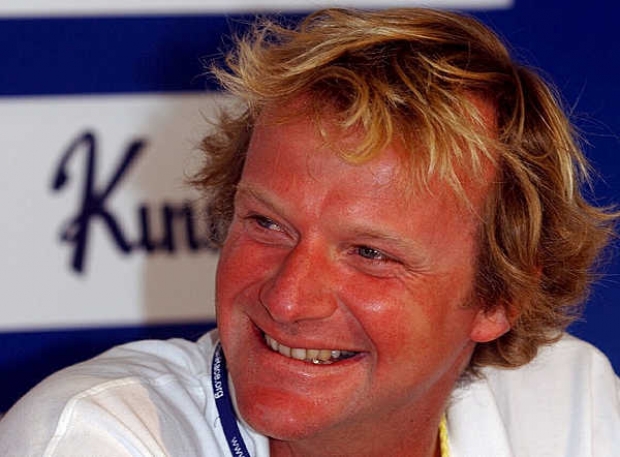
Neal McDonald, the man who Grant Dalton once described as being worth two average mortal crewmen on board a boat, is off on his fourth circumnavigation with Ellen MacArthur on board
Kingfisher2 any time soon.
"I talked to Mark [Turner] during the last Volvo race and he outlined his plans and wanted to know whether or not I was interested and of course I said ‘yeah’ I think it sounds like a fantastic program”," says the Hamble Hero. "In a way it would be very easy to say ‘bugger it, I’m not going down to that Southern Ocean again - I hate it down there”, but in fact personally I believe that everytime I go down there I get one less surprise. And it’s surprises that let you down."
This will be his fourth lap of the globe, his most recent being as skipper of the Volvo Ocean 60 ASSA ABLOY. Previously he was a watch captain on Grant Dalton's Club Med during The Race and with Lawrie Smith on Silk Cut. "You’d be wrong to include my Fortuna debacle as a circumnavigation," he says of his first grapple with the Whitbread in 1989/90. "It was more like round the Isle of Wight! It was still one of my better Isle of Wights!"
On board it seems likely that with his vast experience McDonald will be a watch captain again, although at the time of our interview this hadn't been finalised. "We haven't got down to the nitty gritty. We’ve got a pretty star studded crew. If you like the hierarchy it going to be pretty simple – there isn’t going to be a lot of it. Ellen is obviously going to be the boss and the rest of us will do what we need to do to get around the best we can. I think there’s a number of people who’ve got specific talents or background. I guess once I’m on the boat looking after the rig will probably be my association. We haven’t really decided on how the watch system will go, but there will probably be three watch systems. I imagine there is a possibility of my being a watch leader."
On board Ellen will obviously be skipper and make the big calls as well as taking on the navigator's responsibilities working with her shore-based routers in Germany and France as well as the Offshore Challenges HQ based in the GBR Challenge yard in Cowes.
Prior to sailing the Sydney-Hobart with wife Lisa on board Canon Leopard, McDonald was in Cherbourg minding the build of the new carbon fibre wingmast for Kingfisher2, following her unfortunate dismasting in Med last summer.
"It’s not a great deal different," he says of his precious new spar. "It came out of the same moulds, essentially with the same layouts. We really weren’t brave enough to go too wildly different. Despite that one coming down recently, they’ve done a lot of miles that particular design." That mast had been around the world twice.
A slight cause for concern is that they don't know why the mast broke. "It is a bit of a worry. There’s a lot of reasons we know weren't the cause, so we’ve managed to tick off a lot of those. But we still don’t know the exact problem associated with it. So it is a bit of a worry, because we are building a similar mast and going smoking off round the world with it. But they have done a lot of miles those particular rigs. So I’m not untowardly worried about it."
Aside from the new mast McDonald says that there has been a big drive to remove weight from the boat. "That’s something which Albert [ Neal Graham] has put a lot of energy into it. I think if you looked at the way this has been arched up compared with the previous generation I’d say the gains are probably going to be in the weight that the boat crosses the line at. I don’t know if the numbers are completely official but it is significant." Before the boat was around 23-24 tonnes on the start line. This time round it should be substantially less.
"Reducing weight in a boat like that makes a huge difference if for nothing else it means you don’t trash it so quickly," continues McDonald. "The boats are very fragile and being heavy actually makes them much easier to damage. And the other big gain is that we’ve gone not radical but much more race-orientated with the sails. We’ve got the whole swinging shooting match now."

The sails put on Club Med and Innovation Explorer (now Kingfisher2) when they were new were made in bulletproof Spectra. "You needed a crane to get them on the boat, but now you can carry these on with crew. I don’t know if it would be half weight, but it might be more than 200kg lighter, which up in the air is a massive gain." The new wardrobe is in North carbon 3DL, which Ellen used in the Vendee Globe.
Aside from this they want to make sure that they don't experience the same problems as they did on Club Med with delaminating beam fairings and padeyes and mainsheet track popping out left, right and centre.
So how is sailing a 110ft catamaran different from a Volvo boat? McDonald says that it is not that great. "It is still a race boat, you still need to get the shifts right, you still need to tack on a bad shift, you still need to make sure you are VMCing right, you are still trying to optimise everything...
"On a Volvo 60 you still take the masthead chute down knots because you know the rig’s going to come down and put up fractional chutes – you NEVER take those down! On Club Med we had a spinnaker in 55 knots – I’ve never done that in a Volvo 60. We were doing 30 knots absolutely dead downwind – 175 true for about half an hour.
"The perception is that you take it easy [on big multihulls] and it’s a cruise round but it’s not. It’s actually much harder work. Sail changes have to be planned further ahead and they can take two hours because of the size and weight and the planning of everything. So the emphasis is slightly different, but it is still a race and you’re still doing it as hard as you can.
"I guess the biggest difference is when you go into a seaway. Uphill in a Volvo 60 you don’t slow down because you’re slamming off waves. Having said that in a maxi you do. You’d smash a maxi up if you kept going in 40 knots upwind. In a multihull in 16 knots you might be throttling if the sea state is wrong, so there is a different balance, but it is still about going fast without blowing it up."
One of the criticisms of Bruno Peyron's Jules Verne Trophy record breaking voyage last spring on Orange (now Kingfisher2) was that they sailed too conservatively. The consensus about the Kingfisher2 voyage is that it will be sailed in a more flat out manner and it will be interesting to see if this approach works and the boat holds together.
McDonald certain thinks they will be pushing harder than they did on Club Med during The Race, when they were effectively left in a one horse race situation, the pressure off considerably. Besides making a record attempt requires a different approach. "I think we will be pushing it harder than that. In a way racing against the clock is harder than racing against another boat. If the other boat blows up and you’ve left them in your wake then you will obviously throttle back and won’t push as hard. If you are racing against the clock I think you've got to push all the time, because even if you’re way ahead you can't be complacent and if you’re way behind you never know you might just get a lucky streak at the end. So I still don’t think there’s ever a possibility of throttling back."
Meanwhile McDonald, like his wife, is waiting attentively to find out what Volvo will be announcing in February. He is known to favour a big multihull option for the Volvo Ocean Race, but says that the decision is a highly complex one. "My point has always been that the people who should be deciding is the sponsors. They’re the ones who are paying the bills - it should be catered for what they want and that is a very difficult decision, but I do feel confident that Bourky [VOR CEO Glenn Bourke] has taken on board everyone’s opinions – he’s listened to 1000s of them - and if anyone had the responsibility of making that decision then I am bloody happy it’s him.
"At the end of the day the boat doesn’t make a huge difference providing that the event allows likely sponsors to get what they want out of it. Do they want to throw a couple of million more into a boat that actually gets to more stopovers - it is a very hard call because it is a chicken and egg thing: you’ve got to double guess what the sponsors are going to be and what do they want, before making the decision. But he [Glenn Bourke] has talked to a lot of people, so I’m comfortable that he’s in as good a position as anybody as long as he hasn’t been restrained too much by the machine around him. I’m happy that whatever decision he comes up with will be as good as you can get."
Almost for his recreation McDonald has endorsed the new RMW40 catamaran, that could herald the rebirth of a Formula 40 style circuit if RMW Marine can secure some purchasers. "I just love that kind of thing. In the short term, one thing I’d like to do would be a Round England race on one of those. It would be just fantastic. The wife might take me!
"I still feel that one of the successes of the skiffs when I did them was that they were based in one place and if you had a circuit of those 10 boats racing in the Solent each weekend and people knew where to go and watch them then I think it wouldn’t be too difficult to get small, local companies involved with sponsoring it and it would be great fun."

Most Read
Most Commented
Comments
Businesses


Pro businesses
-
United Kingdom
-
-
Italy
-
United Kingdom
Editor's choice
Member blogs
-
 Ned Collier Wakefield: MOD70 round BarbadosWell that was intense. 12 hard fought for seconds for the win. In idyllic conditions, Tony Lawsons MOD ...
 -
 Mini Transat leg 2 reportThe second leg of the Mini Transat started on 31st October, just over a month after ...
 -
Leg 1 reportI’ve been working towards the Mini Transat now for three years. In 2013 I was part ...
Business blogs
-
 The Island Sailing Club in Cowes, Isle of Wight, is delighted that Prince Michael of Kent ...
 -
Peta Stuart-Hunt chats with the 25 year-old British solo sailor Lizzy Foreman before she sets sail ...
-
The 2015 Student Yachting World Cup (SYWoC), an ISAF-recognised event hosted and run by students for ...
Editor's Choice
All time favourites...
-
 Three legs down into Ian Walker’s
 -
 Winning all but two races at
 -
 For the first time in its
Latest Comments
Add a comment - Members log in