

Once more into the fray
Monday November 3rd 2003, Author: James Boyd, Location: Transoceanic
Life is as relentless as ever for Ellen MacArthur. When we caught up with Britain's most famous sailor and singlehander on the P&O Ferry between Portsmouth and Le Havre, despite being seated with her entourage in the Premier Class lounge, there was a steady stream of calls upon her to sign autographs and, as is normal these days prior to the start of a major race, there was a French TV film crew in tow to record her every move. All of this Ellen seemed to take in her stride.
After her continued success racing offshore singlehanded in 2002 in the Route du Rhum, 2003 has not been the greatest of years for Ellen, starting with the dismasting of her maxi-cat Kingfisher II mid-way through an attempt on the Jules Verne Trophy record. This has been followed by a series of disasters sailing with Alain Gautier on board the French trimaran Foncia.
"This year we have had big problems," Ellen admits. "We capsized in the first race of the year after two days in the Challenge Mondial [Assistance] and then we went straight into three months of boatyard, building a new mast. Set off, did the delivery up to Fecamps [for the trimaran grand prix] and then in the first race that we did with the boat with the new mast in, the top of the mast stripped off. So for us it has been a disastrous year - we haven’t managed to achieve anything other than the qualifier and the delivery up to here, without any major problems."
At the Fecamps Grand Prix the top six inches of mast snapped off, but they were able to salvage the rig and subsequently scarf on a new head to the carbon fibre wing.
As a result MacArthur is loath to theorise about what their prospects might be in the Transat Jacques Vabre, the 60ft trimarans now due to start at 10am local time this Wednesday having been delayed in an attempt to avoid the severe weather.
Ellen says that the most recent mast breakage was not a handling issue, but a problem with the construction of the mast. "We were doing nothing different from the other trimarans around us. Sure, you learn things but that was nothing to do with driving the boat hard," she says.
The capsize in the Challenge Mondial was more of an unfortunate accident. For reasons of safety, but also performance, Foncia has transom-hung kick-up rudders in order to save the rudder in the event of a collision. Prior to the capsize their leeward rudder collided with an underwater object severely enough to break the rudder fuse causing it to kick up (as it was designed to do). At the time they had the genniker up and full main in 25 knots of breeze. "And the boat was fine. It was a fine day. We were down below having lunch. There was no stress," says Ellen.
They bore away to depower the boat so they could lower the rudder again but at the time they were off the coast of Portugal sailing in big waves. "Before we could do anything a wave picked up the back of the boat, the wave rolled under the boat, and as it did so the main rudder came out of the water. We dumped the genniker completely, but the boat was already corkscrewing out of control. The windage on the genniker and the main was just too much."
During the capsize the mast didn't break straight away but did break their tumble briefly. They then checked that all the crew were accounted for - they were. "When you are upside down it is fine. It is a bit wet inside and you have no electrics but you can think around that. We had a phone charged, we had an outside antenna, we had a waterproof case... It was already in the survival container. We even managed to make pasta upside down…full on, flying pan and everything, you know finding onions in the bilge…The risk is being hit by a ship, but we always had something on the hull, we always had a light."
Ellen says she still has faith in the kick-up rudder system. "We didn’t break the rudder. We hit something pretty hard. If we didn’t have a flip up rudder, the chances are the rudder would have broken off and the same thing would have happened. But it wasn’t great."
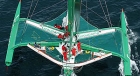
It will be in this boat newly repaired once again, that Ellen and Alain Gautier will be setting sail in the Transat Jacques Vabre. Sailing the old Foncia, now renamed Banque Covefi, she and Gautier finished second in the Transat Jacques Vabre two years ago, after being pipped at the post by Franck Cammas' Groupama, after the failure of one of the hydraulic rams use to cant her wing rig.
Ellen says compared to the old Foncia the new boat is certainly faster, but also feels safer. "She feels more controllable and less prone to cart wheeling. The other boat - the floats were really buoyant until a certain point when they weren’t buoyant when they were going down! Twice off Finistere we had some pretty hairy moments when the floats went right in and it wasn’t much fun. With these [new] boats it is not like that. You don’t have that sensation of you’re going down...Yes, they go in, but they come out again." This is due to both the advent of more efficient foils but also the latest in trimaran float design.
The last year has been a slightly tentative one for the ORMA 60ft trimaran fleet following the carnage in last year's Route du Rhum. In the Transat Jacques Vabre the boats will set out in the north Atlantic in a similar time of year and once again, as the last few days have proved, there will be more bad weather. Due to the possibility of a wind against tide situation in the Channel in 40 knot headwinds, the organisers of the Transat Jacques Vabre have in our opinion wisely postponed the start for the trimarans until the weather becomes more clement in the middle of the week.
"I think the Route du Rhum was an exceptional case," MacArthur says of the conditions a year ago when some skippers recorded 70 knot winds on their boat's instruments. "The weather was horrendous. I feared more for Kingfisher in the Route du Rhum than I ever did in the Vendee. You can’t iron out the fact that it is not the first time the boats [the 60ft tris] have done the Route du Rhum, it is not their first time in the Jacques Vabre. There have been problems in the past. There will be problems in the future. You can never take all those problems away. You have to be philosophical about it. The Route du Rhum was extreme. The depression was extreme. The conditions were extreme. Everything was extreme. I hope we never have those conditions again."
Following the Route du Rhum there were cries from many quarters that the trimarans were too extreme, too dangerous and should have their wings clipped. Most in the know think that the conditions the boats experienced in the Route du Rhum were unprecedented and so the class shouldn't be too quick to over legislate. As an example the most wind the boats experienced in the entirety of the last Volvo Ocean Race was 55 knots.
As the trimarans were rebuilt over last winter many of the weak areas such as the structure within the floats and the beam fairings have been strengthened and the trimarans now, although ostensibly identical are supposed to be considerably more seaworthy.
"It is very easy to destroy a class by making all the boats defunct," says Ellen. "That is a pretty harsh thing to do. Equally you have to look at the situation that happened and make changes. It certainly worked with the Vendee Globe. In 1996 there were a lot of problems and in 2000 there were significantly fewer and the boats were altered but as to how you can alter the multihulls, I guess time will tell. A lot of it is also technology: Fujifilm and Sergio Tacchini [designed by Nigel Irens who is the architect behind Ellen's new trimaran] was a case of learning about what works and what doesn’t work with structures. If you take your boat every day off the coast here you’ll probably never find out that problem. You’ve got to go out into extreme situations and, sure, lessons were learnt. Boats won’t be built that way in the future. But no lives were lost which is the most important thing."
Meanwhile Ellen's brand new trimaran, a 75 footer designed purely for singlehanded record breaking is nearing completion in Sydney, prior to her official launch date on 9 January next year.
"The floats and main hull have just gone into the oven for spraying," says MacArthur. "The beams are just being finished, but are pretty much all there. The components are all done. It is just a case of when the paint is dry sticking the bits on three lorries (one for the beams, one for the floats and one for the mainhull)."
The builders of the new trimaran, Boat Speed, are based in land, so once the pieces are finished they will be transported to a shed in Glebe in the centre of Sydney where the boat will be assembled and finished. "All the bits will be down there. By the end of this week everything will be on the road," Ellen continues.
Aside from being bigger than the present crop of 60ft trimarans, the new trimaran is different in many ways. It has been conceived entirely for singlehanded and hasn't been built to any rule. As a result Ellen believes the boat will have better longevity. "It is not like two years down the line there is a new boat built [which will be faster], so it is not the same pressure as being in a class. So she could do this for a long time." Personally Ellen expects to campaign her for around two years.
Physically the boat is unlike the 60ft trimarans in that the hulls are not the same length (the floats are slight shorter) and as the boat is optimised for reaching and running her bows seem relatively long for her length. Although longer than a 60ft tri, her overall beam slightly less and her mast is just marginally taller. The boat is also considerably simpler than the 60s with no hydraulics to cant the rig and no complex appendages. Unlike Geronimo, she will have three rudders.
Ellen's first comment about her new steed is "she's big! The floats are taller than me. The central hull - the bow freeboard is 2m and in the centre it is almost 3m. And we’ve got two floors! We have a floor all the way through the boat and an engine room underneath."
Ellen doesn't expect that the building of her new trimaran will see the dawning of a new class; the rebirth of the old multihull class one of the late 1980s. Personally she still expects ultimately to commit to the 60ft trimaran class. "She’s built specifically for a purpose which is breaking records and I think the 60 class is fantastic. I think a few people were quite scared when we went to 75ft, saying 'My God - what is this going to do?' But I fully intend to go back to the 60s and do the Route du Rhum in 2006. We announced that right from the beginning."
It seems most probable that Ellen will sail the boat around the world singlehanded in an attempt to break the present record - set by Michel Desjoyeaux in the last Vendee Globe. [Francis Joyon is soon to embark on this record himself aboard a 90ft trimaran (formerly Olivier de Kersauson's Sport Elec)]. However Ellen is reticent about this. "It is stupid to say that we are going to run headlong into something when the boat hasn’t even touched the water and she’s quite new. The objective is to get her in the water and sail her back and provided all goes well there is a possibility of going to New York on the way back to have a go at the transatlantic record. But again we’ll see how the boat is, see how I am."
In the meantime it is fingers crossed for the Transat Jacques Vabre. They have the machine to win it, but as the old adage goes 'to finish first, first you must finish'.
Most Read
Most Commented
Comments
Businesses

Pro businesses
Editor's choice
Member blogs
-
 Ned Collier Wakefield: MOD70 round BarbadosWell that was intense. 12 hard fought for seconds for the win. In idyllic conditions, Tony Lawsons MOD ...
 -
 Mini Transat leg 2 reportThe second leg of the Mini Transat started on 31st October, just over a month after ...
 -
Leg 1 reportI’ve been working towards the Mini Transat now for three years. In 2013 I was part ...
Business blogs
-
 The Island Sailing Club in Cowes, Isle of Wight, is delighted that Prince Michael of Kent ...
 -
Peta Stuart-Hunt chats with the 25 year-old British solo sailor Lizzy Foreman before she sets sail ...
-
The 2015 Student Yachting World Cup (SYWoC), an ISAF-recognised event hosted and run by students for ...
Editor's Choice
All time favourites...
-
 Three legs down into Ian Walker’s
 -
 Winning all but two races at
 -
 For the first time in its
Latest Comments
Add a comment - Members log in