
Diamonds are forever
Friday September 19th 2003, Author: James Boyd, Location: United Kingdom
In sailing there is no substitute for experience especially when it comes to the death-defying art of racing singlehanded non-stop around the world. It has been almost five years since
Team Group 4 - subsequently renamed
Ecover - and every moment of this has been a valuable learning experience for skipper Mike Golding and his team.
The history of the first Ecover was somewhat chequered. Golding convincingly won the first leg of the 1998/9 Around Alone into Cape Town and looked set to repeat his victory on the second leg of that race until an unfortunate navigational error caused the boat to run into a sand spit off Cape Reinga at the top of New Zealand's North Island damaging the keel and flooding the boat.
A promising third place in both the 1999 Transat Jacques Vabre and the 2000 Europe 1 New Man STAR was followed by disaster in the Vendee Globe when eight hours into the round the world race Team Group 4 dismasted. When many would have bowed out, but Golding persevered, fitting his replacement rig and setting out again eight days later. He proceeded to work his way up the fleet to finish seventh overall out of 24 starters.
Since then the boat has ungone considerable improvements and in an ever more competitive fleet has regularly finished in the top three. Yet the boat was conceived before the latest IMOCA class rule changes and has been superceded by faster, newer designs. If Golding was to stand the best chance of winning next year's Vendee Globe a new boat was needed. Hence he returned to Merfyn Owen, originally Team Group 4's project manager, and now one of the leading Open 60 designers, to create him a new state-of-the-art Open 60.
Above: Merfyn Owen and Mike Golding
We originally wrote about the general concepts of this boat back in March when Golding revealed that the new boat was being built and that it would once again be sponsored by Ecover who make eco-friendly cleaning products.
The boat was built in carbon/Nomex at Southern Ocean Marine in Tauranga, New Zealand - the same yard where Graham Dalton's Hexagon (now Emma Richards' new Pindar). She too is an Owen Clarke design but Ecover 2 is a significant evolution. Since her launch in Auckland the new Ecover has since been shipped back to Europe and was on display briefly during Southampton Boat Show, where The Daily Sail had an opportunity to crawl around her.
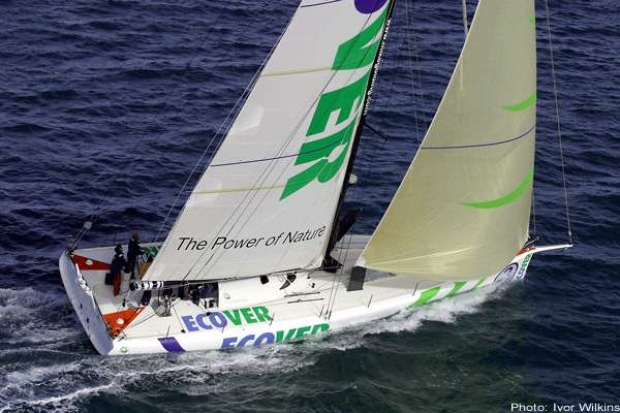
Most unusual aspect of the new boat is her rig. The original Ecover had a multihull-style rotating wingmast, with deck spreaders as first used in the Open 60 fleet aboard Yves Parlier's Aquitaine Innovations (now Garnier). In comparison the new rig rotates but uses a smaller wing section supported by two sets of diamonds. The rig is also fractional and does without deck spreaders instead having two hinged spreaders similar to those originally use on Michel Desjoyeaux's Vendee Globe winner PRB (and originally - it should be pointed out - on Tony Bullimore's Open 60 schooner).
Designer Merfyn Owen explains how the new rig came about: "The genesis of the rig was a long process. We started with three rig options back in June last year before we had any money from Mike [Golding] and then we went to Southern Spars and did a deal to carry out a joint development of a rig program together. So we took the three different rigs and designed three different boats around the different rigs - so we optimised the hull shapes, weights and beam around the rig.
"We have always wanted to design the rig first - as it is the aerodynamic bit which drives the boat - and then the bulb and then design the hull around those two things, because in the Open 60 rule that’s what makes the boat go quick. We managed to get all that work done in time to do a tank test program which was funded by Mike who then decided to go ahead with the boat."
Following this they had all the data on the rigs, including weights and they put these through a wind tunnel program to look at the drive they produced versus their drag against the drag of each hull and its righting moment.
"That data came out in December and we sat down with Mike, and we looked at all the positives and negatives of the different rigs, because it is not just about speed, it is about the Vendee Globe and Mike’s experience and we came to a decision about which rig to put in the boat."

Above: the new rig
Looking back at the pros of Kingfisher was her ability to change gears and her upwind ability, says Owen. "What we wanted to do with this boat was to take everything we learned from Kingfisher and what Mike learned from Ecover and try to design out the areas where there were weaknesses - Kingfisher for example had weaknesses such as power reaching which is all to do with sail area, power and beam - but at the same time make a boat which is good in the light and upwind. We also wanted to imagine where the other guys are going to be."
They also wanted Kingfisher's multiple furler arrangement that allows the amount of sail forward to be change quickly and easily. However Kingfisher has a conventional spar, spreaders and rigging and Owen says that at the same time they wanted to reduce the drag of this without increasing the weight. Hence the new Ecover mast has a section of a similar size to Kingfisher's but is teardrop-shaped and rotates.
"On a normal mast the back wall of the mast is quite wide now because of the track," says Owen. "You don’t want that if you are going to rotate it."
The decision to shy away from a wingmast was made because wingmasts are heavy and they wanted to keep the weight of the boat down. The overall result, says Owen, is that the new Ecover is a fraction heavier than Hexagon/ Pindar but with a bigger more powerful rig. Despite other reports to the contrary Owen believes that Hexagon was the lightest boat in Around Alone.
The diamonds are a further effort to reduce the weight of the tube while being able to use larger more powerful sails such as what the crew refer to as the 'Code Eco' - a masthead upwind/reaching sail tacked from the bow rather than the bowsprit that is effectively a Code Zero. Aside from being light Owen maintains that the new rig has lower drag than the previous Ecover because of the absence of the deck spreaders (although we imagine the flow higher up the rig cannot be as clean).
Also unusual for the Open 60 class is that Ecover is the first (we believe) to use halyard locks to reduce compression in the mast. All standing rigging is PBO, again to reduce weight aloft.
Because of the change of rig, the hull shape of the new Ecover is very different from Hexagon/ Pindar. To accept the more powerful rig the hull has more volume (and therefore form stability) - it has more beam both overall and at the waterline and has more volume forward. The keel is also slightly further forward and the back exits of the hull have a different shape.
On deck the boat makes full use of the overhang rule in the bowsprit (rather than having a boom overhang). There are twin fore and aft tracks for the headsail cars (most offshore race boats have athwartships tracks these days) although Golding can always barber haul if he needs to move the headsail clew across the boat.
The cockpit is very similar to Hexagon's and very different to Ecover's - open ended to shed water quickly and with twin wheels instead tillers. This should actually be quite a pleasant boat to steer.
Down below the chart table area is also different with the engine box repositioned making access to the chart table far easier. The chart table seat is on rails so that it can be hoisted up to weather, while the chart table itself is C-shaped making it much easier to get one's legs under it. At the chart table is the familiar array of electronics based around two fully plumbed in PCs.
Immediately aft of the chart table to port and starboard are two smart carbon fibre seats can be reclined to suit the heel of the boat. The separate washbasin and single burner stove are next to this.
Otherwise down below is standard Open 60. Going forward there are two bulkheads to support the canting keel box. The keel canting involves twin rams and Owen says they have stuck with known technology here in the name of safety. In the forward compartment there is a large centreline water ballast tank, that can be filled to add displacement to the boat when sailing upwind. Unlike Kingfisher there is no central water ballast tank, although there is an aft tank to help raise the bow when surfing downwind.
Another signficant improvement over previous boats is that the new Ecover is much more precisely built to the limit of the rule. This applies throughout the boat from the overall draft being with 1mm of that allowed to having just 18mm excess throw in the keel canting rams.
To sum up - the new Ecover looks the business. Mike Golding and his team at Mike Golding Yacht Racing are well versed in how to make Open 60s go fast. A problem with all boats of this kind is how long they take to work up and significantly how long they take to get reliable. Their previous experience should rapidly accelerate this process.
The Open 60 class over recent years has been rife with dismastings and it is fingers (and toes) crossed that this new rig will remain pointing in the direction her designers and skipper intended.

Most Read
Most Commented
Comments
Businesses


Pro businesses
-
France
-
Italy
-
-
Italy
Editor's choice
Member blogs
-
 Ned Collier Wakefield: MOD70 round BarbadosWell that was intense. 12 hard fought for seconds for the win. In idyllic conditions, Tony Lawsons MOD ...
 -
 Mini Transat leg 2 reportThe second leg of the Mini Transat started on 31st October, just over a month after ...
 -
Leg 1 reportI’ve been working towards the Mini Transat now for three years. In 2013 I was part ...
Business blogs
-
 The Island Sailing Club in Cowes, Isle of Wight, is delighted that Prince Michael of Kent ...
 -
Peta Stuart-Hunt chats with the 25 year-old British solo sailor Lizzy Foreman before she sets sail ...
-
The 2015 Student Yachting World Cup (SYWoC), an ISAF-recognised event hosted and run by students for ...
Editor's Choice
All time favourites...
-
 Three legs down into Ian Walker’s
 -
 Winning all but two races at
 -
 For the first time in its
Latest Comments
Add a comment - Members log in