
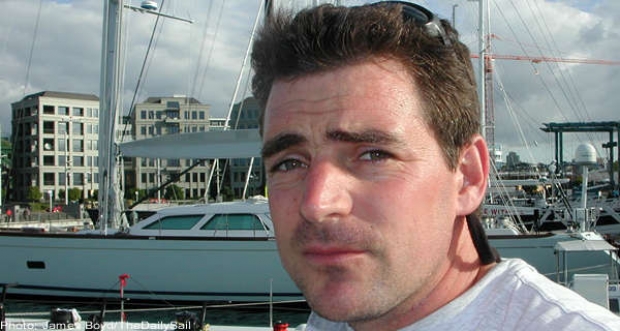
The brains behind the Bols
Friday March 28th 2003, Author: James Boyd, Location: Australasia
Meeting Gordon Kay, skipper and manager of the new
Bols super maxi, I am struck by his many similarities with Offshore Challenges' svengali Mark Turner. Both are early 30s, running substantial businesses in yacht racing with a turn of conversation that can seamlessly shift from sailing into marketing and business speke and back. Both are go-getter, high achievers. Both are deeply involved with the business of offshore yacht racing, yet remarkably they operate in entirely different spheres. While Turner's lie in the French school - singlehanded, Open 60s and multihulls, Kay's forte is in the more Anglo-Saxon world of the maxi-monohull.
Kay's age is particularly impressive. At just 31 he is not only the skipper of what may turn out to be the world's fastest offshore racing monohull, but he was also responsible for putting the entire package together through his company Superior Yacht Services. This has involved the complex process of overseeing the design and build of the new maxi, as well as arranging the maxi boat's program in such a way that it will realise the maximum potential for the Dutch-based distillers.
Kay was born in England and sailed his first transatlantic having left school aged 17. Bitten by the sailing bug he signed up to sail as a crewman on Jimmy Cornell's Europa Round the World Rally in 1991, cramming in an accelerated three year course over a year at Cambridge Business School before he left.
With Europa under his belt, he worked on a number of superyachts in the Med and Caribbean including the 100ft Camper & Nicholson classic ketch Aile Blanche. "The boat was quite scarey with no lifelines, but you learned about big loads," he recalls.
He was subsequently involved with the completion of a 120footer in Italy before taking up his first skipper's post on a 70ft Nordia, following its refit in New Zealand. The middle of the southern hemisphere winter in 1995 saw him delivering the Nordia across the Tasman in 50 knots. He then delivered the boat back to Europe.
Kay's big break came when he was hired to skipper a Swan 651 Fazer Blue Magic in another World Cruising event, the Expo 98 round the world rally. The boat was being sponsored by Peter Fazer's Finnish company the Fazer Group who had previously entered the modified Swan 65 Fazer Finland in the Whitbread Round the World Race.

"There was quite a good racing class in the end, sleds, Swans, J-Boats, and some ultra-light boats," recalls Kay, who was the youngest skipper in the race. "We sailed with some great guys like Pelle Petterson. I think we didn’t win a leg until about half way round and then we didn't lose a leg for the whole second half. We fired a few people and kept on ripping more weight out of the thing and eventually we had a good team and won the event." They also won the Finnair Altantic Challenge on the race's last leg between Cape Town and Lisbon.
During the Expo 98 rally they set new speed records for the Swan 65, "It was an awesome boat," recalls Kay. "The 65 you can drive it and drive it. We broke the speed records for the 65. There were six or seven times when we drove the boat at over 22 knots. We did a 300 mile day run twice which for a 47ft waterline and a 36 ton boat was going some. We learned how to drive big heavy boats through big waves. You can see why they used to do all those old Whitbread in them. Just keep the boat under the rig and you should be alright – lovely boat."
But winning the race was only part of the story. The deal with Fazer Group
also involved having a Finnish production company make a series of television programmes about their circumnavigation. "I got a lot of great experience of dealing with the media and our client," says Kay. "We ended up doing a lot more for Fazer than the TV company did. And that is how my company grew. We started to have a really good understanding about the bang for the buck that people were looking for."
The TV series comprised 25 episodes each of 45 minutes and gave Kay celebrity status in Finland and in other countries around the Baltic where it was aired. "In Finland it was the highest-rated TV programme that was made in Scandinavia," says Kay. "So Baywatch got more viewers but out of the domestic programmes nothing was more highly watched. They’ve since rerun its four times plus the three hour Christmas special. So Fazer came out golden from that.".
Aged 27 Kay found himself giving speeches to senior management on subjects such as 'motiviation' and 'how to succeed'. He delivered the boat back to Nautor at the end of August 1998, got married 36 hours later in England and took two months off as he schemed his new project.
The deal with Bols, the Dutch distillers came about following the high visibility of Fazer Blue Magic throughout the Baltic "Originally it was in co-ordination with a big advertising campaign. The commercial they ran was yachting. This started off as a back up and became the forefront," says Kay of the promotion the Dutch company was running - particularly aimed at the Polish market.
Kay arranged the purchase of John Caulcutt's Maxima, formerly the 1989 generation Whitbread maxi Martella and proceeded to campaign the boat in an intensive program of offshore and inshore events around the world, kicking off with the Caribbean Big Boat Series in 1999.

Crucially different to other forms of race boat sponsorship, this was not a case of Kay wanting to campaign a maxi and getting Bols to sponsor him to do it. The Dutch company owned the boat and they were directed by Kay and their advertising agency over how they might use the boat solely to further their commercial ambition.
"For us it is very simple," says Kay. "Everything we do is devoted entirely to the client. So there is no “we’re going to do the Fastnet because that’s what we want to do". If you’re going to get a miniscule amount of press out of the Fastnet because if your product doesn’t exist in the UK – why do the Fastnet Race? So the client gets a very good return on investment. We race when it’s appropriate to race. We have to leverage in different markets. and that’s what we as a company work out them with."
The starting point was the ad campaign. Bols employees and clients would go sailing on the boat. They held the Bols Maxi Cup in Poland (see below), where they chartered another maxi and match raced the two boats. Then there was the race program. In the Sydney-Hobart race for example Kay recalls that more than half their crew was Polish - a mixture of top Polish yachtsmen and others who had won a place in the crew following a national competition throughout Poland.

During Kay's tenure Bols underwent massive development shedding around 4 tonnes in weight "We did the Round Gotland Race and finished third about three minutes behind the old Rothmans which we always knew were going to be quicker than us - they had won it the year before and were locals. Over the winter we ripped out more weight, Hugh [Welbourne] did us a new rudder which made a big difference. We went with new sails, the D4s and came back and beat Rothmans by 4.5 hours. The only boat to beat us was Morning Glory."
The highlight of the Bols campaign was winning the 2001 Sydney-Hobart race on IRC ahead of Wild Thing and Line 7. Kay believes that they would also have been the Volvo boats on corrected time.
By this stage Kay says they had gone as far as they could with a 1989 generation Whitbread maxi. "You couldn’t get any more out of the old boat," he explains. "It had just won the Hobart Race. We were saying, "listen that’s great, but you’ve gone as far as you can go with this boat. If you want the campaign to go on then we need to go on with another boat." If the boat had turned up at this year’s Hobart race then it wouldn’t have won because there was only about 10 knots and it wasn’t a great boat in 10 knots. We'd been to the Gotland race, done it twice and we’d always looked good but we were never going to clean up that race in an 80ft 32 ton maxi. So it was a case of let's bow out when you're in great shape."
The old maxi was sold to an Irishman who last year made an attempt on the Round Ireland record with her. Kay meanwhile set about putting together his dream race boat.
The new Bols super maxi will be run by Kay's company Superior Yacht Services. Aside from having the necessary expertise in running boats their 8-9 person team have additional in house marketing and corporate experience. Kay's wife who is part of the company has a Masters degree in business administration and speaks six languages. Another worked for ad agency Saatchi & Saatchi. They work closely with a Spanish/US company who finds clients for them and there are murmurings that they may be close to signing up another client for a second maxi monohull.
"We’ve got a lot of interest because we offer an awesome bang for your buck," says Kay. "You are not talking about getting your pants pulled down with big agency fees as we’ll do a lot of the ad agency’s work for them. We’ll send people in on the ground and will help structure the campaign."
He cites the example of a new client they are talking to who only wants a campaign that is focussed on Europe and Asia. "They don’t want to do anything else so that calls for a specific type of boat. Then we have to produce the whole agenda for them and say that is how you leverage this, that is how you leverage that."
One interesting difference in their approach is that their deals are client not individual-representing-sponsor led. "Everything we do is based on the client. You don’t know my name. It is not about Gordon Kay. It is all about the brand and the client," says Kay.
Interestingly the new maxi is owned by Bols and not Kay's company, although Kay says they have the structure in place to own boats themselves. "Some clients want to own a boat, some don’t. There are good reasons for both and it just depends upon the company structure.
"These things aren’t cheap to run. If they don't own the boat a client can change their marketing plan and they just walk away. If they own the boat, they control it. They can fire us! It also depends upon what their shareholders are like and whether they perceive it as being for someone’s personal use. Nothing upsets a shareholder like seeing a rich man’s toy on the company books. But it is a management decision and we are happy to advocate whatever works for them."
Kay - skipper
Aside from running the show, Kay also drives the boat and was keenly involved in all aspects of its design. Having run numerous big boats and the old Bols Sport maxi he has had particular input in the deck layout on the new boat. On a boat where the mainsail is 256sqm and the biggest kite is just under 800sqm handling the sails - both in terms of hardware and technique - took considerable planning.
Fundamental to the sail handling will be their central winch island in between their twin hatchways. This arrangement is similar to the VO60 SEB - but without the feature where water comes pouring in below during a knock down. Kay is convinced it would never come to this because the rig would pop out of the boat before they even came close to being laid flat.

"We are very realistic about the size of the gear. Mastmen don’t exist on a boat like this because you can’t always find two nine foot monsters to get the things to the top." With everything simply too big to handle from the mast, all lines are led back to the central winch where - if need be - all the pedestals can be directed to the task in hand.
"From having the 80ft maxi where we ended up winding all the halyards up to the top of the mast when you were doing an in-line change, there was no way the mastman could pull them to the top of the rig when they’re going up side by side when they were wet," Kay continues. "They do it on the grinder. So we’re thinking this time they’re going to be even bigger, we’ll need more grunt, we’ll need a winch to do. Hence we have this winch that basically winds everything to the top of the rig, spinnaker retrieval, the whole thing."
Kay gives the example of their giant 1.5oz all purpose kite which will be a four man lift. "All of the winches have 1:2 gearing, so when you are doing a spinnaker peel or a hoist four guys can get it to the top of the rig faster than any mastman could: You’re lucky the guy can collect the rope coming off the drum at the speed it goes.
They will also use the winch for winding in kite between boom and main during envelope drops. "You do it on the Volvo boats with a 300sqm genniker, so when you have got an 800sqm genniker you REALLY want to be doing it that way."
Unlike SEB they will not be using their central winch for the mainsheet. However this area will also be where the trip lines for the halyard locks are and where the controls for the water ballast are located. "Basically the pitman runs the boat," says Kay.
Considerable safety measures have been built in. The halyards are fitted with locks, but at deck level they are also on Spinlock jammers so if the lock at the masthead fails, the jammer takes the load. Similarly the genoa halyard is rigged so that it can also be used for fractional kites.
To limit crew numbers and because of Bols' offshore orientatation they have chosen to go for four, not five pedestals. "For example one pedestal is on the main and one on the runners so you can tack pretty fast. And when you’re gybing you can’t wind the runner until the main is in anyway so you put 4, 6 or 8 guys on the mainsheet and the guy just hauls in the runner - job done. There’s no dip pole gybing. It’s all gennikers. There's no symmetric kites - not at the moment. As soon as you take a symmetric kite you need an extra three crew. And I hate feeding the buggers!"
Instead of padeyes, they have through deck Spectra loops

There are hydraulics for the checkstay, topmast, Cunningham, outhaul, vang as well as to control the Cunninghams for the jib and Code Zero and the up and down for the jib floating block (controlled by one ram so that it is the same on both tacks).
Another technique picked up from illbruck was sailing double headed with a staysail - a modern day cutter rig. "On a boat like this when you want to sail it flat, rather than spinnaker reaching around and scaring yourself, under a jib top and a staysail this thing will hoon," says Kay. "The staysail padeye is a long way forward so there is good separation everywhere, you can get a good-sized sail on the boat and we think that is going to be a really potent sail plan. illbruck always had smaller reaching kites than everyone else and they were always jib topping or using reaching kites and they weren’t going sideways: they were flat and they might have been going slower but they were straight and they didn’t keep wiping out."
The size of the staysail on Bols is considerably larger than a VO60s - about the same size as the No3 on a maxi boat. "It is about making that area work for you. Once you are off the breeze - get it in there. In fact the boat is so fast that the apparent wind is quite a long way forward anyway."
In terms of crossovers they are likely to use the Code Zero upwind until around 7 knots of breeze and at that time they will change down to the jib top and staysail. Another consideration is that because the sails are so large they want to minimise the number of sail changes. "This isn’t a boat where you want to peel a lot, so the sails must have as big a range as possible."
At present the boat is undergoing sea trials out of Auckland as they get her up to speed. Central to this is the Doyle Auckland team led by Richard Bouzaid, the downwind trimmer on Alinghi and including Justin Ferris, who worked on illbruck's sails.
Bouzaid will form part of the race crew along with several Doyle heavies and Billy Merrington, Connan Hunt, Will l’Anson, Robbie Warren and Ian Moore or Stuart Quarrie navigating. For long offshores they are expecting to sail with 15-16 while for shorter offshore this may increase to 20. Kay says that the exact numbers will depend how they get on during 'the big peel' or 'the big gybe'.
The first major race for the new Bols will be the Gotland Runt and you will be able to follow the progress of the boat on The Daily Sail.
Most Read
Most Commented
Comments
Businesses
Pro businesses
-
Italy
-
United Kingdom
-
-
France
Editor's choice
Member blogs
-
 Ned Collier Wakefield: MOD70 round BarbadosWell that was intense. 12 hard fought for seconds for the win. In idyllic conditions, Tony Lawsons MOD ...
 -
 Mini Transat leg 2 reportThe second leg of the Mini Transat started on 31st October, just over a month after ...
 -
Leg 1 reportI’ve been working towards the Mini Transat now for three years. In 2013 I was part ...
Business blogs
-
 The Island Sailing Club in Cowes, Isle of Wight, is delighted that Prince Michael of Kent ...
 -
Peta Stuart-Hunt chats with the 25 year-old British solo sailor Lizzy Foreman before she sets sail ...
-
The 2015 Student Yachting World Cup (SYWoC), an ISAF-recognised event hosted and run by students for ...
Editor's Choice
All time favourites...
-
 Three legs down into Ian Walker’s
 -
 Winning all but two races at
 -
 For the first time in its
Latest Comments
Add a comment - Members log in