
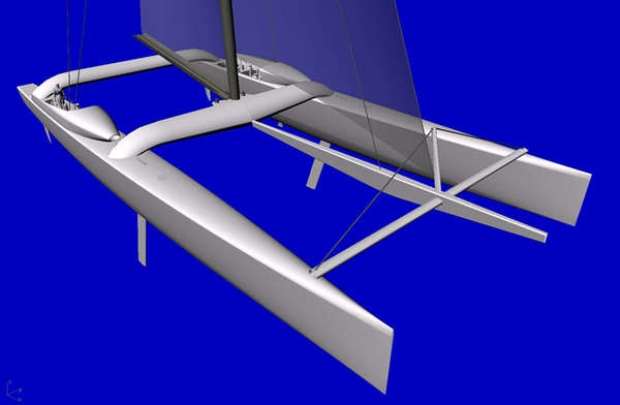
The new monster
Friday October 3rd 2003, Author: James Boyd, Location: France
The first details of Bruno Peyron's new maxi catamaran, codenamed B1, due for launch this autumn have been made public.
The new boat is a development of the trio of cats Club Med, Innovation Explorer and Team Adventure originally built for The Race. Like these the boat has been conceived by the Gilles Ollier Design Team comprising Gilles Ollier, Yann Penfornis, Franck Martin, Jack Michal and Alan Cattelliot and is currently nearing completion at Chantier Multiplast, Ollier's boatyard at Vannes on the Morbihan.
"Four years ago, we entered totally unknown territory," commented Ollier. "Since then we have had feedback from five circumnavigations about the machines built by the yard." Aside from The Race, Innovation Explorer went on to be rechristened Orange and broke the Jules Verne Trophy in spring 2002 and subsequently was bought by Offshore Challenges and sailed around again earlier this year until an unfortunate dismasting in the Southern Ocean.
 So why a catamaran? "First of all, that’s what the skipper asked for," says Ollier. "But also because our race results and latest studies lead us to suggest this configuration in view of the sailing programme the boat is built for. The catamaran option was retained as for the same level of power, a catamaran is longer. Remember that length is an essential factor when it comes to average speed.
"Generally speaking, we have built a bigger boat, finer and higher above the water than the Club Med generation to prevent the boat from being slowed down by the waves. She is also stiffer so that the sail plan can be more efficient."
Obviously speed potential was paramount, although once again the design team have concentrated on high average speeds rather than point speed. "With the old generation, the top speed was around 43 knots, whereas the potential of this new catamaran is in excess of 45 knots," says Ollier. "But we are not encouraging ourselves to push the boat above 40 knots, as beyond that the speed becomes dangerous. Never the less, the 700 miles per day threshold should be exceeded with this catamaran."
The design team have concentrated on improving light to medium air performance as these conditions are relatively numerous when sailing round the world. The current average speed for a maxi multihull circumnavigating the planet is just above 18 knots.
Also making a boat that would be simple and easy or indeed possible to sail with a crew of 10-15 is vital. "With Club Med, which had well-scaled fittings, we were pleasantly surprised that she turned out to be easier to handle than we had imagined. Given our experience and technological developments, B1 should be every bit as easy to handle," continues Ollier.

"Take the sails for example, they are all much bigger on B1, but their weight is very close to those of the Club Med generation, thanks to new more reliable materials, which are light and water-repellent. Moreover, we have used the biggest manual winches on the market which, in the space of four years, now produce 25% more effort with the same technology."
For the engineering of the boat, the Gilles Ollier Design Team worked once again with two groups of engineers, Hervé Devaux Structures (HDS) and the Ecole Centrale de Nantes (ECN). They each used different software so that the design team would have two sets of data.
Currently the vital statistics of the boat are not available, but she is believed to be in the order of 120ft long, 10ft bigger than the old generation boats and slightly shorter than Steve Fossett's PlayStation. Whether Ollier's comments about her being 'more stiff'' means that she has more beam remains to be seen. Generally a narrower beam makes it easier for the boat to lift its weather hull, reducing wetted surface area.
Most Read
Most Commented
Comments
Businesses

Pro businesses
-
France
-
United Kingdom
-
United Kingdom
-
Editor's choice
Member blogs
-
 Ned Collier Wakefield: MOD70 round BarbadosWell that was intense. 12 hard fought for seconds for the win. In idyllic conditions, Tony Lawsons MOD ...
 -
 Mini Transat leg 2 reportThe second leg of the Mini Transat started on 31st October, just over a month after ...
 -
Leg 1 reportI’ve been working towards the Mini Transat now for three years. In 2013 I was part ...
Business blogs
-
 The Island Sailing Club in Cowes, Isle of Wight, is delighted that Prince Michael of Kent ...
 -
Peta Stuart-Hunt chats with the 25 year-old British solo sailor Lizzy Foreman before she sets sail ...
-
The 2015 Student Yachting World Cup (SYWoC), an ISAF-recognised event hosted and run by students for ...
Editor's Choice
All time favourites...
-
 Three legs down into Ian Walker’s
 -
 Winning all but two races at
 -
 For the first time in its
Latest Comments
Add a comment - Members log in