
The professional approach
Tuesday September 9th 2003, Author: James Boyd, Location: Transoceanic
American Jonathan McKee is one of the race favourites for the Mini Transat and with the Mini Transat now started (and at the latest report, him leading) so is the culmination of his attempt on a fast in, fast out, Mini-in-a-season experience.
To date this year he has had one of the most successful seasons in the class: "I did my qualifier at the end of April and then Brian [Thompson] and I did the Courses de Lyons and we were second. Armel Tripon was first and Seb Manuard third. Then I did the Mini Pavois and won both legs, but as impressive as it looked the field wasn't as strong as it could have been.
"Then I went home [to Seattle] for a while and came back and did the Open Demi-Cle with Bates, my elder brother and we had a good match race with Nick Bubb all around the course and ended up winning the doublehanded division of that.
"Then a week later was the Transgascoigne. On the first leg it was quite light and I was fourth or fifth and I got lucky on the last day and ended up having a good match race with Fred Duthil for the last 10 hours - we were really close into Gijon. So at that point I was on a real roll - I had won four legs in a row.
"Then on the trip back home we had this trouble with the degagement buoy and there was this briefing where they said 'I think we aren't going to have one' and then they ended up having it and I didn't catch the flag - my fault. A bit disappointing, but I was second across the line and Armel Tripon beat me by 20 minutes." McKee had also missed out a buoy in the Mini Pavois.
With his background skiff racing and in the Olympics and America's Cup, being part of the Classe Mini has been a rather different experience. McKee says the boats have been an eye opener: "I have been impressed by how seaworthy they are and how much fun they are to sail. They are not skiffs, they are yachts. I feel very safe in mine. I don't know exactly why that is, but it seems very solid even though it is pretty light. They have a fair bit of stability. My boat is well engineered and well built and designed - it is a credit to Simon Rogers for coming up with such a seaworthy little yacht."
Tackling big conditions in such a short highly powered boat one would imagine to be a death defying experience. McKee says he saw 40 knots in the Course de Lyons and 30 knots upwind for most of a day in the Mini Pavois and neither caused him undue concern for the boat, Team McLube, or his safety. "It is okay. You just keep making the sails smaller and smaller. They are light but they track pretty nicely."
The philosophy of the Mini class is also very different to what he is used to: "It is a unique blend of professionals and aspiring professionals and real amateurs that are doing it for the adventure and the joy of it. There are all kinds: young and old, experienced and less experienced and there is a great spirit and everyone shares this sense of community which is quite strong and we all help each other. I have worked pretty hard to integrate myself into that (even though my background is a bit different) - to try to get to know the guys and help people out and to be part of it and people have reciprocated to me too."
Compared to the other races in the class calendar the Mini Transat is by far the longest with the first leg roughly 10 days long and the second of around three weeks. As a result McKee says it requires a different approach.
"It is more of a marathon - particularly the second leg, so you have to pace yourself pretty carefully and make sure you are sailing within yourself and pushing at the right times and getting enough rest and time to eat and drink and all those things that become more of a factor as time goes on.
"It is interesting because there are certain times which are critical points in the race when it is important to push hard and hand steer and make a lot of sail changes and work the boat hard and sail aggresively to get through the next transition and that can be quite critical," says McKee. "But you can't do that all the time."
The hard part is knowing when to back off. "You don't really know when to do that," admits McKee. "You have to go with your instincts and trust yourself, but that is the same with all shorthanded racing, so it is nothing new, but it is new to me."
Then there is the whole weather side: "Strategically - I've had good weather routing for all these shorter races and that will be good for the first few days of each leg, but after that you are on your own. That makes it a little bit more random, because no one has anything, so it is a bit more hit and miss about how the weather plays out. So because the race is long I think the results are more unpredictable - someone 100 miles away could have totally different weather from you that you couldn't have predicted at the start. But you can't get too hung up on it. You do the best with what you have."
Part of his pro-sailor approach to the Mini has been the use of some of the world's top meteorologists including Ken Campbell of Commander's Weather who he worked with at OneWorld and he is rumoured to have been consulting the likes of old west coast mates such as Mark Rudiger. Last week a car load of 'helpers' from the UK paid McKee a visit including the old owner of his boat, Brian Thompson, Mark Chisnell (who was with him on OneWorld) and sailmaker Dick Parker.
During the race the competitors can receive general forecasts through their radios (they can take HF receivers - but not transmitters), but McKee says that this is of little value. "You have the high seas forecast which is extremely general and doesn't give you too much you can use tactically. Then you can observe, you have your barometer and your eye looking at the clouds and looking at the sea."
The distances to finish of the boats is also transmitted once a day, although again this is of little tactical value as it omits the positions of the competition.
McKee says that the first phase of the Mini Transat - crossing the Bay of Biscay - will be a critical part of the race as getting ahead early could allow a jump into the next weather system before the others. However at present the situation is quite dynamic thanks to the effects of Hurricane Fabian. "We are getting into the fall weather patterns too, so the lows are starting to roll through a little more regularly. Once you are half way down the Spanish coast the weather pattern tends to become more settled, but anything could happen. You look at the averages, but the reality is always different." However in the Bay of Biscay it will be wave rather than wind action that is most perilous to the competing yachts and hence why with 5m breakers forecast for yesterday afternoon the race start was delayed until today.
While most offshore races, particularly singlehanded ones, are sailed on boats bristling with comms equipment, Minis are unique in having none of these modcons. In fact one of the most significant aspects of the Mini experience is the isolation. There are no two way voice comms (except VHF) and in the past we have witnessed skippers stepping ashore at the end of leg, talking incessantly while being completely unaware of how well they have done, most assuming they have done really badly (previously only the top positions were broadcast).
"I don't know - it will be interesting," says McKee of how he thinks he will cope with the isolation. "The longest I've been by myself is for 11 days. The first leg is the same as that and the second leg is double that. So, I don't know. I'm sure I'll learn some things about myself. I'm not a person who is prone to loneliness, but I know I'm going to miss my family and human contact. That is one of the challenges you have to deal with that and so you have to find ways to divert your mind. You have to stay mentally active, because there is a lot going on just in sailing the boat properly."
Ashore most Mini campaigns are also run singlehanded, which comes as quite a shock for those used to being team players. "You learn a lot about preparation," says McKee. "Nothing that is a real eye opener, mostly just how much work it is to get the boat ready to go to sea. Every little thing can be done better, so it is a case of trying to find the things that are important and not worrying about the things which aren't. There are so many aspects from keeping sponsors happy to the weather to the media stuff, provisioning, to paying the bills, it goes on and on and you are on your own or maybe you have one guy to help you. But it is a lot of work."
While he has made an effort to fit in McKee says he has deliberately not paid too much attention to other people's boats or their campaigns, an approach he has used previously. "For better or worse. I never really have and I haven't in this. Maybe it is to my detriment and I could have learned more if I'd watched other people, but I try to just focus on my own thing and do it my way. Maybe it is just because I am older and more set in my ways!"
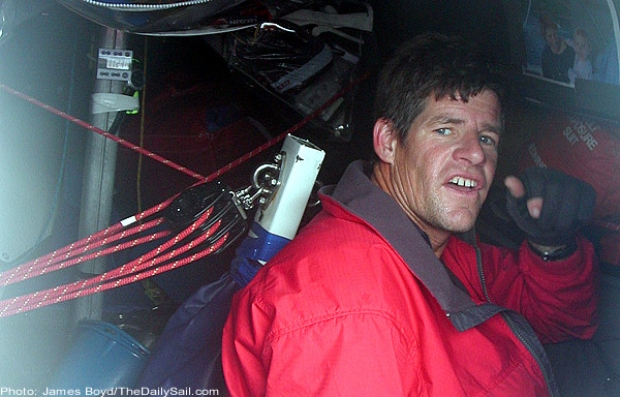
Jonathan McKee is currently leading the Mini Transat as they head out in the Bay of Biscay.
Most Read
Most Commented
Comments
Businesses

Pro businesses
-
Italy
-
France
-
-
United Kingdom
Editor's choice
Member blogs
-
 Ned Collier Wakefield: MOD70 round BarbadosWell that was intense. 12 hard fought for seconds for the win. In idyllic conditions, Tony Lawsons MOD ...
 -
 Mini Transat leg 2 reportThe second leg of the Mini Transat started on 31st October, just over a month after ...
 -
Leg 1 reportI’ve been working towards the Mini Transat now for three years. In 2013 I was part ...
Business blogs
-
 The Island Sailing Club in Cowes, Isle of Wight, is delighted that Prince Michael of Kent ...
 -
Peta Stuart-Hunt chats with the 25 year-old British solo sailor Lizzy Foreman before she sets sail ...
-
The 2015 Student Yachting World Cup (SYWoC), an ISAF-recognised event hosted and run by students for ...
Editor's Choice
All time favourites...
-
 Three legs down into Ian Walker’s
 -
 Winning all but two races at
 -
 For the first time in its
Latest Comments
Add a comment - Members log in