
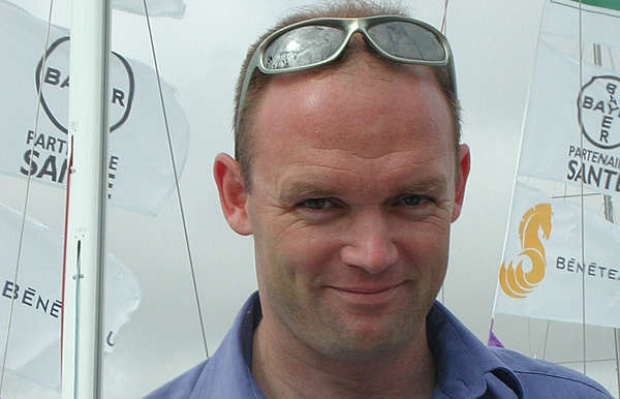
Dynamic of Cowes
Thursday October 2nd 2003, Author: James Boyd, Location: United Kingdom
Among the movers and shakers within our sport one man in the top 10 internationally is Mark Turner, supremo of Offshore Challenges, a company that he shares with sailing star Ellen MacArthur.
From its humble beginnings as a vehicle for scraping together money for their campaigns to do the 1997 Mini Transat, Offshore Challenges has come a long way, fuelled heavily by the success on the water and the resultant fame and media appeal of Ms MacArthur.
Since then the company has expanded to encompass the Offshore Challenges Sailing Team, including the highly bankable Sam Davies with her Skandia-sponsored Figaro campaign and charismatic Australian Vendee Globe hopeful Nick Moloney, with this potent duo teaming up to take part in November's Transat Jacques Vabre aboard Ellen's former Kingfisher Open 60.
This summer Offshore Challenges have announced further diversification with their taking over the Royal Western Yacht Club's classic quadraennial singlehanded transatlantic race from Plymouth to Newport, starting next year.
Turner says that this is a logical development of some of Offshore Challenges' less well published activities. "Effectively we have had two separate entities running for a few years," he says. "There is quite a lot of other work we have done outside of the sailing team such as setting up all the database and information management systems for the America’s Cup media centre, various communications consultancies and work for other campaigns and events quietly in the background without our name being associated with it. That all fits into the 'events' bracket and is not related to the sailing team. So there are two distinct areas and internally we even account for those separately and there will be some people 100% dedicated to the events side rather than working on multiple projects."
Offshore Challenges taking on the STAR is a deal that involves them taking on the commercial side of the event - in particular finding an event sponsor and building the profile of event, two areas where the Royal Western YC have been notoriously weak in the past. In fact, Turner points out, the media, sponsorship and communications side of the STAR has been handled by Transat Jacques Vabre organisers Pen Duick for almost 15 years or in the case of the 2000 event, the Paris-based sports marketing company Havas.
However the deal Offshore Challenges have done is far wider reaching - they have effectively taken over the STAR in its entirety including the race management side.
Part of the reason for this is one of insurance liability for the Royal Western Yacht Club. In the 1987 Double Handed Transatlantic Race an Italian 60ft monohull was lost with her crew and the Royal Western YC were subsequently sued by the families of the crew and lost the court case.
"The issue is that the liability the RWYC was putting its members under in the modern day litigious world - in order for them to step out of that liability, they have to take a step away from it in all terms of responsibility," explains Turner of the present situation. "So we have taken over that responsibility at a race management level, media management level, funding and all legal liability attached to the event."
Aside from the tragic incident with the Italian 60 footer Turner says that legal liability insurance for events like the STAR have gone through the roof since September 11th.
The race will now have a professional race management team, although the Royal Western YC membership may still continue to assist on a voluntary basis.
Turner has undergone some criticism for being both event organiser and competitor manager (Nick Moloney is likely to be taking part in the old Kingfisher) and the possible conflict of interest this presents. Turner rebukes this. "There will be an independent race management team, jury and race director - and that will not be me. To make a successful event that involves a lot of different elements and that is just one aspect of it. It is important that I stand back enough to take an view of the overall situation".
Prior to Offshore Challenges involvement the Royal Western had already made the decision to limit the 2004 STAR to solely the 50 and 60ft classes. This is yet another decision made by the Royal Western YC that has fallen foul with traditionalists who hold the notion that it humanises such an event having amateur corinthian entries in small boats racing alongside fully funded stars of the professional sailing world, not to mention continuing the long tradition of the event - Blondie Haslar's tiny modified Folkboat Jester having taken part in all the races, to give one example.
Turner's view is that transforming the STAR to a pro or at least semi-pro event only for the big boats is a good thing. "I regret that a small element of the history of the race is being eroded in that they won’t be racing at the same time, but I think the 50ft class is quite well established as an amateur or semi-pro stepping stone, and that still provides a really great opportunity for people to be up against the top professionals in the world, yet not at the same budget level."
He adds that the split has safeguarded the future of the transatlantic race for the smaller boats as the Royal Western YC are intending to run an event specifically for the smaller boats in 2005. "With the race left as it was, there was the potential that ORMA (the 60ft trimaran class association) and IMOCA (the Open 60 class assocation) would withdraw their support for the event, thereby righting off the entire event. In the ORMA fleet particularly, Plymouth and the race last time was a disappointment to some people. The returns that the sponsors saw was below their expectations."
Even without the smaller boats, next year's STAR will be one of the most impressive ocean racing events ever. Many Open 60 campaigns will be using it as a qualifier for next year's Vendee Globe. "On paper right now we are looking at potentially the biggest ever ocean race however you want to measure it - in terms of number of sponsors, skippers, numbers of big yachts," says Turner. "Currently there are 15 active 60ft trimaran campaigns, I would imagine more than twenty Open 60 monohulls, as it is a Vendee year. Then the 50s and a number of 60s that won’t be doing the Vendee. So it is not inconceivable that there will be more than 40 big race boats."
Another reason for dividing up the fleet is the physical problems with berthing 15 60ft long by 60ft wide trimarans and a large number of beamy Open 60s both at the start and the finish of the race. While Plymouth will remain as the start the berthing problems at the finish are greater and there is a strong possibility that the event may no longer conclude in Newport.
"There are three different options which we’re studying," says Turner. "Bear in mind the race has not always gone to Newport. The first race finished at the Ambrose light and we are studying whether we can incorporate the WSSRC record route, which means including the Ambrose light." In TheDailySail's view the east to west transatlantic record between the Lizard and New York is hardly as significant as the record times set on the traditional STAR course between Plymouth and Newport honed down over the course of the last 40 years. "We’re looking for the best scenario that works for the sailors and sponsors on the other side," says Turner.
While the event has suffered from a long term shortage of major sponsorship, in its favour is that it is the 'original' singlehanded transatlantic race and comes with collosal history. This forms part of Turner's drive to improve its position in the offshore racing calendar. With less than a year to go until the start getting a major event sponsorship will be a problem, but Turner says he has anticipated this. "We haven’t got a great amount of time, but the existence of the race in 2004 is underwritten in the sense that whether we find sponsors or not we will invest in it sufficiently to ensure it exists in a professional manner. We expect to make a loss or at best break even and any sponsorship we find will be going back into the race to re-establish it at the level it deserves in terms of its extraordinary history. There wouldn’t be an IMOCA or an ORMA fleet without the OSTAR in 1960 - full stop. And what is interesting is that the French are as passionate about the event as the English: is there another sporting event which has such an equal level of French and British history?"
While for the 60ft trimarans it will be a full-on competiton, this may prove not to be the case with the Open 60s who are using the event as a Vendee Globe qualifier. Michel Desjoyeaux in the 2000 Europe 1 New Man STAR for example had to throttle back in order that he definitely finish, to complete his qualification. This situation has been alleviated by the addition of a new Vendee qualifier between Salvador and La Rochelle - a singlehanded return event back from the finish of the Transat Jacques Vabre. For the 20 Vendee Globe Open 60 competitors (the list of competitors has been oversubscribed for more than six months now) it will be necessary to have completed in one or other of these events or to have raced in the Vendee Globe previously.
"It is hard to imagine anybody with a serious Vendee campaign, spending all 2004 without racing," says Turner. "It would be extraordinary not to go out there and do that test. It is a perfect time before the Vendee because you could have a catastrophe in the STAR and still make the Vendee. It is worth pushing the boat and the skipper to find out what those limits are in an event where there is generally some fairly harsh conditions because the best way to go in the Vendee is with that level of confidence behind you."
For the 60ft trimaran fleet it will be the first singlehanded transatlantic race since the carnage-filled Route du Rhum in which only three boats finished and only one without stopping. "The ORMA class had a period of reflection after the Route du Rhum," says Turner. "One of the big questions they asked themselves - particularly the skippers and sponsors - was the position of singlehanded racing in their whole set-up. There was a strong majority that voted for a singlehanded transoceanic race to be held every two years and that should a fundamental part of their circuit.
"The risks may be there, but they also know that it is the solo races that draws the interest and gets the greatest return sporting-wise for the skippers as well as from a sponsorship point of view," says Turner.
The STAR will have a long way to go before it reaches the level of public interest that the Route du Rhum receives prior to its departure from St Malo. "The French have been fairly dismissive of the organisation [of the STAR] in the past, and clearly Plymouth has never seen the same level of interest that St Malo does before the Route du Rhum - it is a very very long way from it and I don’t expect we can turn that round to the extent that people might hope for," admits Turner. "But then in sailing terms, nothing else anywhere comes equal to St Malo before the start of the Route du Rhum."
With the STAR in their portfolio, Offshore Challenges are also in the market for other yacht races. At present though, Turner says they will not take on a full-time race management team, but will sub-contract. "At the moment, it is an organisation to run this one event and that is not something we can add great value to. There are people out there who do a very good job in that area so let’s work with them and let’s focus on the area where the race needs more development. We can’t do a significantly better job on the race management than the people already out there doing it, so we are going to put our effort into other areas, such as sponsorship, media, communications, the village."
In the short term there is the possibility of some sort of event for the 60ft trimarans prior to them heading north for Quebec and the build-up to the Quebec-St Malo race. Some return race for the Open 60s also needs to be set up. "We are working out some sort of formula for the return of the monohulls," says Turner. "Regardless of whether it is formalised or not there is a Marblehead to Lorient race and there is the Newport-Bermuda race. There are some options about how to return the boats with some meaning."
Tomorrow Mark Turner gives his views on the Mini and Figaro fleet
Most Read
Most Commented
Comments
Businesses
Pro businesses
-
Netherlands
-
United Kingdom
-
Italy
-
France
Editor's choice
Member blogs
-
 Ned Collier Wakefield: MOD70 round BarbadosWell that was intense. 12 hard fought for seconds for the win. In idyllic conditions, Tony Lawsons MOD ...
 -
 Mini Transat leg 2 reportThe second leg of the Mini Transat started on 31st October, just over a month after ...
 -
Leg 1 reportI’ve been working towards the Mini Transat now for three years. In 2013 I was part ...
Business blogs
-
 The Island Sailing Club in Cowes, Isle of Wight, is delighted that Prince Michael of Kent ...
 -
Peta Stuart-Hunt chats with the 25 year-old British solo sailor Lizzy Foreman before she sets sail ...
-
The 2015 Student Yachting World Cup (SYWoC), an ISAF-recognised event hosted and run by students for ...
Editor's Choice
All time favourites...
-
 Three legs down into Ian Walker’s
 -
 Winning all but two races at
 -
 For the first time in its
Latest Comments
Add a comment - Members log in