
The dog's Bols
Tuesday March 25th 2003, Author: James Boyd, Location: Transoceanic
Yet another new maxi hit the water recently in Auckland: the new
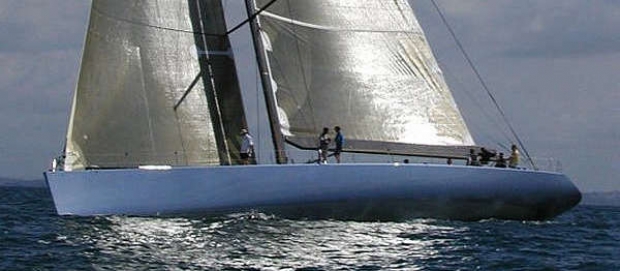
Bols, brainchild of skipper/manager Gordon Kay and designer Hugh Welbourn.
Unlike maxis such as the new Wild Thing and Alfa Romeo, Bols looks like it is going to be much too fast to take part in the Sydney-Hobart race. The CYCA's annual Boxing Day race south is limited to boats with an IRC rating of less than 1.6 (this was recently increased to 1.61) but in her present configuration the new Bols weighs in at a pacey 1.745.
Gordon Kay explains their reasoning: "The rating was of no importance whatsoever. IRC will rate anything. The reality is that the only race there is with a rating limit is the Hobart. So why would you build a one race boat? You can do the Reichel Pugh - turbo the boat up but it was clear if they had had bad weather with that bulb on the boat [Shockwave/Alfa Romeo] they would have struggled, because the boat was seriously nose down. But credit to them and Neville [Crichton] got exactly what he wanted and he’ll probably move it on. Our philosophy is different. We have got a 93ft sportsboat and they have a 90ft Soling. Their’s is a long thin IMS derivative and ours is not. Shockwave is a lovely boat, but they are apples and pears."
Another significant difference between Bols and her other maxi brothers is that she is built as an out-and-out offshore racer with round the world potential. Key to the Bols program is the Round Gotland race, a huge event in the Scandinavian market, along with other top events such as the Rolex Fastnet Race, the Maxi World, but what Kay would really like to do is to put her on the start line of a monohull division in The Race or The Race Tour.
Similar to the maxi-multihulls she has been designed as a high average speed machine, easily capable of demolishing the existing monohull 24 hour record without the aid of the Gulf Stream. Whelbourn thinks her sailing a 500 mile day is possible, while 400 mile days and 250 mile half days will be a regular occurrence.
 For this reason they were looking at the possibility of fitting the boat with a rotating wingmast. "I would like to have done it on this one," says Whelbourn (left). "It was time and insurance constraints."
He will reveal no more about what type of wingmast they might have used. "It has to be designed into the boat's total envelope. You have to figure out what it can do and what it can’t do. They don't give you as much flexibility when you are setting up the rig as a normal mast which you can bend and shove around the place. So you have lost that flexibility - you can't change the mainsail shape to suit the conditions in the same way.
"So you say what are the gains we get from it and put it into the overall equation. One of the big gains, because of the high speeds these boats are going is getting the parts count and the windage down. Windage is a major item. I hate the idea of having to hold this mast up with umpteen spreaders and bits of string but for what we have to do with the boat it is the right thing to do."
The boat currently has a fixed keel. Kay says that they could fit a canting keel at a later date, but Whelbourn says that this will depend upon the likelihood of the boat sailing around the world non-stop. "I wasn't having happy having a swing keel on a boat this size going around the planet," explains Welbourn. "It is one thing on a 60 when you are waving 2 tonnes around, but it is another thing on this when you are suddenly at 8 tonnes with big dynamics and the boat is doing very high speeds. I don't think it is a reliable way to go round the world at this stage.
"It is just the mechanics of the thing. The big problem is that if there is any slack in the system at all, it just destroys itself. I’m sure you could make it work but it will be so heavy that it starts getting counter productive again. It is not light to put one of these systems in a big boat once you have all the hydraulics and all the junk to run it. And you need basic inverted stability criteria and that limits minimum keel size anyway. So you have to say is that actually is that the way to get the boat around the planet and at the moment it is a big ‘no’."
So the new boat is 28.3m (93ft) long with a beam of 6m and a displacement in light mode of 23 tonnes. It has a conventional carbon mast, with unconventional standing rigging, a fixed keel and deep single rudder.
The impression of the hull shape is that it is fat in the astern a little like an Open 60 and a less extreme version of what Whelbourn tried with Heaven Can Wait, the Australian 50 footer. "People look at it and think it is all back end and nothing else," explains Welbourn of his 50. "But it is about three different boats in terms of how the water sees the hull shape. You get the off-axis boat which generates a lot of power like an Open 60, but when it is upright it still keeps a very low wetted surface area and we’ve done the same with this boat."
Aside from this the hull is the product of time in the tank at the Woolfson Unit in Southampton and establishing the working displacement range of the boat with water ballast in it. A significant development over Welbourn's previous designs is that Bols has hydraulically operated power boat-style trim tabs on her transom scoop.
On a powerboat trim tabs are used to keep the bow down while the boat is planing. The idea is similar on Bols. "It changes the trim of the boat: the bow goes down and it gets back into a more efficient dynamic surfing mode, so the net resistance of the boat goes down significantly and you‘re back to a longer waterline," says Welbourn. "If the trim comes up too much you are trying to push too steep a bit of boat through the ocean so you are not getting a very efficient lift producer once you get into a surfing mode.
"The problem with a boat like this is that you have got a boat that is running in a displacement mode in 8-10 knots in light wind or upwind. So you want one sort of hull shape. But it is also capable of fully planning and surfing and you want a hull shape with very little rocker, but that is not what you want to get minimum wetted surface for other conditions or when the boat is heeled over going upwind, it doesn’t want to be dead straight - you need a bit of shape. The trim tabs allowed me to combine the two animals and change the geometry in part of the hull in certain conditions when you know you need to do it."
Further time in the tank, testing the trim tabs and how they worked with the water ballast, indicated that they will come into their own in 16+ knots of boat speed and their performance improves the faster the boat sails. In terms of how they are used Welbourn says it is likely to be sea conditions dependent.
"There are some times when the boat is trying to get up and surf and you want something to hold the bow down, but at other times you want the bow to come up. It is always a fine balance when you design a boat as to what sort of buttock rise to have at the back end of the boat: you can get the bow to come up nicely for early surfing, then it is not very good for high speed work, so this let’s you do both things. If you have awful sea conditions, you might want the bow to ride a bit higher to give you better control through the seas but if it is nice long regular seas you can flatten it down and let the boat run nicely."

The transom trim tabs and, below, their hydraulic mechanism

Similarly the trim tabs could be used with one down and one half down to make the helm more balanced in awkward quartering seas. Whelbourn is utterly convinced of its benefits. "I think people will be smacking themselves in the head saying why didn’t we do that years ago. In my mind it is totally logical and I can’t understand why people haven’t done it before.
With no swing keel, the boat is relying on water ballast to alter her righting. "I did the Fastnet on a Maxi One Design," says Welbourn. "We came round the rock on fetch and we were up against the ILC70 Morning Glory and we filled up the tanks and nothing happened. The water ballast only sank it."
Bols can carry 4.8 tonnes of water ballast in two tanks each side, although Welbourn says they are unlike to use more than 4 tonnes at a time as it will take them over the top end of the displacement range. "You can put on another ton of ballast but all that will happen is that you load the gear up and you start to go slower."
Water is dumped down into the leeward tanks by gravity prior to tacking via giant 12in diameter pipes, while they can be filled from empty in around two minutes by two massive pumps located in the engine compartment beneath the cockpit. The overflows are on the transom to prevent the crew getting an entertaining soaking each time this is carried out.
Welbourn says they came up with size not soley through reasons of cost. "You go round the numbers and you end up somewhere in the mid-90s which is where all the numbers are still working for you. If you start going bigger, it is hard to get enough sail on it for the light stuff without having too much in a breeze." There is also the cost and weight issues beyond this of having to fit custom gear. "It was like the IOR maxis - there was a size which worked there structurally at that time. It was the same with the sails, the rigs, the ropes, etc. It is the size we can make work while still being reasonably manageable."
At a size in the mid-90s Welbourn says you can get a boat with all round capability. This will be harder to achieve in bigger boats. "The new Mari Cha is a schooner. That will be great for transoceanic aspects but will it go uphill effectively or straight downhill? So immediately you have a bigger, subdivided rig, and you have something which is not necessarily a great all-round product. It will still be a quick boat but it is not as quick for its size relatively as something in this sort of area at the moment."
Due to both its round the world capability and its speed, the structure, build and gear of the new Bols is more substantial than the other new generation maxis. While the boat is expected to make 11-12 knots VMG upwind, downwind the rudder is engineered to cope with full lock at 35 knots. "You'll be well over 30 knots in a nice set of waves and regularly high 20s," says Welbourn. "It is phenomenal when you start doing the numbers. But it produces its own set of problems. Size of the rudder blade - I haven’t got as big a rudder as I’d like because at 25 knots you don’t need a very big one. So there are trade offs all the way down the line."
Structural calculations were carried out by High Modulus in Hamble. The boat is built to Cat0 and there are two full bulkheads forward and another two aft. In the bow there are massive 450mm deep longitudinal stringers while aft either side of the engine compartment are two full height centreline longitudinals in addition to the tank fronts.
The boat was built at Peter and Sari Ullrich's new Boatspeed factory just outside of Sydney where the centre piece is their new 127ft long by 24ft tall by 36ft wide oven. The boat was built in carbon fibre with a mixture of PVC and Airex cores in the hull and Nomex in the deck using the Ullrich's Custom Preg system. This involves them making up their own pre-preg on site using a computer-controlled machine to dictate the degree of wet-out of the cloth. (More on Boatspeed later this week).
Welbourn says that the new boat is comparible with Stealth, Gianni Agnelli's Frers designed black super-maxi that was sold recently following the Fiat boss' death. But while Stealth was on the very edge of technology when she was built, today this is not the case. "Compare it with Stealth, we are a similar size, we have got more sail area, significantly more downwind sail area, a lot more grunt from the hull in the form of stability and the ballast configuration and at about 24 tonnes we are more than a few tons lighter."
As a reaction to the near loss of Leopard when her rudder broke, the new Bols has three levels of security. Inside the boat the rudder stock is contained within a tube that holds the rudder bearings. The whole assembly is inside its own watertight compartment and should that fail there is still a water tight bulkhead forward of this. An emergency rudder can also be fitted to the transom.
Another go-faster feature below the waterline is the fold-up prop shaft. This has been tried on a few boats in the past such as Mike Garside's Open 50 Magellan Alpha (now Brad van Liew's unbeatable Tommy Hilfiger Freedom America). Welbourn says he tried it on a 1/2 tonner. "With no engine it used to trickle along in the light stuff and it just didn’t stop. Later we put an engine in and it stopped."
Bols' prop shaft has a single pin joint with the end of the shaft attached to a cruved P bracket that drops down when the engine is required. At the end of the shaft is a Gori 3-bladed folding prop which should allow for respectible speeds under power. When the prop is not required it is feathered, turned to an index position and pulled up inside the boat, the 'bomb bay door' closing up behind it. Getting underway is a 30 second operation reckons Welbourn.
having no folded propeller and P bracket to drag through the water represents a big performance gain reckons Welbourn. "If you are trying to put in big average miles you get big gains in the low speed range. If you are dragging that through the ocean it could be taking a knot off the speed at times. If you’re doing 15 knots you’ll probably be doing 14.5 knots. It depends how much excess power there is in the system. Where it hurts is in margin conditions. Do you need that extra little bit to get over a wave. But it particularly hurts you in the light stuff."
Above the deck there is a 34m tall carbon fibre mast constructed by Southern Spars in Auckland. The rig has in-line spreaders and uses mostly non-overlapping headsails. The mainsail is 256sqm, the jib 180sqm, the Code 0 (which on this boat is an upwind headsail) is around 300sqm and the 1.5oz all purpose kite is 784sqm.
The sails are in Doyle's carbon D4 moulded technology put together by Richard Bouzaid's team at the loft's Auckland branch. A fairly basic suit is being built to start with as the crew and team at Doyle's establish where the horsepower is needed. "We’ll carry a type of Code 0 once we've decided how big it needs to be," says Welbourn. "In only 6 knots of true breeze and the boat is powered up under its non-overlappers, so there will be a low speed point where you need a little grunt from an overlapping something, but we won’t build that until we see how the numbers are coming up."
Apart from using the moulded sails, a phenomenal 350kg was saved in the rig by having PBO instead of stainless steel rod rigging. PBO has gone round the world on Open 60s, but it is the first time it has been used in anger for the standing rigging on a boat this size. "The addition cost is about same as putting Nomex instead of foam in the deck," says Welbourn. "So you have saved 350kg 15m above the deck as opposed 35kg at the deck. It is a no-brainer."
The new Bols is currently undergoing sea trials in Auckland. Welbourn stays that there is a huge amount of tuning to done on a boat like this, including altering her displacement which could go down by 2 tonnes (at present her bulb is deliberately heavy). "We’ll be sailing in lots of different modes. Do you go for a smaller kite and no water ballast or a bigger kite and a lot of water ballast - what is the best combination? You need to understand the envelopes that boat can work in and then find the optimum ones."
In April she will be put on a ship to Europe where her first major engagement will be the Round Gotland Race.
Over the course of this week we will be looking at other aspects of the Bols project

Most Read
Most Commented
Comments
Businesses

Pro businesses
-
United Kingdom
-
Italy
-
-
France
Editor's choice
Member blogs
-
 Ned Collier Wakefield: MOD70 round BarbadosWell that was intense. 12 hard fought for seconds for the win. In idyllic conditions, Tony Lawsons MOD ...
 -
 Mini Transat leg 2 reportThe second leg of the Mini Transat started on 31st October, just over a month after ...
 -
Leg 1 reportI’ve been working towards the Mini Transat now for three years. In 2013 I was part ...
Business blogs
-
 The Island Sailing Club in Cowes, Isle of Wight, is delighted that Prince Michael of Kent ...
 -
Peta Stuart-Hunt chats with the 25 year-old British solo sailor Lizzy Foreman before she sets sail ...
-
The 2015 Student Yachting World Cup (SYWoC), an ISAF-recognised event hosted and run by students for ...
Editor's Choice
All time favourites...
-
 Three legs down into Ian Walker’s
 -
 Winning all but two races at
 -
 For the first time in its
Latest Comments
Add a comment - Members log in