
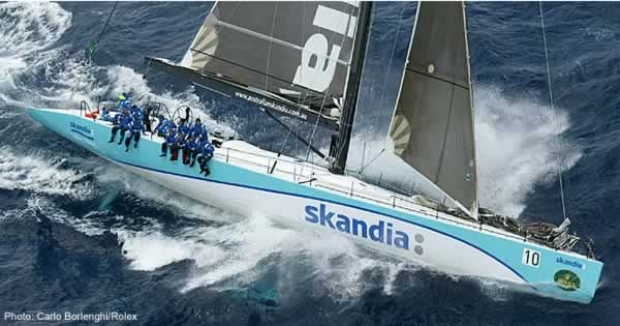
Under the skin of Skandia
Wednesday December 31st 2003, Author: James Boyd, Location: Australasia
The Rolex Sydney Hobart Race is going through a strange period at present. While overall entry numbers are substantially down on previous races, for this year's event two brand new multi-million dollar maxis were built for the sole purpose of winning line honours in Australia's most famous offshore race. In the end, Stuart Thwaites' Brett Bakewell-White designed
Zana from New Zealand finished 14 minutes behind Grant Wharington's
Skandia.
The radical creation that is Skandia was designed by a relative unknown outside of Australia - Don Jones. Jones is an engineer by profession having spent a long career as CEO of a food machinery business and previously in the power industry. So how did he come to design a 100ft state of the art maxi?
"I have always been interested in yacht design and I did a lot as an amateur in my working life. I had the opportunity to retire early on my 58th birthday and decided I would fill in my retired years designing yachts. So I retired, invested in the necessary software and did it more seriously."
Since retirement Jones has designed a number of race boats that have been built by Mal Hart. Most of Jones' race boats have been around the 40ft mark. At the time of our interview Jones had just received the news that his own boat Cadibarra had won line honours and under IRC in the Melbourne to Launceston race, skippered by his son. The previous Cadibarra was racing in the Rolex Sydney-Hobart under the name Kontrol. His design Priscilla won its division in the Melbourne-Osaka while others have performed well around the Melbourne/Bass Strait area.
Skandia is something of a Mornington effort, both Jones, Wharington and builder Mal Hart, coming from the town on the outskirts of Melbourne. Jones is an old family friend of the Wharingtons, Grant being a contemporary of his son. Originally he was set to carry out engineering work on the new Skandia, while other firms of naval architects pitched for the design contract. Jones had run VPPs on numerous boats in the size range Wharington was looking at and between them they had already drawn up the general parameters. "I agreed with his general view of what he wanted to do," says Jones. "So we got to the stage we knew what type of yacht we wanted to do and when it came down to the wire he really decided that I might as well do the design as well as the engineering."
Jones believes that engineering a boat like Skandia took a lot more time than the design. "While the design of the boat is absolutely critical, it is very very small in terms of manhours compared with the engineering work. The mast for example was one enormous engineering job, and we designed that from scratch, largely because we couldn't buy what we wanted. No one had the necessary tooling to do what we needed to do. So I designed the mast and the tooling for it and the shape of the section and the laminate and the rigging design."
To design a Rolex Sydney-Hobart race winner it is necessary for the boat to be at the maximum rating of 1.61 under IRC. From here it became a question of juggling the various parameters of the design to reach the fastest solution within this rating.
"Grant had the view which I think was right - to go for the longest boat he could build to the handicap limit that would carry enough sail for satisfactory light weather performance," explains Jones. "Once you have this handicap limit, if you go the conventional way and take the mast as a case in point - you could have a five spreader rig and a spinnaker pole, but you end up having to build a shorter boat. So the reason the boat has got a two spreader mast with a bigger section than it would have if it had five spreaders is simply because we are simply able to build a longer boat." Zana in comparison has a state-of-the-art five spreader rig, but can't use her movable ballast.
One of the fundamental differences of designing a 100footer compared to a 40 footer is that the wind doesn't blow any harder for the larger boat and as a result it spends considerably less of the time sailing at hull speed. "Also because it is easy to get stability you tend to build a narrow boat which has less wave making drag so wetted surface drag becomes of paramount important," adds Jones explaining the logic behind Skandia's design. To reduce wetted surface area of the hull you end up with a rounded rather than a square underwater section but this doesn't have much stability. However add a canting keel to the equation and all stability issues are restored. The rounded hull shape also is more seakindly than a square shape.
The result is that Skandia is 30m (98ft 5in) long with a beam of 5m (16ft 5in) that is carried well aft to the transom to improve handling when heavy running. This compares to 6m beam for the Bols maxi that is not constrained to a Hobart race rating limit.
She is fitted with a canting keel, but the degree of canting is modest compared to Open 60s or CBTF boats like Wild Oats. To squeeze within the 1.61 limit as well as the 10deg static heel rule mandatory under Australia and NZ rules of sailing, canting is limited to 14-15 degrees. Canting keels cannot be rated under IMS but can be under IRC.
Under normal circumstances being able to cant the keel allows bulb weight to be reduced, but again if they had done this, the boat would have got lighter and resulted in a rating hit. However with their heavier keel bulb - weighing 14 tonnes, roughly 50% of the displacement - Jones says, the overall effect is similar to Wild Oats canting her lighter bulb (roughly one third of her displacement) through a wider angle.
The small amount of canting keel has also meant it is not necessary to fit the boat with a daggerboard or canard arrangement to prevent leeway and once again they have managed to reduce drag as a result. Because of this lack of forward appendage it was assumed that Skandia would be found wanting upwind, but in the round the cans regattas in Sydney Harbour prior to the Hobart race this has proved not to be the case.
"If you think about an aeroplane, it can still fly even if its wings are up like that," Jones says doing an imitiation of a bird of prey. "So what really determines the effectiveness of the keel is the depth they go below the surface."
Beyond the Hobart race and if they are ever to race without the maximum rating constraint then they can cant the keel by up to 20 degrees, but even then Jones doesn't think they will need an additional foil.
The canting mechanism on Skandia, hidden beneath her galley, comprises two substantial hydraulic rams unusually both mounted on the port side (their weight offset by the batteries). Although these are independent the system is not such that they can be used independently. "It is like a mobile crane," says Jones. "If a line burst the thing locks solid. If it is a motor or power failure then you have a hand pump."
While canting keels on Open 60s traditionally hinge around a single pin at the exit through the hull, if they had tried this on Skandia with her 14 tonnes bulb (an Open 60's all up weight in comparision is 9 tonnes just remember) then the load on each bearing would have been in the order of 600,000lbs Jones calculates. Their arrangement can take a 3G de-celeration according to ABS requirements and achieves this by having the top of the keel fin mounted on a substantial set of runners. Forward of these runners is a thrust post that extends forward to the maststep. This set up can take a force of about 200-300 tonnes reckons Jones.
While the boat is built in carbon fibre with a balsa core, round the keel and rudder the laminate is carbon with a core material of straightforward glass.
The most obviously radical feature of Skandia is her substantial mast section and her only having two spreaders, both extending beyond the shroud base so that the V1s have a slight angle inwards as they descend to the deck.
Jones doesn't find the rig that unusual. " Ichi Ban (the Farr 52) has got a two spreader rig, but I know this is bigger. You could have a no spreader or an unstayed no spreader rig if you designed the carbon section big enough. Obviously in our case that would be far too heavy." To reduce weight in the mast instead of building the spar in solid carbon fibre it has a Nomex core in the sidewalls. The mast was built by Applied Composites in Melbourne in six pieces from a female mould. High modulus carbon uni-directional fibres run up the length of the mast. The rigging is rod (rather than composite) and was made by Ocean Yacht Systems in the UK.
"Although the mast tube is heavier than say Shockwave, the rod rigging isn't, and the centre of gravity of it is low, because by having long spreaders you can have smaller rods," argues Jones.
Another rating beater is her single backstay and no runners configuration. "We have the checkstays that are low down. They don’t interfere with the boom when it’s let out, and they offer fairly powerful control of the mast and are hydraulically controlled." The hydraulics are inter-connected so that the load can be repeated from tack to tack. Jones was concerned that the mast bend characteristics of the rig would make it difficult to build sails for, but he claims this has worked out okay.
However it doesn't end here. The boat has no spinnaker pole on the basis that downwind the boat is so fast and the apparent wind so far forward that it would never sail with the pole off the forestay. This removes much of the effort of handling the sails, but not as much as having electric winches...
While powered winches are banned from record attempts, under IRC boats of 24m or more are allowed them. All Skandia's primary winches are electric and as a result she has no coffee grinders (and as a result a probably highly relaxed, chilled out crew), leading to a very clean deck layout. Electric winches and no coffee grinders means that less crew are required and hence there is a cost saving - Skandia sailed the Hobart race with 19 crew.
The big issue with electric winches one would think would be line speeds, but Jones says that this has proved not to be an issue. Line speed in high gear is 140m per minute and Jones estimates that tacking the sails and the keel, takes around 30 seconds once the boat is settled down again.
An obvious safety issue is potentially tearing the clew out of sails or ripping crew's limbs off when they are going up the mast, but the crew just have to be more aware of when the load is coming on. "Up to now we haven’t had any problems," says Jones. As race boat crews are notoriously bad at maintaining their boat's batteries Jones has insisted on a charging system whereby the generation automatically starts up once battery voltage has reached a certain level.

Powered winches and no grinders also saves crew energy. "If you watch the man on the mainsheet, he just sit there with his foot on the button and it is very easy," says Jones. "I think really when we looked at the powered winches we decided it was the way to go and we didn’t consider doing anything else." One wonders whether this is really maxi boat sailing though?
There are problems though. If one winch goes down each has a slave ring allowing the sheet or halyard to be transferred to another winch. But if there was a power melt down on board, preventing the winches from being used they can just about be hand cranked but this would not be competitive.
Another issue, Jones says, was whether or not they should have halyard locks. "We ended up not having them. They are a science in themselves and as you get older you get more conservative and from a design point of view I would prefer to have any problems at deck level. To get over the stretch problem the jib halyard is 2:1."
As another rating beater they have no headfoil and instead use hanks. "First of all you can't get a foil bigger than for #60 rod and we have a #76 forestay but the advantage on a big boat of having it on hanks, is that it is a dicey foredeck to work on. Relative to other maxis this boat has quite a high freeboard which makes it a bit safer on the forecast, and when you have a foil, you pull the sail down the men have got to save the sail. When the sail is captive on the stay, the sail saves the men and they can hang on to it and take a green one. So that was a consideration."
It is not possible to have two sails hanked on at once due to the constraints of the narrow foredeck and the crew have taken to hoisting the no4 on the babystay to avoid making headsail changes bear headed.
In terms of sails there is little unusual about the wardrobe, with the exception of a very big jib top they carry which allows them to carry 211sqm forward. "It makes quite a big difference in light weather, although it has been academic in this race," says Jones.
To reduce drag beneath the water further, the boat has followed the current tend by having a retracticle prop. While Bols for example has a three bladed folding prop that pulls up within the hull, Skandia has a full-on fixed three blader on an outdrive leg that pulls up into the hull and is then hidden by a pair of doors. The box for the outdrive leg has an airtight lid and compressed air is pumped into it to expel water. "It is a mistake to have it draining out through Venturi because water has got to leak in before it leaks out through Venturi. So you are having to accelerate all that water up to the boat’s speed and then you lose it."
From here Skandia will take part in the Skandia-sponsored Geelong regatta in January. After that she will be taken out of the water for a full inspection. Beyond this no plans have been finalised.

Most Read
Most Commented
Comments
Businesses

Pro businesses
-
United Kingdom
-
Italy
-
United Kingdom
-
Editor's choice
Member blogs
-
 Ned Collier Wakefield: MOD70 round BarbadosWell that was intense. 12 hard fought for seconds for the win. In idyllic conditions, Tony Lawsons MOD ...
 -
 Mini Transat leg 2 reportThe second leg of the Mini Transat started on 31st October, just over a month after ...
 -
Leg 1 reportI’ve been working towards the Mini Transat now for three years. In 2013 I was part ...
Business blogs
-
 The Island Sailing Club in Cowes, Isle of Wight, is delighted that Prince Michael of Kent ...
 -
Peta Stuart-Hunt chats with the 25 year-old British solo sailor Lizzy Foreman before she sets sail ...
-
The 2015 Student Yachting World Cup (SYWoC), an ISAF-recognised event hosted and run by students for ...
Editor's Choice
All time favourites...
-
 Three legs down into Ian Walker’s
 -
 Winning all but two races at
 -
 For the first time in its
Latest Comments
Add a comment - Members log in