
Glenn Bourke interview
Tuesday February 11th 2003, Author: James Boyd, Location: None
 Following yesterday's announcement of the new format and boat for the Volvo Ocean Race 2005-6, The Daily Sail got some more details from the race's CEO Glenn Bourke.
The Daily Sail: Tell us about how you plan to limit the costs of campaigns for the next Volvo Ocean Race
Glenn Bourke: Probably the most significant limiting factor is one boat per programme. Having a new rule, obviously you don't have existing boats to go and buy, like say illbruck did last time with the two EF boats. And issuing the late rule - you have design, construction and training windows which keeps that preparation pretty short. You can probably bring your sailing crew together with a year to go and still be effective in trying to win the race.
The second one is sails. We've reduced the total number of sails from 38 down to 20.
TDS: You ran the illbruck campaign last time and so must have a good idea of boat budgets - what percentage of the overall budget goes in the sail?
GB: We spent $1.8 million on sails with illbruck. You can probably get that down to under $1 million per team, perhaps under $700,000 if you're tight on budget.
TDS: Obviously the biggest cost is crew...
GB: Staffing costs are about one third of the budget in totality, so if you are bringing on people later for a shorter window, those budgets go down significantly if you are only doing a one boat programme. And there also is a necessity to go and train with other teams which bring in better commaraderie and a bit more spirit to the race. You can't really train in isolation.
TDS: How will going for an 'open' design rule affect costs?
GB: I personally think that keeping the rule open will help to reduce the costs. If you take an Open 60 - there's a class of boat with quite a good number of competitors and a reasonable number of boats being created and built. Why can they be built for the price? Because there is competition between the designers and you can allow new innovative designers to come into the forum and to have a chance at designing perhaps for a lower budget team. But they still have the chance of getting their wares out there and if they are smart and they come up with a good concept then why can't they be the next big design office.
Because there are such big line items, there's more creativity involved so you don't have to get into the depths of testing 55 different appendage configurations. You say 'my basic concept is this' and I'll test three and we'll go from there because there are so many other variables in the design package that it isn't worth spending a lot more money on it.
And what we were hoping to do with the rule was to create a rule which didn't have a lot of statutory laws but define the boat into a performance bracket quite quickly. If you define a few things specifically that puts all the boats into a corner of the performance bracket.
TDS: How much faster will the new boats be?
GB: I'd say between 6 and 10% faster would be a conservative guess.

TDS: By going down to nine crew sailing a bigger boat and okay less sails, does that mean you are pushing teams towards things like furling sails
GB: We may even stipulate furling sails. We are still trying to evolve the rule. What we'd like are boats which are really easy to sail. And if stipulating say two furling, non-overlapping headsails will do that, then that's probably what we will do. But obviously with every rule you've got to be careful of the loopholes you create in the text and one of the things I think is important is to have an intent clause which is the overriding principle, whereby your intention when you created the rule was to do this and any steps to get around the rule will be interpreted according to the ethos of the rule.
TDS: So will you end up with an America's Cup style arbitration panel?
GB: We'll have a measurement committee. We really don't want to get into an America's Cup style of management. We believe the ISAF is the governing body of the sport and they have a system in place which we are supportive of. We like an independent jury. We think there is no problem with an internal race committee provided it is clear we are providing an equitable position for all teams. And we'll be judged by the jury if people didn't believe that wasn5t the case.
TDS: Under the old rule autopilots were banned. Will that be the case now?
GB: I don't mind - no problem. It might be safer.
TDS: With less crew that will certainly affect how teams sail the boats?
GB: We took a pretty simple breakdown of the crew and we said basically two four man watches and a navigator. That's how we got to nine men. It is so arbitrary, when you're trying to determine how to evaluate the strength of a woman versus the strength of a man - we just tried to keep it simple.
One of the great things to come out of the last race was the scoring system. It was simple and with this concept of crew numbers we're not talking about weighing people and really evaluating it. It is just here are the three models which you can compete under. So - a more simple boat with greater ranges for each sail selection and perhaps making it a bit easier for the guys and girls.
TDS: The rule for the hull you want to keep open, but the bits you want to standardise are the keel and the mast. What about sails?
GB: There will be various rules about overlapping and non-overlapped headsails and roach of mainsails and maybe mainsail area and all the general things to stop really unusual looking development and expensive development. We'll have all of that - I can't tell you what it is yet because we're only on an early iteration of the rule. There are things which are quite difficult to word - how do you word a one boat syndicate and make that stick? We've been spending a lot of time getting the concept right and from now on we'll spend a lot of time getting the detail right.
TDS: When will you get the rule finished?
GB: Probably towards the last quarter of the year. We'd like to give at least two years prior to the event for design, construction and training periods.

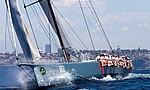
TDS: Who are the potential competitors? We understand that the most advanced is Stig Westagaard (above)
GB: Yes, Stig is going very well but there are a few others as well. Obviously some of the old stages are putting their hands up again and have good contacts and have the ability to be able to walk into board rooms and get the job done.
And there are a few new faces who are enthusiastic and bright and good markeeters so it looks good so far. What our concept is is to get the package right so that they have a product that is easier to sell, and then support them in the selling phase by bringing in our marketing and sponsorship person who can give them our package of data, all the bright and glamorous video pieces that will help them promote it to a sponsor and to help them understand how to present to a major corporation if they are a sailing jock and haven't been in that environment before.
TDS: The race will be two months shorter - are you looking at shaving off time from the stopovers?
GB: A little. The stopovers are more consistent in the time duration. After a shorter ocean racing leg it is 17-19 days and on the longer legs, it is 21-24 days. What we're doing is we're focusing on the nine day window. The in-port racing will happen weekend before the restart so most of activities will happen in the nine day chunk before the restart. On the Saturday we'll have the in-port race. On the Saturday afternoon we'll have a presentation for podium pace getters. On the Sunday we'll have a presentation of the previous leg, then we'll have all the prepartion of the boats before the restart the following weekend.
TDS: Do you have a feel for overall weight of the boats?
GB: Not really - you'll have to ask a designer that. I think the bulb and fin would proably be about 5 tonnes. We'll use ABS or some sort of scantling requirement for the hull. We will allow carbon fibre in the construction.
TDS: You've announced the Volvo Pacific Race and there was the Volvo Baltic Race last week. Will you be announcing other events?
GB: Volvo would like to have an integrated backing of the sport in general with everything from youth sailing to world championships to boat shows to local small events and a lot of it sometimes comes up with what a national Volvo marketing group will decide to do. And they make their own decisions. But in terms of Volvo centrally - our three biggies are the Baltic race, the Pacific Race and the Volvo Ocean Race in that area.
TDS: What about a championship scheme?
GB: We have to see how it works. If there are teams which come in and they have a long term objective and they want to do this first Volvo Ocean Race and follow it up with the Pacific race, because it goes to their markets, then that is great. If a team is only here for the Volvo Ocean Race and dissolves its activities, then the boat and the assets are up for sale to a new team, who might use the Pacific race as the stepping stone to the next Volvo Ocean Race. That's how we see it panning out. Will there be a championship which incorporates points from all those events? Perhaps.
TDS: You could obviously include events such as the Bermuda Race, Fastnet Race, Sydney-Hobart, etc.
GB: We think there's some logic in this Open 50, Open 60 and Volvo Ocean 70 progression. We would like to see the people who sail Open 60s, if they think the next step for them is to go into a crewed event then the Volvo Ocean 70 would be a logical progression for them. We hope that it might be interesting for the French guys - that the circuit might go on for Open 50s and 60s and might embrace Volvo Ocean 70s.
TDS: Why did you introduce the in-port racing?
GB: The focus for us is about the sport. My personal belief is that if the sport is right then everything else falls into place. And a race which is prestigeous and is a complete test. I think there will be a few traditionalists out there who say that in-port racing isn't the direction it should head. I disagree.
If you think of the kind of guys who've won this race recently, Cayard and Kostecki and the new guys who're coming through like Freddie Loof and Chris Nicholson. All of these guys are fantastic fleet racing sailors - so why not throw that into the mix as well? None of those guys would be scared to put themselves up to that test.
TDS: In port racing is 20% of the racing - how much will it change the design of the boats.
GB: It'll just refocus the designers a little bit on going upwind. Obviously they spend most of their time creating boats that are slippery off the breeze, anywhere from VMG running to pressed up tight reaching but they need to think about how many points and how easy the boat is to sail upwind as well.
TDS: There is a pitstop in New York. Will that be the same format as the one in Hobart last time?
GB: Probably. My guess is that it'll be 3 and 24 hours. Just enough time to have a hamburger and chips and off you go again! With such a population there and so much of the corporate wealth of the world based in New York it just seemed like a logical stop. But not only that - it lines us up for the Ambrose Light to the Lizard record. So why not stop, have a breather to get ready for the sprint across and see if we can crack the record.
TDS: Do you think the changes will give the race more soul? It seemed a little clinical last time.
GB: For me the challenge of the Olympic Games is exactly the challenge of the Volvo Ocean Race. Traditionalists said you can't run the Olympic Games inside a harbour. But that's ridiculous - everyone of these competitor grew up racing inside a harbour. They spent 95% of their lives racing inside a harbour so how can we do it and keep the integrity in the sailing. I think we've used a similar concept for the Volvo Ocean Race. What provides the best test for the sailors? How can we make their lives bearable in an almost unbearable environment down in the Southern Ocean? And how do we put a test to them which is interesting. Because one of the problems in the port stopovers in the past has been boredom. And boredom for the people involved in the event and the sailors - now they have a focus. They have to get the boat ready the weekend before. They have to be ready and recuperated themselves and then they have to put themselves up to a very difficult test.
TDS: How long will the in port races be?
GB: 3-5 hours. The course will depend upon the venue. If we can fit in windward-leewards and it made sense, then yes, but we'll wait for the design to evolve and find out what the peculiarities of the boat are. But yes, in an open port environment then probably windward-leewards, but there may be an olympic triangle in there too.
TDS: You'll probably get a few crazy people trying to sail these singlehanded...
GB: Absolutely - why not!
TDS: So the Volvo Singlehanded Ocean Race?
GB: Well that would reduce crew costs by 29 of the 30%!
Most Read
Most Commented
Comments
Businesses
Pro businesses
-
France
-
United Kingdom
-
-
France
Editor's choice
Member blogs
-
 Ned Collier Wakefield: MOD70 round BarbadosWell that was intense. 12 hard fought for seconds for the win. In idyllic conditions, Tony Lawsons MOD ...
 -
 Mini Transat leg 2 reportThe second leg of the Mini Transat started on 31st October, just over a month after ...
 -
Leg 1 reportI’ve been working towards the Mini Transat now for three years. In 2013 I was part ...
Business blogs
-
 The Island Sailing Club in Cowes, Isle of Wight, is delighted that Prince Michael of Kent ...
 -
Peta Stuart-Hunt chats with the 25 year-old British solo sailor Lizzy Foreman before she sets sail ...
-
The 2015 Student Yachting World Cup (SYWoC), an ISAF-recognised event hosted and run by students for ...
Editor's Choice
All time favourites...
-
 Three legs down into Ian Walker’s
 -
 Winning all but two races at
 -
 For the first time in its
Latest Comments
Add a comment - Members log in