
Le Professeur
Sunday November 24th 2002, Author: James Boyd, Location: France

Michel Desjoyeaux's win in the Route du Rhum was interesting not because it was a feat of outright bravery or balls-to-the-wall sailing as we might have been writing if Steve Ravussin had won.
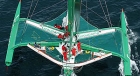
Geant's victory does show just how shrewd the Vendee Globe winner is as a yachtsman. To have sailed north to avoid the worst of the weather, to have continued so conservatively in the powerful conditions and then to put into Madeira to reinforce the beams before continuing, showed great presence of mind. He stopped twice, once for 15 hours AND STILL WON!
While Desjoyeaux has sailed a great deal on trimarans, this was his first ever event singlehanded on one and it was also the first race for his new boat. New 60ft trimarans tend not to fare well in their first events and it is testament to Desjoyeaux's ability and knowledge gained from his vast and diverse experience on the high sea from the Whitbread to inshore racing, that he pulled through. He is nicknamed 'Le Professeur', the teacher, a name given to him through his selfless propensity for helping novices in the Figaro class.
37 years old and with three children, Desjoyeaux heralds from compact Breton harbour of Port la Foret, known among the French sailing fraternity as "la vallee des fous" (the valley of the mad) because it has spawned so many nutter Figaro and trimaran sailors including Bonduelle skipper Jean le Cam and Sill skipper Roland Jourdain.
Desjoyeaux has an unusual lineage with a mother from a French aristocratic family and a father who was a Resistance fighter during WW2 and later one of the founders of the influential Les Glenans sailing school.
Aged 18 the young 'Mich Des' joined the famous Eric Tabarly on board the maxi Pen Duick VI to follow La Solitaire du Figaro. He gained the great man's confidence and Tabarly took him on as a crewman in the 1985/6 Whitbread Round the World Race aboard Cote d'Or. In the race eight years later he was invited back as a watch leader on Tabarly's clipper-bowed maxi ketch La Poste.
Tabarly was a great influence on the young Desjoyeaux and aside from his seamanship, racing skills and a general love of the sea, he picked up Tabarly's flair for innovation. Pen Duick VI was controversial for having a keel filled with dense spent uranium, similarly Desjoyeaux's foray into the Mini class was with a boat that had a canting keel - some years on they are now de rigeur on Open 60s. He also pioneered the long and complex articulating bowsprit system still popular in the Mini class today. Several ideas such as a semi-circular main sheet track extending forward to double as both the genoa sheet track and vang/preventer attachment points ended up also being used later on his Open 60 Vendee Globe winner PRB.
In the mid to late 1980s, Desjoyeaux was part of CDK Competition, sailing as tactician alongside Jean le Cam on the winning Biscuits Cantreau Formula 40 trimarans.
Like le Cam and Roland Jourdain, he was also at this time getting involved in the Figaro circuit. In 1990 in his first Solitaire du Figaro he finished an impressive fourth. He topped this winning the event outright in 1992 and in the same year won the two handed Transat AG2R sailing with veteran shorthander Jacques Caraes. He won the Figaro again in 1998, one of only three Solitaire du Figaro multiple winners.
Continued on page 2...
Most Read
Most Commented
Comments
Businesses
Pro businesses
-
United Kingdom
-
-
United Kingdom
-
Editor's choice
Member blogs
-
 Ned Collier Wakefield: MOD70 round BarbadosWell that was intense. 12 hard fought for seconds for the win. In idyllic conditions, Tony Lawsons MOD ...
 -
 Mini Transat leg 2 reportThe second leg of the Mini Transat started on 31st October, just over a month after ...
 -
Leg 1 reportI’ve been working towards the Mini Transat now for three years. In 2013 I was part ...
Business blogs
-
 The Island Sailing Club in Cowes, Isle of Wight, is delighted that Prince Michael of Kent ...
 -
Peta Stuart-Hunt chats with the 25 year-old British solo sailor Lizzy Foreman before she sets sail ...
-
The 2015 Student Yachting World Cup (SYWoC), an ISAF-recognised event hosted and run by students for ...
Editor's Choice
All time favourites...
-
 Three legs down into Ian Walker’s
 -
 Winning all but two races at
 -
 For the first time in its
Latest Comments
Add a comment - Members log in