
Route du Rhum form guide - 60ft tris
Thursday November 7th 2002, Author: James Boyd, Location: Transoceanic
One of the most impressive, competitive and, if truth be told, downright scary fleets of offshore racing boats is currently parked under the shadow of St Malo old town's ramparts.
The 60ft long by 60ft wide ORMA trimarans due to take Sunday's start of the Route du Rhum prior to their high speed sprint across the Atlantic to Guadeloupe in the French Caribbean, already look anxious to leave. At present they are all heavily tethered to the dock as their towering wingmasts (some canted) power up in the 30 knot gusts.
Who will win? The question when I try it out on various people who should know here results in a pursing of lips and outstretched upturned hands: "sais pas" "don't know". Strangely the question doesn't seem to really matter over here, where taking part in 'an event' such as the Route du Rhum, a moment that will enter the history books, is almost more important than who gets to Pointe a Pitre first.
Anyway, we're not from France and who will win this 24 year old ocean racing classic is important to us.
In essence the trimaran fleet can be broken down by generation (see page two for a more accurate breakdown):
A) Impressively the 60ft trimaran fleet includes many new boats, all of them built to take part in the ORMA circuit of Grand Prix and offshore events of which the Route du Rhum is king. This year we have seen the launches of the new Gitana, of Sodebo and Geant of Vendee Globe competitors Thomas Coville and winner Michel Desjoyeaux respectively. Also launched this year were the new Foncia of Alain Gautier, Bayer CropScience of former Tornado sailor Fred le Peutrec and Sopra Group, of Philippe Monnet, current holder of the east to west non-stop singlehanded round the world record.
B) In 2001 there were also several new launches including 60ft tri champion Loick Peyron's new Fujifilm and her sistership, Karine Fauconnier's Sergio Tacchini, Jean-Luc Nelias' Belgacomand the new Banque Populaire of Lalou Roucayrol.
There was also Bonduelle of multiple Figaro winner Jean le Cam and TIM (formerly Fila) of Around Alone winner Giovanni Soldini.
C) Among the generation of boats built before this are Franck Cammas's highly successful Groupama, which won last year's Transat Jacques Vabre. Her sistership, the old Foncia has been sold to Swiss multihull sailor Steve Ravussin and is now called TechnoMarine. Also of this generation is Marc Guillemot's Biscuits la Trinitaine/Ethypharm.
D) Not to be discounted are the really ancient tris (all about 12 years old) - Rexona Men (formerly Primagaz) of Yvan Bourgnon, recently made famous by the photos of her towing a waterskier and the sisterships Banque Covefi (formerly Fujicolor) of Bertrand de Broc and Eure-et-Loir/Lorenove of Francis Joyon. Long in tooth as these boats might be you only have to look at the photos of Rexona Men to see she is still capable of considerable pace while Joyon's boat two years ago won the Europe 1 New Man STAR ahead of all the newer opposition.
So this is the field - what of the form?
To win you have to make it to the other side and this will not favour the very new boats, particularly in the heavy conditions forecast for the start. At present the weather for Sunday's start looks like it may be as much as 35 knots from just south of west and deteriorating - this will certainly separate those who have done their preparation thoroughly and those who haven't.
This year has seen a spate of dismastings in the trimaran fleet and this could mean more breakage for the boats or it could also mean that the breakages have already happened and that those who have replaced spars have now taken a more cautious, more conservative approach. We think it is safe to say that some of the newer boats are likely to end the race limping into France rather than sauntering home to glory in the French Caribbean.
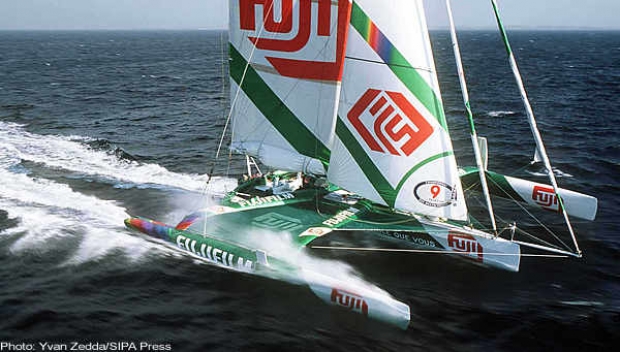
Our line honours favourite would have to be Loick Peyron's Fujifilm, although it was only a year ago that she dismasted at the Fecamps Grand Prix. So far this year Peyron and his team have dominated the circuit, romping home with a race to spare in the Grand Prix at Zeebrugge and dominating the war-torn Course des Phares offshore race before that.
"We're sort of pleased and disappointed in a way," commented Fujifilm's designer Nigel Irens, "On the basis of the Zeebrugge regatta it doesn't seem to matter who the hell the architect is because we had first and last position with two sisterships!" Irens believes Fujifilm is good, but is particularly impressed by the team Peyron has surrounded himself with. "It's a seamless operation, with the same people sailing as work on the boat. It's a very very good operation."
While he has twice won the OSTAR across the north Atlantic, Peyron has always failed to win this Route du Rhum, although four years ago when he was once again race favourite, he took the lengthy southerly route. He is hugely experienced having sailed all but the first race. Going against Peyron is that he is not as young as he once was and family life may have relieved him of some of his competitive edge.
The other obvious favourite is Franck Cammas' Groupama. This boat may be four years old, but has been continuously developed over that period. The boat was originally built with the old floats of Primagaz (now Rexona Men) and since has been fitted with new floats. A new mast was fitted this year - but like many of the boats in this class they were a victim of mast failure and have reverted to the old one. They have changed the profile of the rudders on the floats, but the major change this year has been the fitting of larger curved foils to the outriggers. (Franck Cammas is having a new van Peteghem/Prevost designed Groupama built next year).
If Peyron has always been known for his raw talents, then so has Cammas, who, now 29 years old, has been racing this boat since he was just 25. He originally moved into the 60ft tri class after an impressive three year stint on the Figaro circuit, culminating in his winning the Solitaire du Figaro in 1997 followed by a third in the 1998 Route du Rhum aboard his new trimaran.
While these two are our possible favourites, it is by no means clear cut and we would estimate that all but two of the eighteen 60ft trimarans have the potential to win.
The effect that the bigger fleet - there were only eight 60ft trimarans in the last Route du Rhum - will have, must also be taken into account. This will inevitably lead to increased competition, skippers will push harder and this could increase the risk of damage, breakage or worse still, capsize. Fortunately the latest generation of boats are safer - with foils and fore and aft canting masts that make them less prone to pitchpole when pushed hard.
See The Daily Sail form guide on page 2...
Most Read
Most Commented
Comments
Businesses

Pro businesses
-
-
-
United Kingdom
-
United Kingdom
Editor's choice
Member blogs
-
 Ned Collier Wakefield: MOD70 round BarbadosWell that was intense. 12 hard fought for seconds for the win. In idyllic conditions, Tony Lawsons MOD ...
 -
 Mini Transat leg 2 reportThe second leg of the Mini Transat started on 31st October, just over a month after ...
 -
Leg 1 reportI’ve been working towards the Mini Transat now for three years. In 2013 I was part ...
Business blogs
-
 The Island Sailing Club in Cowes, Isle of Wight, is delighted that Prince Michael of Kent ...
 -
Peta Stuart-Hunt chats with the 25 year-old British solo sailor Lizzy Foreman before she sets sail ...
-
The 2015 Student Yachting World Cup (SYWoC), an ISAF-recognised event hosted and run by students for ...
Editor's Choice
All time favourites...
-
 Three legs down into Ian Walker’s
 -
 Winning all but two races at
 -
 For the first time in its
Latest Comments
Add a comment - Members log in