

What to do with the 60ft tris?
Thursday December 19th 2002, Author: James Boyd, Location: France
Three finishers out of 18 starters in the recent Route du Rhum is a far from impressive record even for such a development class as progressive as the ORMA 60ft trimarans. In scenes reminiscent of those that occurred during the Open 60 monohull class crisis four years ago after the spate of boats capsizing and remaining that way, there is currently heated debate going on in France over what should done to regulate the trimaran fleet. Opinions vary from nothing at all to banning them from singlehanding. And who should be making the decisions? ORMA, the class association? The designers? The skippers? Or maybe the insurance company who have taken the financial hit from November's carnage.
| Pos | Boat name | Skipper | Condition |
| ABD | TechnoMarine | Steve Ravussin | Capsized |
| 3 | Banque Populaire | Lalou Roucayrol | Finished |
| 1 | Géant | Michel Desjoyeaux | Finished |
| 2 | Biscuits La Trinitaine - Ethypharm | Marc Guillemot | Finished |
| ABD | Bonduelle | Jean Le Cam | Beam damage |
| ABD | Banque Covefi | Bertrand de Broc | Skipper gives up solo sailing |
| ABD | Sergio Tacchini | Karine Fauconnier | Weather float broke - boat dismasted |
| ABD | Sopra Group | Philippe Monnet | Capsized - severe conditions |
| ABD | Bayer CropSciences | Frederic Le Peutrec | Preserving boat |
| ABD | Belgacom | Jean-Luc Nélias | Deck gear failure |
| ABD | Fujifilm | Loick Peyron | Weather float broke - boat dismasted |
| ABD | Groupama | Franck Cammas | Capsized - moderate conditions |
| ABD | Rexona Men | Yvan Bourgnon | Capsized - severe conditions |
| ABD | Sodebo | Thomas Coville | Structural problems with beam and float |
| ABD | TIM | Giovanni Soldini | Structural problems |
| ABD | Gitana X | Lionel Lemonchois | Top mast broken |
| ABD | Eure&Loir-Lorénove | Francis Joyon | Capsized - moderate conditions |
| ABD | Foncia | Alain Gautier | Structural problems with aft beam |
To summarise - of the 15 boats, four capsized, the Irens designs Fujifilm and Sergio Tacchini broke their floats and the third, er, decided to stay in port, four boats suffered beam delamination and the rest pulled out with gear of varying degrees of magnitude. One skipper got scared and decided he'd had enough.
The minor gear breakages can be explained away as being inherent and expected when racing new and highly complex boats across an ocean.
The capsize issue is once again being discussed, but there seem to be precious few new arguments. Loick Peyron, skipper of Fujifilm told The Daily Sail why.
 "Capsizing is normal if you consider that a multihull is a normal way to sail," Peyron says. "Capsize is part of the game. If you don’t want to capsize you don’t have to race multihulls and that’s it. The capsize story is exactly like on a [Formula 1] car. If you make a mistake on a car you go into a wall. If you do a mistake on a multihull you capsize. When I say 'mistake' I am not saying these guys are bad sailors - that is not the case - but they made a mistake."
Peyron is the most highly capped skipper in the trimaran fleet and during his 20 years racing these boats singlehanded across the Atlantic has yet to capsize. It is worth pointing out that in recent history the instances of capsizes have been limited to short handed races when the sheets are not constantly trimmed.
One suggestion has been to have two rigs - the present 100ft tall wingmast for Grand Prix and another cut down version for more extreme singlehanded offshore races like the Route du Rhum and OSTAR. But Peyron thinks this is nonsense. "For 10 years, I've been saying 'no' to this. In any case that is not the solution."
He maintains that many of the capsizes occurred when the boats were reefed. "A smaller rig means that you’ll keep your mainsail up all the time and you won’t take a reef! The only way to slow a car is absolutely not to reduce the power but to tell the driver there is another pedal in the middle - which is the break!"
 Designer Nigel Irens says that a cut down rig option may also create engineering difficulties. "Cutting down the rig brings its own structural problems because the mast gets less stable structurally as the dimensions decrease."
Marc Lombard who designed Sopra Group and Banque Populaire, warns that having a shorter mast will result in boat being built with less beam and therefore less stability. "I think it would be stupid to change the size of the engine, the power, because in the end it will come back to a platform that will have less stability. In order to be able to fly a hull in 10 knots of wind everyone will want narrower boats..."
Lombard thinks that there might be a restriction on the cord of the wingmast. At present the maximum is 850mm, although some boats have as little as 600mm. "That will go in the direction of less windage in the very heavy weather, so that is not a bad idea," he says.
Of greater concern are the structural problems, not just those thrown up by the Route du Rhum, but the six dismastings that occurred in the ORMA fleet earlier in the season. The issue of the dismastings has been discussed in these pages before, but generally agreed is that more research needs to be done to study why these breakages happened: Is it the materials - the high modulus carbon fibre/Nomex sandwich? Is it the unusual load case and the difference in shroud tension when the mast is canted or raked aft as they almost all can be now? Is ithe overall structural stiffness of the new boats the cause?
 Marc Lombard (left) thinks that new masts should not built with a core material. "It would be a clever idea to go for a single skin laminate for the mast instead of a sandwich, firstly because of the price and secondly, and more importantly, because with more competition, more capsizes will happen.
"This morning I went to see Sopra Group [which capsized in storm force winds when the top of her furled jib began ballooning out] and the boat is destroyed basically – the entire float was broken by the mast, its deck and the crossarm was destroyed – it was all mashed by the mast. All the boats which had a single skin mast, in terms of capsize, they have a big advantage – the mast sinks, and then you don’t have these impacts all the way around. So basically the thinking that the boats will capsize and not be destroyed every time is a good idea."
Nigel Irens maintains that a significant part of the reason for the Route du Rhum breakages were the extreme conditions particularly to the southeast of the storm where some skippers recorded as much as 70 knots in the gusts. "If you have a forest of trees and a once-in-10-years storm comes along – they fall down and people say “what an amazing storm” they don’t say “god, what badly designed trees”. Nature learns over a period of years and makes things strong enough and I guess we’re on the same evolutionary path to learn from the mistakes."
He draws parallels with the 1979 Fastnet Race. "One only has to think of the 1979 Fastnet which suddenly exposed huge problems that had been latent for some while and yet were only discovered when they got out in those conditions."
The ORMA 60ft trimarans are an experimental development class and although the level of failures in the Route du Rhum were more than normal, they were to be expected to some degree. It would be possible of course to legislate so that the boats became strong enough to withstand a hurricane, but then they would become heavy and boring to sail. Part of the attraction of the class is the challenge of attempting to be master of these powerful, extreme yachts. But where to draw the line?
"Obviously the motor racing parallel is there," Irens continues. "Cars break, cars burn. If you knew that in next season’s Formula 1 not a single car was going to have an engine explode or come off the track then obviously it wouldn’t be as interesting. The whole thing is that you are working close to the edge and the whole trick is to try not to fall over the edge. It is a frontier…" The same is true of America's Cup class boat breaking in two.
Part of the problem is that a 60ft ocean going trimaran with three floats, two sets of crossbeams and secondary beams for tracks, with masts that can be canted to weather as well as fore and aft, with foils capable of lifting the boat out of the water in its entirety, with 5m long daggerboards - travelling at speeds in excess of 30 knots or crashing through large waves - through wind and and water this must be one of the most complex engineering scenarios known to mankind.
There are structural engineers such as Herve Devaux who works with Marc van Peteghem and Vincent Lauriot Prevost and others such as SP Technologies, High Modulus and John Levell, who has been working recently with Nigel Irens - who are integral to these projects, but still a rather large amount of guess work goes into the structures, with solutions mostly defined empirically by what went before.
Peyron says they have even worked with Bureau Veritas. "Today if there is one expert I'd like to find them, but there is nobody. The big problem is that we are suffering from the certainty of people. The people who say “I know" are not good ones and we, the sailors, are believing them. The only thing we know is we don’t know, we feel." He adds that this is part of the reason he is not going to start building a replacement for Fujifilm immediately. "We have the moulds and everything - but I don’t know what to put in it."
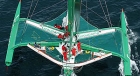
During the Route du Rhum Peyron's new Fujifilm broke up when her weather hull snapped in two between the beams (see top photo), causing the hull to break off and the rig to fall down in the exact same way as happened to Karine Fauconnier. Irens says that when briefing the engineers they were asked to follow the parameters of Peyron's previous boat Fujicolor. However part of the reason for the float breaking aside from the extreme conditions was because of a change in the design when they moved the capshroud chainplate from the float between the two beams to the aft beam. "The fact that it is now on the aft beam means that unless you know otherwise, it is legitamate to take out the structure that was there to support that capshroud," he says. Without this structure the centre of the float broke failed due to wave impact.
Another argument is that in being increasingly optimised for Grand Prix the 60ft trimarans are now less suitable for shorthanded ocean races. Irens feels that there should be more concentration on shorthanded offshore races, but because this is what people are interested in. "I think the Route du Rhum has proven once again that public taste is for ocean sailing and not so much for regatta sailing. So I think everything has to be done so that regatta sailing does not take centre stage. There’s been a lot of talk that the boats have been developed for regatta sailing and not for ocean racing. I would only say that in certain aspects of their appendages that’s true but I think that if someone said to me would you have build Fuji any differently for ocean sailing only I think the answer is ‘no’. Indeed they are very proud of their cockpit on Fuji and they feel it is equally successful for offshore sailing as it is for inshore sailing."
Between the designers there is a feeling that they should work more closely to pool knowledge about the complex structures of these boats. At a meeting yesterday they studied the configuration of the different boats and it became evident that the ones that experienced crossbeam fairing breakage were the ones without internal bulkheads in this area. Simple enough, you might think, but van Peteghem/Prevost, the designers whose boats suffered most from this have sent countless trimarans across the oceans without bulkheads in the fairings and prior to the Route du Rhum this had not appeared to be a problem.
The designers are campaigning to get ORMA, the class association, and the teams to fund a commission to study the structures of these boats. "We will ask to pool our knowledge into a commission that will be directed by someone like Bureau Veritas who can analyse all the breakages independently," says Marc Lombard. "And then out of this we, together with the skippers and owners/sponsors and maybe with the insurance companies, will decide the limits on where to go and we would like to put recommendations into the ORMA rules about what should be done".
Whatever the class come up with - they need to do it sharpish, because Franck Cammas is waiting to have a new Groupama built and there are many others waiting to be rebuilt. Lombard thinks it likely that teams will err on the cautious side for their repairs and this will give them some breathing space to get the commission established and to start carrying out tests.
Interestingly some of the boats have had load cells fitted, but the data from this at present remains within the teams. However Marc Lombard says that it is unlikely to show very much because none of the teams have the budget to get the right data and to analyse it properly, as might an America's Cup team. He hopes that such a commission will rectify this.
Perhaps one of the most remarkable things about this - aside from no one being killed or seriously injured - is that there were 18 boats in the Route du Rhum and 15 retirements and yet at present there is no word on the street about any of the sponsors or teams pulling out. Good on them...
Most Read
Most Commented
Comments
Businesses

Pro businesses
Editor's choice
Member blogs
-
 Ned Collier Wakefield: MOD70 round BarbadosWell that was intense. 12 hard fought for seconds for the win. In idyllic conditions, Tony Lawsons MOD ...
 -
 Mini Transat leg 2 reportThe second leg of the Mini Transat started on 31st October, just over a month after ...
 -
Leg 1 reportI’ve been working towards the Mini Transat now for three years. In 2013 I was part ...
Business blogs
-
 The Island Sailing Club in Cowes, Isle of Wight, is delighted that Prince Michael of Kent ...
 -
Peta Stuart-Hunt chats with the 25 year-old British solo sailor Lizzy Foreman before she sets sail ...
-
The 2015 Student Yachting World Cup (SYWoC), an ISAF-recognised event hosted and run by students for ...
Editor's Choice
All time favourites...
-
 Three legs down into Ian Walker’s
 -
 Winning all but two races at
 -
 For the first time in its
Latest Comments
Add a comment - Members log in