
Exhausted - elated
Sunday December 1st 2002, Author: James Boyd, Location: Transoceanic
"And then we got into the long awaited Trade Winds," she continues. "And I’ve never had such a shitty time in the trades. I’ve never seen such really massive squall activity. It’s not like the Doldrums, it’s smaller than that - but these are pretty big engines. Normally your Trade Wind squalls – you can see them, you can gybe out of the way, you can sail around them. These ones were just horizon to horizon jobs, and there was just no way round them. And it was just a constant pressure. If you put more sail up and you need to go to sleep – what happens if you oversleep, which is something that started happening to me? You can’t really risk it.
"I can easily see how Steve Ravussin [the skipper of the trimaran Technomarine which capsized while in first place] overturned in one. You’d be there in very little wind. You’d get sucked in slowly always on port tack and then suddenly there’d be this massive downdraft from it blowing 35+ knots. If you can bear away in time – excellent. If you can’t you’re in all sorts of trouble. And your boat is not going to bear away under full main and genniker on its ears in that amount of breeze. And okay you can sit through it but it’s not very good for the boat or the mast."
She says she got used to this, but there was the constant dilemma between keeping sail up when she slept with the risk of a squall hitting or reducing sail and living with going slowly, but safely. "I mean you’ve got to cross the finish line to finish the race. And I think that’s what I don’t know. I don’t know where the balance is on my own between pushing the boat and calming it down."
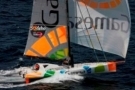
It was during one night about a week from the finish that Merron had the biggest shock of her life when after gybing she put the runner on and cranked it up bar tight only to find sometime later that it was hooked around UUDS's full width spreaders. "I scared myself shitless when I thought I was going to bring the rig down by getting the runner the wrong side of the rig and it took me a couple of days to get over that and I was very careful after that," she says - bearing in mind it was only a few months ago that she experienced a dismasting on board Amer Sports Too while crossing the north Atlantic in the opposite direction.
"I got caught out in a very big squall the next night with the genniker up and I was quite surprised that I didn’t lose the genniker or anything else. So it made my night time sailing much more conservative and I think it should be the other way round – I think maybe I should be sleeping more during the day and working more at night rather than the other way round. Because at night you need to be a lot more vigilant - if you aren’t prepared to be vigilant then you have to reduce sail and make it safe which is quite nice because you get to sleep! But the point is that during the day you also have to be vigilant, but it is a lot easier to wake up and be able to look at the sky around you and you can see straight away what is going on. Whereas at night it is a lot harder, especially because the moon has been rising later and later all week – so long hours of darkness. I’m wondering whether that’s a different way of approaching it.
"But hey, I don’t know," she admits. "My entire solo career has happened in the last few months: Seven nights at sea during my qualifier and 21 nights at sea during this race. So, I’m quite new to the game still."
Continued on page 4...

Most Read
Most Commented
Comments
Businesses
Pro businesses
-
-
Netherlands
-
United Kingdom
-
France
Editor's choice
Member blogs
-
 Ned Collier Wakefield: MOD70 round BarbadosWell that was intense. 12 hard fought for seconds for the win. In idyllic conditions, Tony Lawsons MOD ...
 -
 Mini Transat leg 2 reportThe second leg of the Mini Transat started on 31st October, just over a month after ...
 -
Leg 1 reportI’ve been working towards the Mini Transat now for three years. In 2013 I was part ...
Business blogs
-
 The Island Sailing Club in Cowes, Isle of Wight, is delighted that Prince Michael of Kent ...
 -
Peta Stuart-Hunt chats with the 25 year-old British solo sailor Lizzy Foreman before she sets sail ...
-
The 2015 Student Yachting World Cup (SYWoC), an ISAF-recognised event hosted and run by students for ...
Editor's Choice
All time favourites...
-
 Three legs down into Ian Walker’s
 -
 Winning all but two races at
 -
 For the first time in its
Latest Comments
Add a comment - Members log in