

"The back of the float jumped on the boat when the mast fell"
Wednesday November 20th 2002, Author: James Boyd, Location: Transoceanic
Of the 18 skippers taking part in the trimaran division of the Route du Rhum, Karine Fauconnier, 30, was the lone woman.
On Friday morning last Karine's trimaran Sergio Tacchini was midway between Spain and the Azores among the more southerly boats.
"I was in 40 knots," Karine recalled when she spoke to The Daily Sail from Madeira. "With Alain Gautier even more south. I went through the first gale and I was having 35-40 knots with a big, big swell coming from the north-northwest. So I put up the storm jib and the mast to be very cool and get through the gale. The wind was on the beam, 90degrees. So the first 36 hours with the storm sail only was quite good – it was easy and I was saying to myself that maybe I was a little bit underpowered, because I think it would have made it [with more sail].
She felt safe in those circumstances. "It was okay, because I didn’t have to steer. Nothing could happen with the storm sail. I was sleeping alright. After I had 24 hours left and I had to take a good rest because I had three battens in the mainsail to repair. So I had to get all my energy back to do that. So I was resting and doing lots of sleep and in the early morning I heard a big noise. I looked through the window and there was a hole in the float."
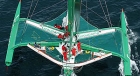
After this events turned rotten very quickly. The weather float had broken in the middle between the beams. Karine estimates it took 5 seconds for the force of the rig on the shroud to break the aft starboard beam bringing the aft part of the float careering towards her as the mast toppled over the side.
"There was a big hole in the middle and the back of the float just jumped on the boat when the mast fell – maybe 5 seconds after. So the float came on the boat and the mast went downwind the other side. So it was a disaster right away. I was just totally destroyed."
The breakage in the float occurred 2m behind the front beam and from Karine's description it sounds like the hull sheared completely.
"So I went outside. The mast was in three parts – one on the boat and two floating outside. The boat gybed because the mast was pulling the boat round. So I had this little bit of float – the front bit of the float in the water, but it was making a huge cracking noise on the beam."
"So I had the whole rear of the float on the boat and the mast in the water. I cut everything off the mast so it went away after maybe one hour of work."
To recap the situation at this stage was the mast was in the water, having broken the aft starboard beam and towed the aft end of the starboard hull up on deck after it. The boat had gybed so the boat was being kept upright by the damaged bow. With a big sea still running the mast was moving around a lot.
Karine says that at this point she was very worried that the boat would capsize completely. "First when I was cutting the mast away I heard the cracking of the float. The mast was like a floating anchor and it was helping me stay in position and I was thinking that if I cut the mast and it went away I would have no floating anchor left and maybe the little float [the starboard bow] will break at the same time and I will capsize and I will be outside. So I was hurrying to cut the mast away quickly and gybe again."
Karine rapidly chopped away the rig and gybed. Even some this manoeuvre was extraordinary. "When I gybed again to be sitting on my good float, I didn’t have time to attach the float was on the boat and it started to move and it was crazy. It was moving up on top of my head on the cockpit – it was crazy. I have no words to explain it. After I cut the hydraulic pipe, the cable from the steering and everything that attached the float and maybe a few hours later I got rid of it."
Come Saturday, 24 hours later, Sergio Tacchini became a full proa. "The front of the float broke and it went in the main hull, so I had to cut all the trampoline. And the foil broke. But it made two holes in the main hull. It was quite violent, because the sea was still very big. So I got rid of the forward part of the float."
All this time Karine says there were many cargo ships in the area and she was worred she might be mown down. Fortunately her Active Echo, radar beacon was working as was her electricity and engine.
When the forward segment of the starboard outrigger collided with the hull it holed it and rapidly 4-5 tonnes flooded into the aft compartment. "I saw maybe 4 or 5 tonnes of water in the back of the main hull, because of the holes the float made, so I had to put all of the water away. It took me a few hours. I went diving in there and found the hole and repaired it and the next morning."
Continued on page 2...

Most Read
Most Commented
Comments
Businesses

Pro businesses
-
-
Italy
-
Netherlands
-
United Kingdom
Editor's choice
Member blogs
-
 Ned Collier Wakefield: MOD70 round BarbadosWell that was intense. 12 hard fought for seconds for the win. In idyllic conditions, Tony Lawsons MOD ...
 -
 Mini Transat leg 2 reportThe second leg of the Mini Transat started on 31st October, just over a month after ...
 -
Leg 1 reportI’ve been working towards the Mini Transat now for three years. In 2013 I was part ...
Business blogs
-
 The Island Sailing Club in Cowes, Isle of Wight, is delighted that Prince Michael of Kent ...
 -
Peta Stuart-Hunt chats with the 25 year-old British solo sailor Lizzy Foreman before she sets sail ...
-
The 2015 Student Yachting World Cup (SYWoC), an ISAF-recognised event hosted and run by students for ...
Editor's Choice
All time favourites...
-
 Three legs down into Ian Walker’s
 -
 Winning all but two races at
 -
 For the first time in its
Latest Comments
Add a comment - Members log in