
No risk no gain
Monday November 18th 2002, Author: James Boyd, Location: Transoceanic
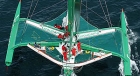
 Transat Jacques Vabre winner, one of France's most capped trimaran skippers despite his tender 29 years, the youngest trimaran skipper in the Route du Rhum, Franck Cammas was one of The Daily Sail's race favourites for line honours. However disaster struck when at 1930 GMT on the first night at sea, his trimaran
Groupama capsized.
Transat Jacques Vabre winner, one of France's most capped trimaran skippers despite his tender 29 years, the youngest trimaran skipper in the Route du Rhum, Franck Cammas was one of The Daily Sail's race favourites for line honours. However disaster struck when at 1930 GMT on the first night at sea, his trimaran
Groupama capsized.
"We were sailing in 17 knots of wind under one reef and staysail," Cammas told The Daily Sail. "I didn’t have a great deal of sail up. Before the capsize, we weren't sailing on one hull."
At the time Cammas was outside in the cockpit, crouched behind the canopy. When the boat nosedived Cammas lunged for the traveller, but was too late and before he knew it found himself dangling from the traveller with the boat slowly inverting as her mast snapped.
The situation was scary for Cammas - his capsized tri at the time was close to the shipping lanes to the north of Roscoff and it was night time. So it was by some massive ill fortune or good fate - depending upon which way you look at it - that it was not a ship that ran into Groupama, but a fellow 60ft trimaran in the form of Jean le Cam's Bonduelle, which wiped out Groupama's starboard bow through a collision.
Cammas remained with the boat - or risk losing it to a salvage claim - and the next morning his shorecrew arrived to mount the rescue operation. Their first job was to cut away the rig and then to stablise the starboard hull to try and prevent more water coming in. She was then towed into Roscoff where later that day she was righted.
Cammas says that in the case of him and Francis Joyon, they were simply unlucky as they capsized in relatively light conditions. "The conditions were not strong - there wasn't a lot of wind and I wasn't pushing the boat very hard," he recalls. "Unfortuately there were gusts and we are not always steering when they hit, so we can’t react very fast."
By contrast the capsizes of Philippe Monnet's Sopra Group and of Yvan Bourgnon's Rexona Men both happened in very very strong conditions that were enough to overwhelm a ship off Portugal at the same time. "Usually we don’t sail in these conditions," explains Cammas. "These boats are not made and built to sail in those conditions. The whole depression was not exceptional, but locally there were some strong winds."
Cammas dispels the myth that the new generation of trimarans are more lightly built than the old ones. However he says they are more 'reactive' - ie if a gust hits they will power up and accelerate faster than they used to.
Continued on page 2...


Most Read
Most Commented
Comments
Businesses

Pro businesses
-
United Kingdom
-
-
United Kingdom
-
Editor's choice
Member blogs
-
 Ned Collier Wakefield: MOD70 round BarbadosWell that was intense. 12 hard fought for seconds for the win. In idyllic conditions, Tony Lawsons MOD ...
 -
 Mini Transat leg 2 reportThe second leg of the Mini Transat started on 31st October, just over a month after ...
 -
Leg 1 reportI’ve been working towards the Mini Transat now for three years. In 2013 I was part ...
Business blogs
-
 The Island Sailing Club in Cowes, Isle of Wight, is delighted that Prince Michael of Kent ...
 -
Peta Stuart-Hunt chats with the 25 year-old British solo sailor Lizzy Foreman before she sets sail ...
-
The 2015 Student Yachting World Cup (SYWoC), an ISAF-recognised event hosted and run by students for ...
Editor's Choice
All time favourites...
-
 Three legs down into Ian Walker’s
 -
 Winning all but two races at
 -
 For the first time in its
Latest Comments
Add a comment - Members log in