
Geant's secret rudder
Friday July 19th 2002, Author: James Boyd, Location: France
We have all seen the dramatic photos of the experimental French foiler
L'Hydroptere - she has recently been moored in Southampton's Ocean Village on standby to make a record attempt.
Not to be outdone as the fastest most extreme ocean racers afloat, the 60ft trimaran teams have been spending many hours developing their foil technology over the last months. Most of the modern tris now have curved foils in their floats that are retractible (to prevent drag in light conditions) and have unusual hooks and spades in their tips.
The previous generation of foils were enough to prevent the leeward float from digging in. It was interesting to witness how cleanly the new tris went through the water at the start of the Transat Jacques Vabre last year, compared to the older ones which would send plumbs of spray flying back from the leeward bow - more dramatic, but less efficient.
The latest generation of foils has proved so effective that at certain speeds the 60ft tris are now beginning to lift their leeward floats clear of the water - like L'Hydroptere. This was witnessed at the Zeebrugge trimaran grand prix at the weekend where for the first time air could be seen beneath Groupama's leeward float. On the reaching dog legs she was hitting speeds of up to 37 knots in 20-25 knots of breeze.
So the 60ft tris are now on the verge of becoming fully airborne with all three hulls out of the water and therefore they have less drag and should go ever faster - in short a significant technological advance for the class. But there are some downsides.
"Now there is a problem of balance," confirms Marc van Peteghem one half of the design team that created both Groupama and Michel Desjoyeaux's new Geantand was involved with the design of L'Hydroptere. Riding along effectively just on one foil makes the boat highly unstable fore and aft. Groupama's leeward float was airborne, but it caused her to sit back awkwardly onto the transom of her float.
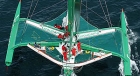
So the French trimaran teams have been looking closely at L'Hydroptere and other foilers to see what to do about this problem. Desjoyeaux was also part of the L'Hydroptere team and the results of this can be seen clearly in this photo below of his new 60ft tri Geant.
While the rudders in the floats are conventional spades, the one in the mainhull is transom hung and lifting. Nothing new there. However look closely and you will see some extra apparatus: a T-foil at the bottom of the rudder and a hydraulic ram to alter its angle of attack. The idea is that in conditions when the tri becomes airborne, the rudder T-foil can be trimmed to keep the boat stable fore and aft. The ram can alter the angle of incidence of the rudder T-foil by +/- 5 degrees, although van Peteghem feels it will not be used by this amount.
"The problem is to achieve stable motion," he says. "You can adjust the incidence of the whole platform using the main foils if you play with the trim of the rudder. Also it allows you to be safer - in the Route du Rhum, being solo you could put a lot of incidence on main foil to be safer. In fact it works exactly like on a plane where you play with the incidence of the tailflaps the same way."
Van Peteghem says that another key part of the equation to get the trimarans fully airborne is the athwartships canting of the masts. "The more angle you get the mast to windward, the more you gain. It was really significant - we should try to go as far as we can with this." Most of the masts in the trimaran fleet can be canted to weather by up to 10degrees, although some can go up to 12 degrees. The trade off is that it is necessary to have a longer (and therefore heavier) ram. However van Peteghem says that at present a more significant handling problem exists with the canting rigs.
While most of the tris have to drop their rigs down to leeward prior to making a tack, on Fujifilm they are able to go through the tack and then crank the mast up to weather, which means they are much faster through manoeuvres. This he feels is one of the reasons why Loick Peyron's tri cleaned up the grand prix at the weekend.
Although foilers traditionally don't perform as well in a seaway van Peteghem can't see the reason for this. "The water was quite choppy in Zeebrugge, so foilers are not especially for calm water. There is no reason they won't work in choppy seas."
At present van Peteghem says the speed gain on Groupama is perhaps only 1-2 knots, because the transom drags in the water, but he believes that when they have solved the stability problem of the boats when they are airborne, achieving speeds of 40+ knots in the 60ft trimarans is not just a possibility, but a certainty.
See more of Thierry Martinez's first sailing shots of Geant on the following pages...
Check out Geant 's new rudder system...

Most Read
Most Commented
Comments
Businesses

Pro businesses
-
United Kingdom
-
United Kingdom
-
Italy
-
Netherlands
Editor's choice
Member blogs
-
 Ned Collier Wakefield: MOD70 round BarbadosWell that was intense. 12 hard fought for seconds for the win. In idyllic conditions, Tony Lawsons MOD ...
 -
 Mini Transat leg 2 reportThe second leg of the Mini Transat started on 31st October, just over a month after ...
 -
Leg 1 reportI’ve been working towards the Mini Transat now for three years. In 2013 I was part ...
Business blogs
-
 The Island Sailing Club in Cowes, Isle of Wight, is delighted that Prince Michael of Kent ...
 -
Peta Stuart-Hunt chats with the 25 year-old British solo sailor Lizzy Foreman before she sets sail ...
-
The 2015 Student Yachting World Cup (SYWoC), an ISAF-recognised event hosted and run by students for ...
Editor's Choice
All time favourites...
-
 Three legs down into Ian Walker’s
 -
 Winning all but two races at
 -
 For the first time in its
Latest Comments
Add a comment - Members log in