
60ft tris start their engines
Monday September 9th 2002, Author: James Boyd, Location: Transoceanic
Flying
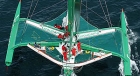
As madforsailing reported recently, the boats are now beginning to fly their LEEWARD floats thanks to improvements in the retractible foils in their floats.
This in turn has dramatically altered the load characteristics on the trimaran's beams i4n particular where they connect to the floats. This has led to another batch of structural problems. So far both Banque Populaire and the new Gitana X have suffered structural damage because of this. "It's like a nut cracker," explains designer Nigel Irens. "Because the lifting component is quite well inboard it's just like closing a pair of pliers. There's huge forces at the outboard end of the foil."
Despite the fitting of the gate to the bottom of Geant's rudder it is still early days in the evolution that will see the 60ft trimarans become full-on foilers like the radical L'Hydroptere. "It's exciting but you run out of pitch control eventually," comments Irens on this latest evolution. "You can go from having lots of lift at very high speed, but if you go over the hump and go bows down suddenly you've got no lift and everything goes the other way. Potentially it's rather dangerous, so everyone's feeling their way into this area."
Vincent Lauriot Prevost thinks that some of the structural problems are occurring simply because the foils are enabling the boats to be sailed faster - today 60ft tris are quite capable of topping 36 knots on a reach. "We know these foils are more powerful than the older ones. And with a more powerful boat, you are able to sail faster in more choppy conditions than before. That increases the effort. It is not the foils by themselves that give some extra loads, but the way of sailing the boats using these more powerful foils," he says.
Also the structural characteristics of the boats have changed: "I think we are maybe in a new age in the way these boats behave and we have to make some work about all these things," says Lauriot Prevost. "We know that on these new platforms, we have bigger effort than the others - that has been taken into account. But we have increased the stiffness of the hull, of the platform, of the mast of the sails, of the ropes and we may have increased some dynamic loads too. It is quite complicated."
The new generation of boats are universally heavier too. "It is true that today the new generation of boats are not as light as the old generation, because the boats are lighter in their general structure, but you have got some extra fittings, which weigh quite a lot, with bigger [hydraulic] rams, more hydraulics, bigger centreboards, bigger foils and so on and then you add a more complicated deck layout - all these factors put in extra weight into the structure," says Lauriot Prevost. "But it is true with the new generation of boats we have taken into account the extra loads due to the extra stiffness. For example forestay tension had a design load at 9 tonnes in 1998, going up to 13.5 with the new generation."
One of the solutions is simply paying more attention to the loads involved. Michel Desjoyeaux for example is fitting load sensors to Geant to find out more about the structure. "Mich is having strain guages in the hulls and the beams and the foils and the centerboard to be able to know more about these boats and the foils programme to be able to optimise the boats for the future. I know he is doing that. I think other boats are in the same way."
Continued on page 3...
Diagram showing modifications made to Gitana X's cross beams

Most Read
Most Commented
Comments
Businesses

Pro businesses
-
Italy
-
-
United Kingdom
-
Italy
Editor's choice
Member blogs
-
 Ned Collier Wakefield: MOD70 round BarbadosWell that was intense. 12 hard fought for seconds for the win. In idyllic conditions, Tony Lawsons MOD ...
 -
 Mini Transat leg 2 reportThe second leg of the Mini Transat started on 31st October, just over a month after ...
 -
Leg 1 reportI’ve been working towards the Mini Transat now for three years. In 2013 I was part ...
Business blogs
-
 The Island Sailing Club in Cowes, Isle of Wight, is delighted that Prince Michael of Kent ...
 -
Peta Stuart-Hunt chats with the 25 year-old British solo sailor Lizzy Foreman before she sets sail ...
-
The 2015 Student Yachting World Cup (SYWoC), an ISAF-recognised event hosted and run by students for ...
Editor's Choice
All time favourites...
-
 Three legs down into Ian Walker’s
 -
 Winning all but two races at
 -
 For the first time in its
Latest Comments
Add a comment - Members log in