
Cape Town bound
Monday October 14th 2002, Author: James Boyd, Location: United Kingdom
It may have been blowing dogs off chains yesterday here in Brixham, but today for the departure of Around Alone's second leg down the Atlantic to Cape Town, the conditions were bright, autumnal and bitingly cold thanks to the moderate northerly breeze blowing.
There were mixed feelings of relief and frustration yesterday when Sir Robin Knox-Johnston and the race committee decided to postpone the start. Unquestionably starting a singlehanded offshore race on a leeshore with 40+ knots blowing would have been irresponsible, but for several of the skippers there was a day spent twiddling thumbs and looking at watches.
For others however the 24 hour delay could not have been more welcome. In nearby Dart Haven Marina, Japanese entry Kojiro Shiraishi was applying the finishing touches to the repair of his keelbolts. This morning Californian competitor Bruce Schwab had fitted the repaired boom for his boat's unstayed rig, but was not in a postion to start and is currently still at the dock.
After much stamping of feet due to skippers Bernard Stamm and Simone Bianchetti being late down to their respective boats, the boats were late getting out of the marina, and then spent more than an hour mosying around the bay between Brixham harbour and Torquay as shore crews helped hoist mainsails, spouses bade their tearful farewells and spectators gathered along the Brixham breakwater and out on the water.
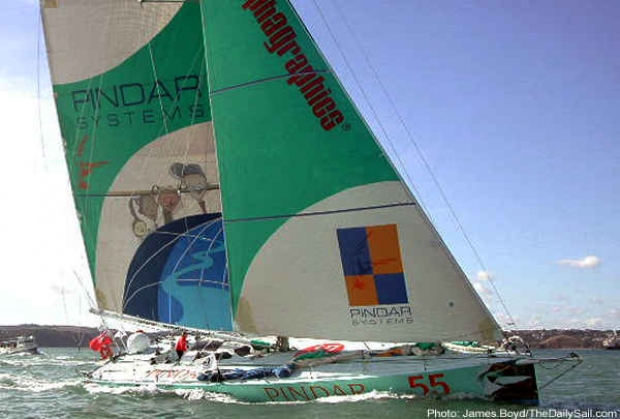
1200 saw the gun go and the boats taking a leisurely start. Once again it was the former Mountie Derek Hatfield, who was the sole competitor to hit the start line at a gallop and, repeating his performance in New York on leg one, was early leader aboard his class two yacht Spirit of Canada. The Open 60s were slower to wind up but within a minute of the gun Bobst Group/Armor Lux and Solidaires were up to speed and reeling in Hatfield.
For spectator appeal, the boats had to round a mark off Torquay before heading out to sea. They lumbered across the bay on port, and a majority of the boats (due to the relatively poor windward ability of these Open class boats) had to put a short tack in to lay the mark. However Simone Bianchetti on board the Open 60 Tiscali didn't and gained considerable ground by being able to lay the mark directly. At the mark the first three boats - Bobst Group, Tiscali and Solidaires rounded in unison.
Emma Richards rounded in sixth, but seemed to sling shot around the mark, then overtook Graham Dalton's Hexagon and Spirit of Canada and had soon moved up to second place.
What's in store for them?
Over the next 48 hours the boats will be crossing the Bay of Biscay heading for the Trade Winds. Once into the Trades they will be looking for the best place to cross the Doldrums. Then in the South Atlantic they will again get into the Trades and it will be a case of working out how best to tackle the South Atlantic high pressure system.
Usually this will involve skirting to the west of the high (the direct route to Cape Town is upwind down the easternside of the high) before picking up the westerlies and the first taste of the Southern Ocean for a few days before heading north again to Cape Town. On the approach to the finish there is the real prospect of being becalmed in the lee of Table Mountain. So analysis of the weather and the wind direction at the finish is vital as Mike Golding proved four years ago when he pipped his competition to the post on this leg.
Although this is the likely scenario - there are possible variations. Eight years ago French singlehanded sailor Isabelle Autissier utterly demolished her opposition by sailing directly across the South Atlantic to Cape Town as the high pressure system had conveniently divided in two leaving a corridor down its middle, which closed up in her wake.
However rather like winning the prologue of the Figaro race, winning the leg to Cape Town has in recent years proved to be a jinx - Golding subsequently retired when he ran aground off the northernmost tip of New Zealand. Four years previously Autissier was dismasted, then rerigged and was dismasted once again. Eventually the Royal Australian Navy had to mount a rescue mission deep into the Southern Ocean to pluck her to safety.
Most Read
Most Commented
Comments
Businesses
Pro businesses
-
France
-
France
-
United Kingdom
-
Editor's choice
Member blogs
-
 Ned Collier Wakefield: MOD70 round BarbadosWell that was intense. 12 hard fought for seconds for the win. In idyllic conditions, Tony Lawsons MOD ...
 -
 Mini Transat leg 2 reportThe second leg of the Mini Transat started on 31st October, just over a month after ...
 -
Leg 1 reportI’ve been working towards the Mini Transat now for three years. In 2013 I was part ...
Business blogs
-
 The Island Sailing Club in Cowes, Isle of Wight, is delighted that Prince Michael of Kent ...
 -
Peta Stuart-Hunt chats with the 25 year-old British solo sailor Lizzy Foreman before she sets sail ...
-
The 2015 Student Yachting World Cup (SYWoC), an ISAF-recognised event hosted and run by students for ...
Editor's Choice
All time favourites...
-
 Three legs down into Ian Walker’s
 -
 Winning all but two races at
 -
 For the first time in its
Latest Comments
Add a comment - Members log in