
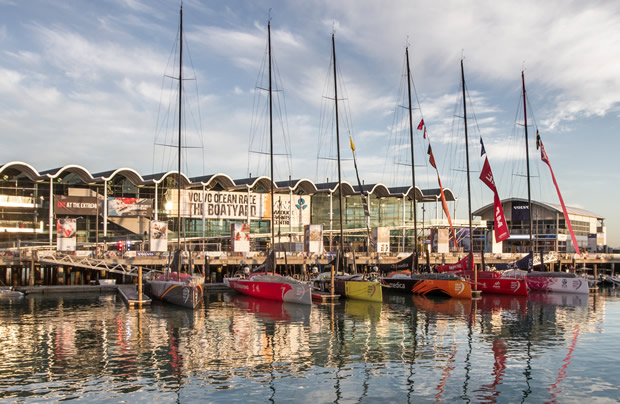
High Performance Yacht Design
The astonishing pace of progress in sailing performance and boat and sail technology was the theme of Burns Fallows’ 'Adapting to Change' keynote presentation today at the opening of the 5th High Performance Yacht Design Conference in Auckland.
The conference for those who make it their business to push the performance boundaries of sailing yachts is organised by the Royal Institute of Naval Architects (RINA) NZ and the University of Auckland
The Head Sail Designer and a Director at North Sails who has headed the sail program at Emirates Team New Zealand for 20 years, Fallow contrasted the incremental change in record times for sports like running and cycling with the explosive growth in sailing performance by small craft and ocean racers.
He was addressing naval architects, engineers, builders, designers and researchers from 15 countries, on hand in the conference room of the Volvo Ocean Race Boatyard for three days of presentations and discussions on the current state of high performance yacht technology.
Fallow offered his own take on Alphonse Karr’s proverb “The more things change, the more they remain the same,” suggesting that when it comes to contemporary boats and technology “The more things change the more they change!”
He cited examples over three or four decades where running sprint records have reduced by 3% and cycling times have lowered by 10%. By comparison, speeds for the 500-metre sailing sprint record have shot up by 81%, and the 24-hour distance record zoomed up 77%.
During the America’s Cup in San Francisco, the Emirates Team New Zealand AC72 foiler hit a blistering 49.987 knots in a brief burst, helped he acknowledged, by a tidal push. That’s 92.57 kilometres an hour (57.52 mph).
“It’s amazing how quickly the extraordinary becomes ordinary,” Fallow said. He remembered the first time the radical new foiler went sailing on the Hauraki Gulf. Six and a half tons of boat popped out of the water and sped foil-borne for 15 minutes. “Our reaction was ‘OK, we’ve done that! What’s the next order of business?’”
Australian John Bertrand who headed his country’s successful 1983 bid for the America’s Cup had sailed with ETNZ in San Francisco. “John said afterwards ‘these guys aren’t sailors, they are test pilots!’”
Noting the progressive change from art to science in boat design and technology, Fallow emphasized that good design practice came as a result of good sailing skills. An example was the way he’d worked with ETNZ jib trimmer Simon Daubney to translate intuitive changes to a precise numerical record.
Looking to the future, and to public interest in sailing, Fallow said the biggest roadblock was cost. America’s Cup campaigns started around $100 million dollars at whatever currency you choose, and on a good day the America’s Cup had attracted 1.5 million viewers. He contrasted that with the recent India vs. Pakistan cricket test match in Adelaide, Australia that chalked up a worldwide audience of one billion.
Competitions like 52 Super Series in Europe and the Volvo Ocean Race were examples of cost containment. Glimmers of hope for the future were China, still a sleeping giant when it came to sailing, the continuing strong interest in one-design sailing and the fact that sailing is a highly aspirational pastime.
“I don’t think the curve has flattened out yet,” Fallow predicted.
Volvo Ocean Race
Ask Volvo Ocean Race CEO Knut Frostad if the absolutely identical one-design Volvo Ocean 65-footers are the right boat for the round-the-world marathon? The answer is an emphatically positive Yes!
With his Race Director Jack Lloyd, Frostad the CEO of the Volvo Ocean Race shared the relatively short history of the new boats at a special open session of the 5th High Performance Yacht Design Conference at the Volvo Ocean Race Village last night.
Veteran Kiwi sailing commentator Peter Montgomery compered the lively panel discussion before a packed crowd that included conference attendees from around the world.
The fleet sets out from Auckland on Sunday in the wake of Cyclone Pam, headed for the seas of the Southern Ocean on their way to Cape Horn and the next race stop in Itajaí, Brazil.
Frostad told how the building tolerances for the special production run of seven Farr-designed boats built in series were just one millimetre. By comparison the one-design tolerances for the popular 4.3-metre International Laser dinghy sailed in Olympic competition is two to three millimetres. All the wiring runs on the VOR65s are exactly the same length.
The impetus to move to one-design came in the wake of the world financial meltdown and following boat breakages and hull failures of boats in the last race designed and built to the Volvo Ocean 70 rule.
“We were not in a pretty place,” the race CEO and veteran VOR skipper recalled. The biggest problem was the escalating cost of campaigning. Meeting with sponsors and skippers the organizers asked what it would take to attract them back to the next race. Every single one said not more than 60 per cent of the costs of the previous race.
Previously, the complexities introduced by a one-off boats built to fit a one-design rule did not sit well with sponsors who didn’t understand the fine points of design and construction. For any boat that didn’t perform well, sponsors would say, “I never ordered a slow boat!” Only a one-design would work.
The situation and the timing required a momentous decision by race organizers to commission and begin building new race boats before teams had committed to competing. The tab was 37 million Euros and the decision was made to take that risk. Meanwhile, skippers when polled were unanimous that they wanted their own designs.
Recalling the VOR 2011-12, Race Director Jack Lloyd said that the then VO 70 design rule used for the third time was proving problematic. After a series of problems and breakages “we were starting to lose confidence in the boat!”
A new boat had to be strong and had to last for two iterations of the race, Lloyd said. So far noted, things were looking good. They wanted more than building a boat at a reasonable price. It had to be a boat that people wanted to sail. They chose manufacturers, products, systems that most teams would probably chose themselves. In all, the boats have 62 suppliers
“We modeled a lot of our thought process on the Laser Class where you can’t do anything. You’re supplied a product and you go sailing.” Even the sails are one-design. No sails have been recut. There have been a few repairs.
There was quite a long session at the French partner Multiplast on a full wooden model of the boat’s deck where crews worked through all the details of winch placement and myriad other details. The shape and size of the cabin house and came from efforts to protect the crew from green water sluicing down the decks. The result is less on-deck water.
With crew safety paramount, Lloyd emphasised that enormous thought and planning had gone into the design and construction of the canting keel mechanism. The collision and subsequent grounding of Team Vestas Wind on a coral reef was testament to the keel’s toughness. After salvage, the ram system was still structurally sound after sitting for three weeks on the reef. They came within an ace of using it in the rebuild of the boat except it suffered some damage during its recovery.
Wings in the America's Cup
A foiling breakthrough was one of the early and critical elements that helped drive Emirates Team New Zealand to near-success at the America’s Cup in San Francisco in 2013.
The Kiwi boat was the first contender for the 34th Cup to achieve stable 100 per cent foiling performance but the defending Oracle Team USA ultimately retained the Auld Mug in a winner-take-all 19th race.
Burns Fallow, part of the four-man ETNZ aerodynamics team responsible for the impressive wing sail, shared the research and design methodology that along with foil design and other work contributed to the race boat’s performance.
Nick Hutchins, Design Director at ETNZ, Steve Collie, Harold Youngren and Fallow comprised the aero team. Fallow presented their paper “Aerodynamic Design Development of AC72 Wings.
The replacement of the traditional mainsail with a wing was expected to be a major aerodynamic design challenge requiring a wide range of new expertise, Fallow said.
“As it turned out the design process involved some new tools and tricks but was largely a refinement of computational approach and methods used in the 32nd America’s Cup.”
Fallow described the range of computational tools and techniques used to develop and validate design decisions for the wing. The main difference, he said, was the increased fidelity and sheer volume of simulations afforded by advanced computational resources.
The aero design team had its first meeting in November 2010 and by April the next year was 70% on its way to the final aerodynamic design. Two identical wings were built for ETNZ’s 33-foot SL33 catamarans in late November and early December.
That project was focused around gaining experience in building wings and for validation of the control system design but also provided opportunities to verify and test many aerodynamic assumptions and choices.
Decisions made in the first two weeks of the program, including a straight leading edge and two wing elements, stayed the whole way though.
Along with the aero work there was a parallel process where the structural team were developing their structural models. Addressing their concerns led to an iterative process as the project went forward. It was “pretty intense,” given that the team was also launching its Camper VO 70 for the Volvo Race, commissioning an AC45 and building its SL33 catamarans for foil and wing sail testing.
Although largely secret until now, the only other team to directly benefit from the ETNZ work was Italy’s Luna Rossa which bought the first Kiwi boat together with blueprints and, in effect, the whole package.
Fallows said that the reason the design process was being shared now was because the wings of the new AC62s will essentially be one-design although there will be variations on individual control systems.
Graeme Finch, Chairman of HPYD5 noted that delegates were surprised to discover they were receiving the same presentation that was made to Italy’s Luna Rossa, when ETNZ transferred the boat and technology to the Italian Syndicate. “This is unprecedented at a technical conference, and certainly one of the highlights this week," he said.
New Zealand Trade and Enterprise is the principle conference sponsor. Gold sponsors include North Sails, Southern Spars, Callaghan Innovation, the Volvo Ocean Race and Auckland Tourism, Events and Economic Development.
Businesses
Pro businesses
-
-
United Kingdom
-
United Kingdom
-
Editor's choice
Member blogs
-
 Ned Collier Wakefield: MOD70 round BarbadosWell that was intense. 12 hard fought for seconds for the win. In idyllic conditions, Tony Lawsons MOD ...
 -
 Mini Transat leg 2 reportThe second leg of the Mini Transat started on 31st October, just over a month after ...
 -
Leg 1 reportI’ve been working towards the Mini Transat now for three years. In 2013 I was part ...
Business blogs
-
 The Island Sailing Club in Cowes, Isle of Wight, is delighted that Prince Michael of Kent ...
 -
Peta Stuart-Hunt chats with the 25 year-old British solo sailor Lizzy Foreman before she sets sail ...
-
The 2015 Student Yachting World Cup (SYWoC), an ISAF-recognised event hosted and run by students for ...
Editor's Choice
-
 Three legs down into Ian Walker’s
 -
 Winning all but two races at
 -
 For the first time in its
Latest Comments
Add a comment - Members log in