
An even faster Full Pelt
Tuesday November 25th 2003, Author: James Boyd, Location: United Kingdom
 Among the owners of race boats there is a wide diversity of tastes, from those who prefer racing offshore to those who prefer inshore in all manner of boats in all manner of places. One of the more eclectic is Stephen Fein, whose long association with skipper/designer Jo Richards has seen him through a series of
Full Pelts including a Sardinia Cup winning One tonner to a Formula 40 trimaran, a Formula 28 catamaran and an Open-style 36ft monohull alongside more conventional race boats such as a Swan 48, three Etchells and most recently a 1720.
Among the owners of race boats there is a wide diversity of tastes, from those who prefer racing offshore to those who prefer inshore in all manner of boats in all manner of places. One of the more eclectic is Stephen Fein, whose long association with skipper/designer Jo Richards has seen him through a series of
Full Pelts including a Sardinia Cup winning One tonner to a Formula 40 trimaran, a Formula 28 catamaran and an Open-style 36ft monohull alongside more conventional race boats such as a Swan 48, three Etchells and most recently a 1720.
The program they have enjoyed in recent years on board their 36ft flier has combined racing in the UK at events such as Skandia Cowes Week and Cork alongside the main events on the Swiss and Italian lakes such as the Bol d'Or and Centomiglia.
Of particular pleasure to the free-thinking Richards is that when racing on the lakes you don't need a boat designed to a rule. "Years ago we decided there wasn’t a rule for racing decent racing boats so we thought we might as well go and have some fun in something that is quick," Richards explains. "And actually the world hasn’t really sorted itself out. There are some lovely boats around, but they are still far heavier than they need to be to go racing in."
The current Full Pelt is nine years old now and Richards has been getting itchy feet to create a replacement. As with the old boat the design constraints are practical ones. "The ability to be able to tow it around Europe and the whole crew get in one car to go to a restaurant without it being a total drama is where we are at. Having played with the Swan 48, it is a complete drama if you have a crew of 14-15 and all the hangers on."
If the last Full Pelt was radical then the new one will be more so says Richards. "Basically we have got a quick little boat at the moment over a wide range of conditions but we are never going to live with bigger boats uphill. We can live with 60 or 70 footers downhill. So we want something that will plane upwind..."
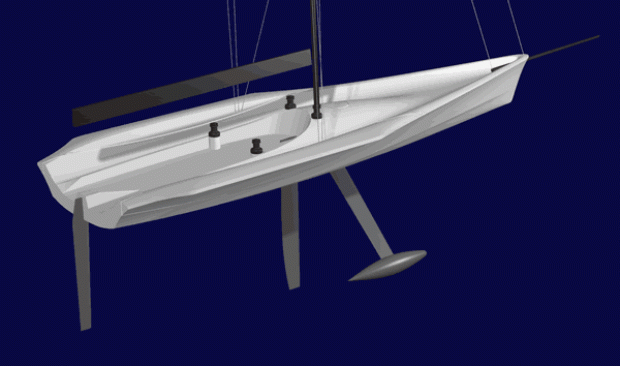
With the old boat has now been sold to three brothers who intend to continue racing here on the lakes Richards is now beavering away in Cowes on his latest creation. "Broadly speaking - if you can imagine a 49er but twice the size, with slightly smaller blended in wings and a swing keel..." describes Richards, adding that unlike a 49er the boat still has a bit of a coach roof on it.
Like the previous boat the new one is 36ft long, any bigger and it becomes tricky to tow it around Europe behind an ordinary car.
While the old boat had a rounded deck the new boat is very much more skiff-like in its shape. Richards' approach with the new boat is to go minimalist and as light as possible. He says he would be happy if she weighed in at 1500kg, roughly 200kg less than the old boat, but with 200kg more packed on to the bulb bringing it up to around the 800kg mark.
A fundamental difference to the old boat is that the new one will have a canting keel. Richards has considered a block and tackle system for cranking the keel, but believes that this system offers more possibility for operator error and with the need for two extra winches and strengthening in the hull, a hydraulic set-up is unlikely to be much heavier.
While a majority of the Open 60s use two rams, the new Full Pelt will use only one. "That is one of the silly things that has crept into yachting," says Richards. "The new Mari Cha has a single ram. The aircraft industry don’t even bother with two rams. You just don’t need two."
Also different to an Open 60 is that because the boat does not have to conform to a stability rule the keel can be canted by up to 55 degrees. However Richards points out a possible downside to this. "Because we are able to cant the keel more than normal, you can get into the potential scenario that if you are doing 25 knots and you have got 20 degrees of heel, then your keel is only 20 degrees off horizontal and if you get 3 degrees of bow up it can start generating lift." In other words the keel foil could start to work like a wing and helping the boat to invert. "So we may fit a trim tab to the keel in order to suck it back down again when reaching in a breeze, otherwise the keel could overcome the weight of the bulb and you could suddenly run out of right moment..."
Also unusual is the configuration of the foils. Because of the canting keel it is necessary to have another foil to provide lateral resistance and Richards, for reasons of simplicity and weight, has chosen a single up and down symmetric daggerboard instead of the twin asymmetric boards favoured on Open 60s. Unusually both this and mast are mounted aft of the keel.
"When you swing a canting keel up to windward then the drag from the keel is off the centreline of the boat, so it is giving you weather helm," Richards explains - imagine sticking an oar in the water on the weather side. "If you put your lifting surfaces in front of the keel in the conventional swing keel set-up and then swing the keel out you are shifting your centre of lateral resistant forwards which is giving you even more weather helm - which struck me as rather daft."
Thus the swing keel is at the mid-length point of the boat with the mast just aft of it and the daggerboard further back its top exiting through the cockpit sole. "It means that when you swing the keel out, hopefully the thing will stay in a balanced scenario and we won’t have tracking issues and those sort of ho-has," says Richards.
The rudder is transom-hung to keep it a reasonable distance from the other foils. "It is a boat we are going to sail virtually upright so it shouldn’t do any harm," says Richards.
Rig
The general concept of the new boat's rig is similar to that of the old one with swept back spreaders but with lightweight PBO rigging and a slightly longer topmast to give more 'gust response'. "The spreaders will be like a 49er to hold the topmast when you’re going downhill, mainly because we don’t want to get involved with runners or backstays going downhill on breezy days," explains Richards.
To save weight they are looking to carry the bear minimum of sails - possibly just four. Headsails will include a fully battened fractional no3 and a loose-luffed masthead no1 flown from the bow. Richards reckons that lowering the swing keel should shunt the centre of lateral resistance forward to help balance the boat under that sail.
The boat has a retractible bowsprit but at 2.2m in length it is not as ridiculously long as that of a Mini. "If you make it too long you end up with a) big lee helm problems going down hill and you have to put another appendage in to deal with that and b) the weight of the thing goes rocketing up, because as you go longer it has to be so much stronger." The bowsprit will remain a similar length to the previous Full Pelt and on that boat Richards says it was strong and stiff enough so that when racing on Lake Geneva they could tack a jib on the end of it.
In terms of dimensions the rig is 16m tall, the same height as the old boat, with 5m on the foot of the main. With the mast so far aft the foretriangle will be relatively big with a J measurement of around 5.8m plus a bit of overlap.
Hull shape
The overall look of the hull is very different from the old boat. While the old Full Pelt had a rounded deck and topsides the new boat is much more dart-shaped and half way to being 49er-like. Overall beam is less at 3.75m compared to 4m and the widest and highest point of the boat will be the wings
Below the water Richards says the hull shape is also narrower, quite dished but not that flat bottomed. "Having made the premise that we are sailing a big dinghy, we will sail it upright rather than letting it lean over because there is nothing to be gained by leaning over more than 10degs with the swing keel."
Part of the reason for the reduction in beam is for trailing it around Europe. The previous Full Pelt had to go on its trailer at an angle. At 3.75m the new boat can lay flat while still be legal to tow and making it substantially easier to launch and retrieve.
In the UK they will have to race with lifelines, but on the lakes Richards says they are more likely to sail with a 1720-type towel rail, just high enough to put your legs underneath. If they are looking for added stability and entertainment in the future they make consider adding trapezes. Although impressed by the Libera class boats on Lake Garda and the handful of other new designs on Lake Geneva which not only have canting keels and water ballast, but have racks and trapezes too, having all of this seems overly complicated says Richards. "We are trying to be brutally simple - we’re trying to get away racing with two jibs and one spinnaker just to keep the weight down. As soon as you say we’re only going to take one spinnaker you don’t need to change sheets or double blocks."
With less sails and a lighter weight boat it is likely that they will sail with six rather than seven crew.
Creation
As a yacht designer Richards is not of the modern school that will spend months working on the development of a model inside a CAD program and then pumping it out a set of drawings for some anonymous boat builder to complete.
For Richards the design and build process are heavily interlinked. "I am a great believer in getting to two thirds of the way through building the thing, then you weight it and then you decide what weight of bulb you’re going to put on," says Richards as an example of his approach. "You can get very technical, but that takes a lot of time. Or you can build the things as well as you can and then evolve them. This evolves while we are doing it."
As with the other Full Pelts they have built Richards is integral to the build process which with the new boat is taking place in part of Nigel Harley's shed in Cowes, with a build team led, as with the previous Full Pelts, by Paul Jennings. The new Full Pelt will be the first of what it is hoped will become a more permanent custom race boat build facility led by Jennings.
In fact Richards' involvement extends beyond the build of the hull. The spars they will build themselves while the sails will be made by Graham Deegan, a long term member of their team.
Richards admits that on this occasion he has handed over the drawings to fellow designer Christian Stimson to create some drawings from which it will be easier for them to build the frames accurately.
At present the plug is nearing completion and unnusually this has been turned over and had the deck built on top of it. "It has got funny shaped edges, so at least there is some chance of the deck and hull being the same shape!" says Richards. "And you only have to set the frames up once and it takes up half the space in the work shop."
The new Full Pelt is due for launch in April sometime and will undergo test sailing in the UK before heading for the lakes. The first job Richards says is to make sure it is faster than the old boat. "In the old boat we were timed sailing downhill at 26 knots fairly consistently by someone in a motorboat with a GPS. This boat will be a tonne lighter and we have no water with us. At the end of the day we should be mid-20s reasonably comfortably in the right conditions."
Most Read
Most Commented
Comments
Businesses

Pro businesses
-
-
-
United Kingdom
-
United Kingdom
Editor's choice
Member blogs
-
 Ned Collier Wakefield: MOD70 round BarbadosWell that was intense. 12 hard fought for seconds for the win. In idyllic conditions, Tony Lawsons MOD ...
 -
 Mini Transat leg 2 reportThe second leg of the Mini Transat started on 31st October, just over a month after ...
 -
Leg 1 reportI’ve been working towards the Mini Transat now for three years. In 2013 I was part ...
Business blogs
-
 The Island Sailing Club in Cowes, Isle of Wight, is delighted that Prince Michael of Kent ...
 -
Peta Stuart-Hunt chats with the 25 year-old British solo sailor Lizzy Foreman before she sets sail ...
-
The 2015 Student Yachting World Cup (SYWoC), an ISAF-recognised event hosted and run by students for ...
Editor's Choice
All time favourites...
-
 Three legs down into Ian Walker’s
 -
 Winning all but two races at
 -
 For the first time in its
Latest Comments
Add a comment - Members log in