
New World Champ
Wednesday December 5th 2007, Author: James Boyd, Location: United Kingdom
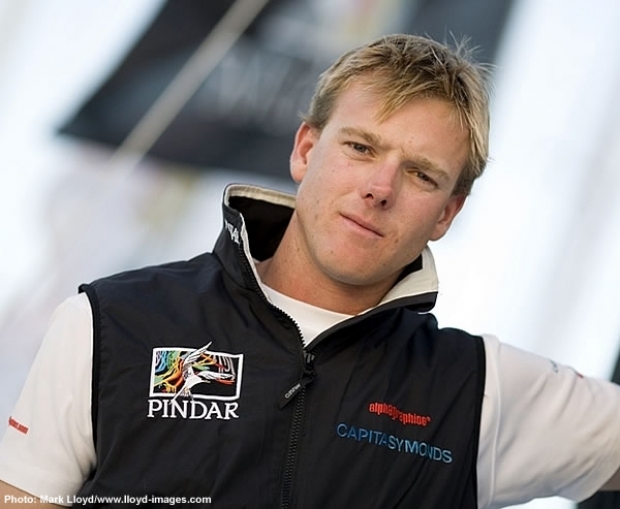
Let the champagne corks fly - Ian Williams and his Team Pindar on Saturday became the 2007 World Match Racing Tour champions, the first time a British team has ever achieved this.
Going into the final event of the Tour, the extravagant Monsoon Cup in Malaysia, Williams had lost his overall lead to talented Frenchman Mathieu Richard, who had won the penultimate event in Brazil - the two teams have been dogfighting at events throughout the year.
"Losing the lead to Mathieu in Brazil was a bit frustrating," recounts Williams, now back in the UK. "We were leading that quarter final against him and we gave it away. But we always knew Malaysia was going to be the key event."
Cunningly the organisers of the Tour have it set up so that events have different weighting in the championship scoring. Being the last event of the season, the Monsoon Cup counts for double points, aimed at maintaining the suspense until the very end of the season, which this year it certainty did. In addition, as a sop to Cup sailors wanting to dip in and out of the Tour, the ranking is based on the top eight results in the 15 event series, with the Monsoon Cup being the only event that has to count. Both Richard and Williams were counting podium finishes throughout their eight.
The organisers of the Tour, Scott MacLeod's Force 10 Marketing, are constantly trying to up the game with their circuit and have added several premier regattas to it in recent years, but the Monsoon Cup is currently their flagship event.
"I think it is the second biggest sporting event in Malaysia after the Grand Prix," says Williams. "It is huge - the Prime Minister and the King attend and they don’t hold back in the way they promote and market it. It is a very different event in terms of the local support and the way they have stepped it up, making sailing a proper spectator/media sport."
For example, the Monsoon Cup was broadcast live for two hours on Saturday and Sunday on stations such as Eurosport, Star Sport, ESPN, Sky Sport NZ, etc. They fly in top match race commentators such as Peter Montgomery, there are big screens up ashore displaying the live TV and they track the boats using Virtual Eye - in short a set-up similar to the America's Cup. "In terms of the spectator experience it is about the best you’ll get in sailing," says Williams.

Live TV led to some modifications in the race management. "You don’t swap boats between races in the finals," says Williams. "They close it all down to a very short time frame. You only get a couple of minutes between races. There are no breakdown flags. They’ll help you repair your boat between races, but they won’t delay the start."
The venue itself is ideal. Racing takes place on a river with on one side the Heritage Bay Club where there is a purpose-built grand stand and downtown Kuala Terengganu on the other. "Literally in the space of one race you can be going up to the limit buoys on both sides," says Williams. "It opens out a bit further up the course and it is in a basin, so it is quite shifty with a reasonably fickle breeze, although at the same time we had a reasonably strong breeze at times - up to about 16 knots. The finals were in around 12 knots."
Another attractive ingredient to the Monsoon Cup is the prize money, the largest up for grabs ojn the Tour. For winning Williams and his Team Pindar walked away with a cool 250,000 in Malaysian Ringgits, worth just over £36,000. "That is a decent salary for each person, split five ways. All we need to do now is win it every year and we’ll be alright!" says Williams.
Over the course of this year Williams estimates he has won around £70-80,000 in prize money at regattas, to the extent that this is now forming part of his team's annual budget.
From having finished second on the Tour last year, so this year it has come good finally for Williams. "We’ve been moving forwards since 2006," he says. "I think the extra funding from Pindar and Capita Symonds has made a big difference in terms of being able to have a much more consistent team. Although it hasn’t given us complete consistency, it has allowed us to build towards the final event. That’s what we got particularly right - we were able to peak as we went to Malaysia."
This year Williams has been sailing with this regular posse of brother Mark Williams, Bill Hardesty, Mark Nichols and Simon Shaw. They were joined for regattas by Andrew Escort and Gerry Mitchell. As Williams puts it: "It is really about individuals within the team being able to commit to a series of events in advance, rather than trying to fit it in around gaps in their schedule of other professional sailing."

Obviously being full time on the Tour also helps, not just in terms of practise but in being able to rack up decent results. As mentioned the best eight of 15 events scoring systems in theory allows rock stars to jet in and do well, but this just doesn't happen in reality. "Ultimately it is never that easy, and nobody can come and win every event. So obviously statistically the more events you do the more likely you are to have some good results," says Williams. "As an example, Spithill won in Rome but then he came 9th in Malaysia last year. The reality is that you can’t expect to do the minimum number of events and necessarily be right up there, although with the extra points you get in Malaysia, and you having to to count it, it does give some opportunities to come up."
Now Williams and his team have some time off, although this weekend they are competing in the JPMorgan Asset Management Winter Challenge grade two event in the UK. The Tour doesn't fire up again until the next event in Brazil in March. Meanwhile Williams'will be racing the Farr 40 Worlds as tactician on board Fred and Steve Howe's Warpath. This year Williams sailed with the American father and son team in Miami and the Worlds in Copenhagen, but in 2008 with the Worlds in Miami, they will have a slightly fuller program including Key West and Miami prior to the main event.
Obviously being part of the Pindar stable of sailors, Williams gets to sail on a variety of boats. This included racing on board the Pindar Volvo Ocean 60 at Antigua Sailing Week, the delivery of the Open 60 to Le Havre (yes, when the rig fell down for the second time) and racing on the Pindar Class 40 in the Transat Jacques Vabre prologue event. "It has been enjoyable meeting the likes of Brian Thompson and sailing with him and learning about the offshore side," says Williams.
Once again in 2008 the World Match Racing Tour will be Williams' focus and he says that aside from the Farr 40 sailing, which neatly slots into the beginning of the season, there isn't much time to commit to anything else. He says he might try and get across to the match racing event in Auckland again, but otherwise they'll do more training.


Over the course of the 15 event Tour, they get to sail in a wide variety of boats and Williams says they have been struggling slightly in the DS37s used at all the Scandinavian regattas such as the Swedish Match Cup and the Danish Open. This may be partly due to the numerous Swedish and Danish match racers having cut their teeth in these boats and intimately knowing their characteristics. "They are quite different in the way they manoeuvre, because they turn so fast," says Williams. "So we need to do a bit of work on that for the Swedish Match Cup, Match Cup Sweden and the Danish Open. What we have been pleased about on this Tour is that we’ve won the event in the most light manoeuvrable boat, the Streamline [the trapeze boat used in St Moritz - see pics above] and we’ve also won in the most unmanoeuvrable boat in Bermuda in the IODs. So we have the range of skills. We just need to sharpen up specifically in some boats."
Obviously one criticism of the Tour this year is that in a Cup year many of the big names haven't been competing, although Williams says that typically Cup teams make up about 50% of the entries in major events. This is likely to change when the future of the 33rd America's Cup is decided. "I think once the Cup has sorted itself out, we’ll see more people. If they decide to hold a Cup in 2009 or 2010 in monohulls, then I suspect we’ll see more people come back on the Tour. You tend to see in the lead up to the Cup a few more people coming back on, particularly when they haven’t got their own boats to sail, because they are still building them. If people think the skills are relevant they’ll be there. If they don’t they won’t."
At some stage when the Cup gets its act together and teams are back into hiring mode, then Williams would obviously be a useful tool in the TeamOrigin armoury. As ever the future of so many people in our sport is presently hanging on decisions made by judges, lawyers and billionaires in the US, Spain and Switzerland.
Most Read
Most Commented
Comments
Businesses

Pro businesses
-
Netherlands
-
United Kingdom
-
Italy
-
France
Editor's choice
Member blogs
-
 Ned Collier Wakefield: MOD70 round BarbadosWell that was intense. 12 hard fought for seconds for the win. In idyllic conditions, Tony Lawsons MOD ...
 -
 Mini Transat leg 2 reportThe second leg of the Mini Transat started on 31st October, just over a month after ...
 -
Leg 1 reportI’ve been working towards the Mini Transat now for three years. In 2013 I was part ...
Business blogs
-
 The Island Sailing Club in Cowes, Isle of Wight, is delighted that Prince Michael of Kent ...
 -
Peta Stuart-Hunt chats with the 25 year-old British solo sailor Lizzy Foreman before she sets sail ...
-
The 2015 Student Yachting World Cup (SYWoC), an ISAF-recognised event hosted and run by students for ...
Editor's Choice
All time favourites...
-
 Three legs down into Ian Walker’s
 -
 Winning all but two races at
 -
 For the first time in its
Latest Comments
Add a comment - Members log in