

Back to kindergarten
Wednesday April 9th 2008, Author: James Boyd, Location: United Kingdom
This is something of a rarity at the moment: an article about the America’s Cup which doesn’t once mention the words ‘New York’, ‘court’ or ‘Cahn’.
Now that both sides are resigned to the 33rd America’s Cup being a Deed of Gift affair in multihulls, both the Alinghi and BMW Oracle Racing sailing teams have been going hammer and tongs to get in as much training as possible in these boats. ‘Training’ is in fact a little optimistic. Since the majority of the sailing teams, with a few exceptions such as Alinghi bowman Jan Decker (once part of the Groupama and Club Med crews) have had no multihull sailing experience, save perhaps hooning around on a Hobie 16 during a beach holiday, it is a case of going back to school.
Early this year both challenger and defender acquired Extreme 40 cats and both now have two of these to go race training in out of their bases in Valencia. Both campaigns have hired multihull experts in to teach them - Alinghi have been working with former Foncia skipper Alain Gautier while BMW Oracle have had Franck Cammas and his Groupama team, one time kings of the presently dormant ORMA 60 circuit, along with numerous Tornado experts such as Glenn Ashby, present Gold medallist Roman Hagara and US Olympic cat representative, Charlie Ogletree.
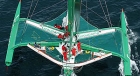
Both teams have recently decamped temporarily to France’s multihull capital, Lorient. Alinghi were sailing on Gautier’s Foncia until their unfortunate capsize last week. Over the last few days the BMW Oracle sailing team have been on Groupama 2 with Franck Cammas as they have been attempting to match race Pascal Bidegorry and his race team on Banque Populaire (helmsman James Spithill says it has been close with Groupama 2 having the edge upwind, but both boats being pretty even downwind).

Meanwhile Alinghi have also recommissioned Ernesto Bertarelli’s lake racer catamaran, the ultra-extreme Jo Richards/Sebastien Schmidt-designed cat in which Bertarelli won the Bol d’Or prior to the change across to the present D35s. Since their flip, the Swiss sailing team have moved on to Geneva and are now sailing this.

At this stage the progress in each team’s training will all come down to how receptive they are to new ideas, for while multihulls are boats that sail on the water this is pretty much where any similarity ends with the world of lead mines they are used to.
Given this, one has to wonder why neither team has filled their sailing squads with French or why Alain Gautier hasn’t been employed to drive the Alinghi multihull while Cammas steers the BMW Oracle boat. Generally it is felt that both teams are looking at the big picture and while the 33rd America’s Cup will be a brief distraction, something they want to get out of the way, neither camp wants to disband their monohull sailing team that they will continue on with towards the 34th Cup, bearing in mind this could be as early as 2011.
So in the meantime we can sit back and enjoy watching some of the leading figures within our sport effectively going back to kindergarten. “It is a little bit forced on us for sure - which school usually is. It is definitely school and we are learning a lot,” admits Alinghi helmsman Ed Baird, who hasn’t raced multihulls competitively since the short-lived days of the ProSail circuit in the US back in the late 1980s when he was on board a Hobie 21. He admits that some of the lessons have already been quite painful...
At BMW Oracle, helmsman James Spithill says that one of his first sailing experiences was also on a Hobie cat, hooning around with his father, but hasn’t sailed them since. However while down under in January he took part in the Australian Formula 18 Nationals – as crew... “I really enjoyed it. It was a lot of fun.”
 Since then intensive multihull sailing has become part of both their daily diets. “The first few days that we had them we were really just trying to learn how to go in a straight line,” recalls Baird of their first experiences in the Extreme 40, where they have been sailing against a variety of other skippers, including Ernesto Bertarelli (ironically the most experienced multihull helmsman in their team at present). “The second day we had the boats we had winds up to 22 knots and pretty big waves in Valencia from the northeast which was imposing when you looked out at the weather. But we went out and got around the track and learned a little bit about how they work. As time has gone by we have gotten more into manoeuvres and some racing and positioning and now we are starting to have some action-packed practise sessions. It is good fun.”
However clearly both teams would ideally like to have the set-up BMW Oracle has managed to achieve this week – regularly being able to match race on the larger ORMA 60 tris. “The complexity and the power go up exponentially as you step up in these things and we are trying to prepare for an event that is going to be in boats that no one has seen the likes of before. So anything bigger is going to be helpful,” says Baird.
At this stage nothing has been revealed about the design of the new boats or even whether they are both cats or tris or one of each. While there are numerous examples where tris have won out in multihull classes where length is restricted due to their added righting moment, teams will almost certainly be contemplating ultra-light weight catamarans too. Bear in mind that unlike the French multihulls these boats will have no offshore pretentions and be designed solely to race off the Cup venue – most likely Valencia, if Ernesto Bertarelli gets the 2009 date he wants. Structurally we can expect they will be very much more honed down than their French cousins. All we can assume is that the boats will be 90ft long, as specified in BMW Oracle’s challenge document of last July, so boats that will be 50% bigger than ORMA 60s, and lighter and very very much more powerful for their length – in short pretty much the ultimate sailing boats.
So what have the good students been learning? “To be a little more alert and active and realise that small changes to where you are steering or the way you are trimming can make a very noticable difference to the power level on board,” says Baird. “Things happen quicker and the power goes up and down fast. I relate it a little bit to when you are helping someone to sail a dinghy in varying conditions: When they go off the dock in 5-7 knots they have a little time to think and the boat doesn’t necessarily mistreat them. But when they go off the dock and immediately are greeted by 15-20, Lasers and other types of boats like that can treat you pretty poorly. You have got to be really prepared from the moment you leave the dock that you have to be on edge and alert and ready to meet everything that happens. That is what has happened with the multihulls - you have to have a higher state of alertness and readiness because things just change so much more quickly.”

Spithill has a similar impression: “It is just a totally different game. The biggest part is learning how to sail one of these boats fast. Just getting to grips with simple things like when you are sailing on a monohull you look at 90degs or behind you for gusts but on these things you are always looking forwards. So tactically it is totally different. Obviously you don’t tack or gybe a whole lot and it is all really really thinking ahead and long term and the decision making must happen quickly, because if you delay a decision at all, when you are going 30 knots, it can take you past the layline pretty quickly.”
Spithill confirms that they have been sailing at more than 30 knots on Groupama, the inevitable boy racer enthusiasm shining through as he tells us this: “Once you have been there, you have to go further. But it is amazing how quick you get used to sailing at those speeds. Now we are blasting around and it is going to be tough to go back because you get to used to launching around at 20-30 knots...”
The biggest problem for both teams is certainly that while monohulls react in a certain way when you pull the helm this way or that or trim the sails in a certain way – something they and their highly experienced crews find totally instinctive, on multihulls the effects can be very unexpected.

Thus the role of the helmsman and the trimmers and the interaction between both is very different, partly because of the increased speed, partly because of the humungous loads in the sail plan and partly because of a multihull’s lack of keel and its inability to carry its own way. Typically on a multihull there is very very much less trimming - it is almost impossible to react fast enough - and so it is the helmsman that compensates.
“There is certainly a lot more that happens from the helming side,” confirms Baird. “It is busier and you have to pay a lot of attention. The trimming becomes much less subtle and much more aggresive: You are either in or you’re out. It is not little bumps here that make the difference, it is the gross movement. If you are overpowered you have to dump some sail somehow RIGHT NOW. And if you underpowered you have to trim some sail in RIGHT NOW. Some of it is steering as well where you have to quickly turn, a little bit like surfing in a dinghy – sometimes you have to play the waves very aggressively and you are moving your bow around a lot to get power in the boat. It is the same thing in a multihull – you have to be willing to make some pretty reasonable course alterations to get the power going and you have to make a big course alteration back to use the power.”
Most seasoned multihull veterans would say this is understating the case. You cannot ease for gusts, for example - it is down to the helmsman to deal with this, as once the gust has gone you find the boat dead in the water. Multihull teams tend to place great emphasis on the set-up, then on the water it is a case of trimming on and letting the helmsman do the rest – the ‘lock and load’ approach, the helmsman responsible for maintaining maximum apparent wind.
“As the helmsman you are always in the speed role, but it is just more so, you drive around a lot more,” says Spithill. “It seems you do more with the helm than you do with trim. The thing that surprised me the most with these boats is how tight you trim, especially the mainsail and how little you adjust the trim. On the Cup boats it never stops. With these boats it just seems like you get going, you trim it on as tight as you can and, okay you might play with it a little, but otherwise you are really driving around and that is what keeps the boat going. It has been great to watch Franck [Cammas] and learn off him and get the guidance from him, because of all the miles he’s done, he’s very very good at it.”
The question is should Cup teams assume that the way the French have been doing it for years is absolutely the right way? Certainly both Spithill and Baird give them impression that multihulls may be more extreme but are ultimately blunt, brutal instruments compared to the Stradivarious-style highly refined Cup monohulls they are used to. For example trimming sails on a Cup boat is a fine art, whereas on a multihull it is more of a wrestling match with very much less finesse required.
“It is an eye opener for them,” says Spithill of their trimmers. “But I wonder if those guys can bring something as well. Maybe there are opportunities to trim a little bit more. Certainly we’ve noticed in the shifty, gusty days that is the case - there is a fair bit to be made there. If it is steady wind like a lot of boats, you are pretty much just trimming on and off you go.”
The sail controls also tend to be used in a very different way. On Extreme 40s for example sailing upwind the mainsheet is bearly touched, the traveller moved only slightly whereas the Cunningham is the principle control, allowing twist in the main to deal with gusts.
Read part two of this article tomorrow...
Most Read
Most Commented
Comments
Businesses

Pro businesses
Editor's choice
Member blogs
-
 Ned Collier Wakefield: MOD70 round BarbadosWell that was intense. 12 hard fought for seconds for the win. In idyllic conditions, Tony Lawsons MOD ...
 -
 Mini Transat leg 2 reportThe second leg of the Mini Transat started on 31st October, just over a month after ...
 -
Leg 1 reportI’ve been working towards the Mini Transat now for three years. In 2013 I was part ...
Business blogs
-
 The Island Sailing Club in Cowes, Isle of Wight, is delighted that Prince Michael of Kent ...
 -
Peta Stuart-Hunt chats with the 25 year-old British solo sailor Lizzy Foreman before she sets sail ...
-
The 2015 Student Yachting World Cup (SYWoC), an ISAF-recognised event hosted and run by students for ...
Editor's Choice
All time favourites...
-
 Three legs down into Ian Walker’s
 -
 Winning all but two races at
 -
 For the first time in its
Latest Comments
Add a comment - Members log in