
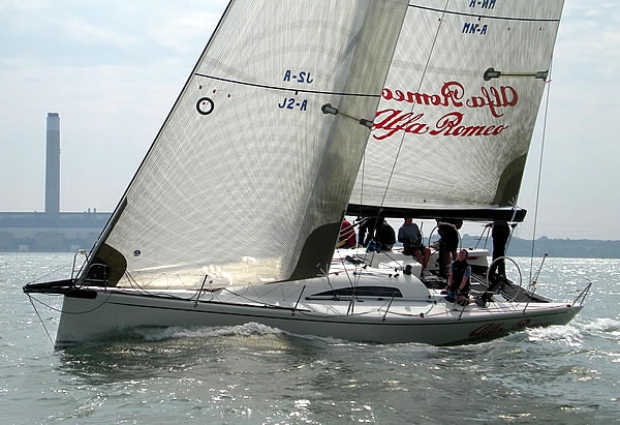
Tim Costello's newly launched Mills 43 Tiamat
Mills v Ker v the rest of the world
Wednesday June 11th 2008, Author: James Boyd, Location: United Kingdom
It could be argued that despite fielding what on paper were the strongest teams with the most new boats in the last two Rolex Commodores’ Cups, the Irish were robbed of victory on both occasions. With this year’s event looming at the end of the month, will it be third time lucky for our friends from the Emerald Isle?
This time Ireland is fielding two teams.
| Team | Boat | Name | Type | Rating | Skipper |
| IRELAND WHITE | 1 | ANTIX ELLE | Ker 39 | Anthony O'Leary | |
| 2 | JUMP JUICE | Ker 37 | 1.098 | Conor & Denise Phelen | |
| 3 | VOODOO CHILE | Ker 32 | 1.051 | Eamon Crosbie | |
| IRELAND GREEN | 1 | TIAMAT | Mills 43 | Tim Costello | |
| 2 | BLONDIE IV | Mills (King) 40 | 1.121 | Eamon Rohan | |
| 3 | NO NAKED FLAMES | Mills (Slim) 37 | 1.074 | Andrew Allen | |
These effectively break down into what people are calling the ‘Mills’ and ‘Ker’ teams after their designers. While all the boats in the Mills team are 2008 launches, only Antix Elle is new in the Ker team, the first of semi-custom production Ker 39s (of which to date three have been built). This may have something to do with Jason Ker having been tied up with his AC design work at Team Shosholoza over the last couple of years. The boat is owned by perennial Commodores’ Cup competitor Colm Barrington, but who this year is not competing, busy as he is with his IRCed TP52, and so the boat has been chartered to Anthony O’Leary.
So having come so close on the last two occasions are the Irish doing anything differently this year? “The fundamental thing we’ve done this time - we will only discover if it works - is that we have two boats that are tried and tested in that they are boats that been around for a couple of years in Voodoo and Jump Juice,” says Anthony O’Leary, who two years ago campaigned the Corby 35 Antix. “And on the other side we have the Ker 39, which we've sailed for three months - yes, you’d like to have it longer, but it is a lot better than six weeks. We have spent enough time in the boat to sort out the little foibles and we’ve managed to benchmark ourselves against some pretty good boats over the last two months, especially marinerscove and we had a brief sojourn against that beautiful French boat in Scotland!” (He refers to Gery Trentesaux’s Beneteau First 45 Lady Courrier, winner of the Bell Lawrie Scottish Series, where they finished third in IRC 1).
O’Leary says that following the Scottish Series they’ve remoded the boat, adding lead to the keel and chopping some roach off the main. “She was just a bit too light air-orientated, which meant that you were fully trimmed at 10.5 or 11 knots and go on a couple more knots and you were starting to lose horsepower, spilling wind from the mainsail. So we’ve made the boat more stable.”
Or as designer Jason Ker puts it: “We’ve moded the boat towards slightly more breeze. The boat is an all-rounder, so you can sail it in the UK or in the Med. It is fine to be an all-rounder when you are not at a high level, but when your opposition is sailing at a high level then you have to mode to beat them.”
More by coincidence than design, a feature of the Ker team is that all the boats are quite small inside their respective rating bands. Of course there could be occasions when this works in their favour. “It is good when you have park-ups and concertinaing races and so on,” says Jason Ker. “Especially in an offshore race, when you are parked, it is good to be lower rated. So it is probably a good thing. From a tactical point of view you want to be far enough behind so that you can see all the skifts on the guys in front of you, or you want to be out in front in clear air and not affected by anyone else. We are more in the first category, but this year there are not that many really big boats.”

Above: Antix Elle
O’Leary adds that they will be relying to a great extent on the experience within their team. In addition to the Cat1 crew, Antix Elle will have the Greenhalgh brothers on board (who usually sail with Colm Barrington) while Jump Juice will once again have Irish Star sailor Mark Mansfield in the drivers seat and Geoff Carveth as tactician. On Voodoo Chile they have 470 sailor David Crosbie and Ruairidh Scott.
Both Jump Juice, launched in 2006, and Voodoo Chile, launched in 2003, are now of course fully sorted. The former finished second at the Irish IRC Nationals, while a Ker 32 has previously been the top boat in its group in the Rolex Commodores’ Cup. Since she was launched Jump Juice has had her trim tab keel fin replaced with a non-trim tab version in order to make it easier to sail. The result seems to have worked as last year they were Irish Boat of the Year with owner Coner Phelan driving throughout the season.
Jason Ker maintains that such trim tabs on IRC boats is an advantage, however it depends very much on how proficient the crew is at using it. For example Colm Barrington’s 50 footer Magic Glove (now sold in the US and renamed Cracker 2) still has the trim tab and in this configuration won Key West, Cork Week, Block Island Race Week and was second at the Acura Miami Grand Prix. Even Jump Juice before she was changed won her class at Cork Week.
“It is more difficult to sail with and less skilled operators can get it wrong,” says Ker. “I don’t think there is any rating advantage in doing it: I think if we are purely against the clock there might be a slight rating advantage to it, but the reality is that you have to turn the corners and every time you tack or go around a leeward mark or try and get off the start line in a tight bunch - all those downspeed situations, you are suffering for it. So that is the downside.”
In the last two Rolex Commodores’ Cups the Irish have always come unstuck in the event’s double points scoring concluding offshore race. However this year the RORC have changed the format of the event, so that now the final race will be a double scoring windward-leeward.
“I think the format of the event is fantastic, much much better,” says O’Leary, who this weekend will be racing Antix Elle in the UK IRC Nationals. “The prospect of a round the island race is brilliant - it used the uniqueness of the area. The long race in the middle is great, but I must confess double points is a bit OTT for the last race. But it will make it some race - the press will get what they want if there is any closeness between the teams which there is bound to be. The last couple of legs of that race will be very very exciting.”
And what of the Mills team and their new hardware? Again the Mills team is highly experienced. Two years ago Tim Costello fielded his then new Mills 40 Tiamat and this year returns with a new 43 built by Vision Yachts in Cowes. Similarly Eamon Rohan in the last Rolex Commodores’ Cup campaigned his Corby 37 and has now upgraded to a Mills-designed King 40 - the first off the production line (off which around 10-11 are in the process of rolling) called Blondie like his last boat. In the small boat class Andrew Allen and his team on their Mills-optimised J/109 No Naked Flames performed well two years ago and he has now upgraded to a new Mills 37, built by Davie Norris in New Zealand. Of these only No Naked Flames has been built with the primary aim of the Rolex Commodores’ Cup.
“She is most directly the extension of marinerscove, our 39 footer from the last event, which was widely acknowledge to be a strong performer,” says designer Mark Mills of the small boat in the team. “She in some way takes the philosophy of trying to get the largest boat to fit inside the rating and displacement-length limits of a class. No Naked Flames takes it further than we did with marinerscove because the DLR limit is higher for that class now.”
While rating-wise Allen’s boat has been shoehorned right at the top of the 1.074 rating band limit for the small boat division, Blondie is close to the top of the mid-sized class while Tiamat lies in the middle of the big boats.

According to Mills, Blondie is an all-rounder, while Tiamat has some features orientated towards the Rolex Commodores’ Cup such as its spinnaker configuration. “The hull itself is partially a nod to IRC getting slightly more liberal as its gets larger but also to Tim [Costello] having other goals beyond the Commodores’ Cup and wanting more of an all-rounder.”
Obviously the new boats are built to rate competitively under IRC and while a secret rule, designers have a feel for how the rule treats various aspects of the boats. Mills shares his theories: “There has been an adjustment in many boats’ hull factors that hadn’t been seen before. They have increased the number of keel options in the application form, so as the level of resolution increases there, they get obviously a better handle on the boats that are coming in front of them. So some of it is suddenly getting better data on what they are trying to rate, but there is more to it - whether it is levelling custom boats against production boats, or lighter more aggressive designs against heavier more dual-purposey hull shapes, etc.”
He adds that there have been some smaller changes over the treatment of spinnakers/sprits. Both Blondie and Tiamat have a fixed stub sprit (the same length as the spinnaker pole would extend out to) while No Naked Flames Project Manager Chris Main had different ideas. “Chris had a specific solution for that requirement to be able to fly A-sails off the pole very low, and especially when gybing, so he pursued his own route which didn’t involve a sprit,” says Mills. “But I think fixed sprits are definitely on the agenda now.”
As to how his boats have evolved in the last two years Mills say that they have benefitted from more CFD analysis. He works with Dr Charles Crosby of Cape CFD, who was part of the CFD team (ironically with Ker) at Team Shosholoza. This has allowed them to make more definite decisions about many aspects of their boats, but perhaps most noticable is how this has affected transom width. Mills says this is also evident in the TP52 fleet where CFD work has led to transoms having more powerful shapes. It has also resulted in them getting a better handle on how to design a boat that sails well when heeled as well as upright in light airs and the transition between these two states.
In terms of construction the new boats are all E-glass and epoxy with a foam core. According to Mills it doesn’t pay to build in carbon under IRC until you are at 50ft+. Both have full-on cockpit coaming and cruiser-racer interior but at the same time state of the art race boat features such as composite chainplates.
The only possible downside of the Mills team is that some of their hardware, in particular the very recently launched Tiamat, is very new. As Anthony O’Leary puts it: “I wish them well, but they only got the boat two or three weeks ago. We made that mistake last time around. We suffered because Jump Juice and Magic Glove two years ago were too new. The improvement on those boats after just six months of sailing was just phenomenal.”
While most of these boats are competing at the UK IRC Nationals this weekend, we await the real acid test at the beginning of July.
Most Read
Most Commented
Comments
Businesses

Pro businesses
-
United Kingdom
-
France
-
United Kingdom
-
Italy
Editor's choice
Member blogs
-
 Ned Collier Wakefield: MOD70 round BarbadosWell that was intense. 12 hard fought for seconds for the win. In idyllic conditions, Tony Lawsons MOD ...
 -
 Mini Transat leg 2 reportThe second leg of the Mini Transat started on 31st October, just over a month after ...
 -
Leg 1 reportI’ve been working towards the Mini Transat now for three years. In 2013 I was part ...
Business blogs
-
 The Island Sailing Club in Cowes, Isle of Wight, is delighted that Prince Michael of Kent ...
 -
Peta Stuart-Hunt chats with the 25 year-old British solo sailor Lizzy Foreman before she sets sail ...
-
The 2015 Student Yachting World Cup (SYWoC), an ISAF-recognised event hosted and run by students for ...
Editor's Choice
All time favourites...
-
 Three legs down into Ian Walker’s
 -
 Winning all but two races at
 -
 For the first time in its
Latest Comments
Add a comment - Members log in