
Leading the field
Monday August 3rd 2009, Author: James Boyd, Location: United Kingdom
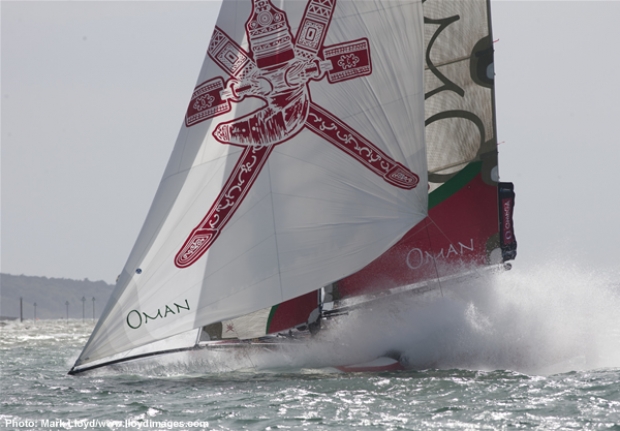
Star of the show at the iShares Cup in Cowes this weekend and going into today’s final races has been Oman Sail’s
Masirah and her crew led by Pete Cumming, with Chris Draper helming and calling the shots with former Tornado Olympic sailor, Mark Bulkeley.
At the end of day two yesterday Masirah had scored nine bullets in 14 races, Sunday being an epic with eight races sailed, thanks to the magnificent conditions.
So with pliers at the ready, prepared to pull nails if necessary, we attempt to find out how the British lads on the red Omani boat have found success.
“We haven’t achieved success yet, but it is going well!” admits Chris Draper, the 2006 49er World Champion and Athens bronze medallist. “We spent a lot of time looking at what Alinghi did last year and how they went about doing it all.” Read our interview with Alinghi helm Ed Baird on this subject here.
“We learned a lot from watching Ed and his manner in the boat and how relaxed and low key they managed to keep it and just tap away and stay out of trouble. And then really good boat handling,” Draper summarises.
With courses laid close to the shore, many of the techniques for sailing in the iShares Cup are different to what one is typically used to. For example the courses are impossibly short.
As Draper explains: “You are sailing at full speed for such a short amount of time that if you do the manoeuvres well, then it means you get the sails in quicker at the mark roundings and you are up to speed quicker, so it seems like your boat speed is a lot faster.”
Oman Sail have been working hard on their manoeuvres and their boat speed and had the opportunity to focus on this helped by acquiring a second boat, Renaissance, the ‘blue boat’, skippered by multihull legend, Loick Peyron. As a result they could spend much time two boat training over the winter.
While the courses are tight, start lines are even more so and Draper says that they always have two options pre-planned. “For example, if we were going to start on port and suddenly seven other boats are going to start on port and its going to be really hard to get out of there, but there is an option to start on starboard and then tack, then we always know we have that option. So we try and work on plan A and plan B and how we execute them before we get into that situation. So we try and have a decision made at four minutes [from the gun] and if it is looking bad for one of them, we try and switch to the other one."
Draper explains how it typically works on board during a race: “Freddie [bowman David Carr] does all the build-up time and distance until about 30 seconds to go and then Mark and I take it over and are pretty much calling the shots from then onwards. Depending on the conditions we determine how much of the shot calling is done by Mark or me. If it is really quick and the wind is very up and down, then Mark will concentrate on boat speed more and I’ll call the shots, but if it is a bit more boat speedy, then he’ll call a bit more the shots and I’ll concentrate on the boat speed. Then Pete and Freddy will decide how they want to get the kite up and when they want to do that coming up to the mark and Mark and I make the decisions about how to get down the run and the rest of the race carries on like that.”
Skipper, Pete Cumming expands on what they all do: “Chris is on the helm - he has a really uncanny feel for the boat and knows exactly which mode to put it in all the time. It helps that his best mate, Mark, is on mainsheet, who is a Tornado sailor. Mark brings in that multihull sailor experience. Then Freddie and I upwind are eyes out of the boat, keeping eyes on other boats, laylines, modes, etc. There is a lot to think about as it happens so quickly. You need to need to have a picture of where you are going and what you are doing, but also you need to know where the boats are around you, what mode they are in, are they low, high, are you going to get crossed up? There is a lot of information to process. We try to keep it all to a minimum. So key information we’ll fire back to Chris and he’ll process it. We avoid, as much as we can, a conversation. It is just key information and he’ll react to it.”
An additional bonus for Cowes is that they have former iShares Cup winner Rob Greenhalgh on their training boat (brother Pete sails on Oman Sail’s Renaissance and is campaigning a 49er with Draper now). Investigating the course is something they are doing at all the iShares Cup events they are doing this year.
“Each one has different features,” explains Cumming. “So the feature here [off Egypt Point, Cowes] we know is going to be the shoreline because there is so much tide. So we spent a lot of time with Rob going up and down looking at shallow spots the week before, and focussing on learning the shoreline and knowing where we can hit points on the beach.”
Another reason why the Masirah is coming out on top is that it is their second season on the iShares Cup with the same crew. “That was the big thing,” says Cumming. “If we were going to do it again we wanted exactly the same crew. Because we’ve seen guys come in on the first year and do okay and come back the next year doubly strong where other crews change. That is the big key for us.”
Draper adds: “We are basically a group of very good friends. Mark was best man at my wedding and Freddie and Pete have been good friends for a long time. So that’s how we set about the project and decided that if we put in the time and the hours we could make it happen.”
While iShares Cup courses are always short, they are also laid for maximum spectator appeal first and foremost, as close to the shoreline as humanly possible and this often means that the first leg isn’t the perfect beat competitors expect when sailing in other classes. Some teams have found this hard to come to terms with.
“Basically it is different and if you don’t like it you have to go and sail something else,” says Draper. “In some ways the class has a bit of a quandary about whether they want to keep the big teams coming back and maybe make the racing a little bit more open or keep it the same and maybe people will complain. But people tend to complain when it is not going their way. I totally understand where there are coming from. It is probably going to be southerly today so the wind will be pretty wacky and we won’t be beating a huge amount and it makes the racing pretty tricky. But to be honest, the racing has been a lot more legitimate this year than it was last year. The first event in Lugano [last year] we had reaching starts all the time and doing triangles where there was hardly a beat. And in Hyeres this year there was good racing up and down the wind and, yes, it was close to the shore and pretty gusty but… and here the first day of racing, the first three or four races were a bit dodgy, but after that it has been good. But that is what this racing is about.”
As to their boat, Masirah is in fact the original Holmatro, the first Extreme 40 launched, which thedailysail was the first to test sail in Holland eons ago. There is weight difference between the boats, but they are weight corrected with lead slung from the main beam. On Masirah they carry 38kg which is middle of the road, the lightest boat in the fleet carries 45.
“I think the boats are very similar,” says Draper. “The amount of weight differential - a vast majority of it is the branding, but as the class has moved on there have been some changes. The beams are being built by a different company, so there is going to be slight variation in weight. But they are corrected and I think the boats are very similar to be honest. It is about how you pull the sails in and how you set the rig up. The rig is pretty responsive. We move the rig around quite a lot, move the diamonds around and we have different settings for each wind speed and according to what we are requiring, whether we are accelerating a lot or whether you are at full speed all the time. So the diamonds and rotation make quite a big difference and so does the shroud tension. That sort of stuff is way more important than worrying about whether you have 30kg or no kg on your front beam.”
So does he still find it as exciting as ever? “It is bloody great fun! Peter and I, when we go back into the 49er - and that is obviously wicked fun as well - it is amazing how open that seems after doing the iShares stuff. And the 49er is regarded as tight short courses! So it is bloody good fun. I think it is one of the most intense sailing experiences you can have, because it has all got to happen so quickly. It is a good crack. Obviously it is quite specialist. It is not America’s Cup, but it is good fun.”
More photos of the lads getting wet on the following pages...
Most Read
Most Commented
Comments
Businesses


Pro businesses
-
France
-
-
Italy
-
United Kingdom
Editor's choice
Member blogs
-
 Ned Collier Wakefield: MOD70 round BarbadosWell that was intense. 12 hard fought for seconds for the win. In idyllic conditions, Tony Lawsons MOD ...
 -
 Mini Transat leg 2 reportThe second leg of the Mini Transat started on 31st October, just over a month after ...
 -
Leg 1 reportI’ve been working towards the Mini Transat now for three years. In 2013 I was part ...
Business blogs
-
 The Island Sailing Club in Cowes, Isle of Wight, is delighted that Prince Michael of Kent ...
 -
Peta Stuart-Hunt chats with the 25 year-old British solo sailor Lizzy Foreman before she sets sail ...
-
The 2015 Student Yachting World Cup (SYWoC), an ISAF-recognised event hosted and run by students for ...
Editor's Choice
All time favourites...
-
 Three legs down into Ian Walker’s
 -
 Winning all but two races at
 -
 For the first time in its
Latest Comments
Add a comment - Members log in