
Blood from a stone
Wednesday June 10th 2009, Author: James Boyd, Location: United Kingdom
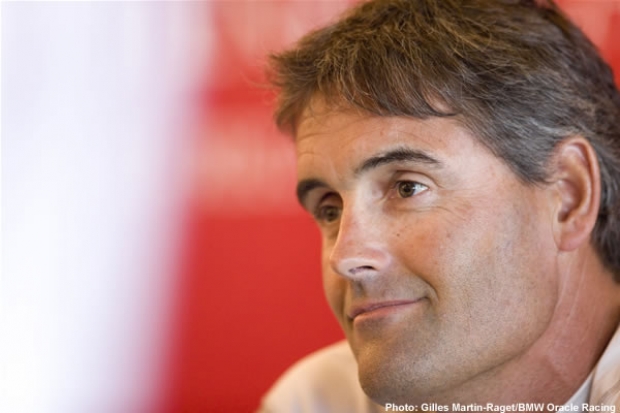
Russell Coutts is in Marseille this week reunited with his 2007 Audi MedCup winning skipper/helm Torbjorn Tornqvist aboard their third TP52
Artemis. With the new boat they have returned to Judel-Vrolijk for the design, as their 2007 winner was, but Coutts says that he has had nothing to do with putting their latest craft together.
We of course wish to talk to him about this, but primarily the thorny topic of the America’s Cup, to see if we can squeeze him for anything that so far has not come to light about next February’s one on one Deed of Gift match between the two giant multihulls of his BMW Oracle Racing team and that of the Swiss defender, Alinghi.
The latest empasse between the warring factions is over the venue. Alinghi reckon that the latest round of court action that confirmed the date of the 33rd America's Cup as February 2009, means they can hold it anywhere in the world, whereas BMW Oracle Racing believe, given that the Deed of Gift states that it cannot be held in the Northern hemisphere before May, it can only be held in the Southern hemisphere in February with the court-ruled exception of Valencia.
Alinghi have a compelling argument. In her recent decision the New York Supreme Court's Justice Kornreich ordered: "I'm directing SNG to hold the race as per the order of the Court of Appeals and Justice Cahn in February as the order required."
Justice Cahn's Order of 12 May 2008 states: "the location of the match shall be Valencia or any other location selected by SNG, provided SNG notify in writing not less than six months in advance of the date set for the first challenge match of the location it has selected for the challenge match races."
So this brings us back to the crucial point of whether the order of the courts takes precedence over the Deed of Gift or vica versa, something which Justice Kornreich failed to clarify in her decision, just as Justice Cahn also failed to a year earlier. ‘Valencia or any other location’ doesn’t stipulate whether or not the 'other location' must be Deed-compliant.
Coutts explains his team’s position. “The way I explain it is: ‘anywhere in the world?’ Could you have it on Lake Geneva? And the answer is ‘no’. Why not? Because it needs to be in open water/Deed-compliant. So it can be anywhere in the world, that is Deed-compliant, but they made a specific exception for Valencia. So you can’t have it on dry land, you can’t have it on the ice or an inland lake – because none of those things would be Deed-compliant. So you still have got to comply with the Deed: that means anywhere in the Southern hemisphere or Valencia if you want to have it in the northern hemisphere.”
Back in February, Ernesto Bertarelli told us that the 33rd America’s Cup would be in Valencia regardless of whether it was a multi-challenger event or a DoG match, so there could be any number of reasons for his about turn. Many have suggested that it is in order to pick a venue where there are conditions allowing their maxi-multihull to have the edge over the BMOR 90 tri. More likely is that Bertarelli firstly wants to keep Ellison’s team guessing about the venue for the greatest amount of time, until he has to announce the venue six months out from the contest (beginning of August), and secondly that, astute businessman that he is, he needs a deal in place with Valencia before it is formally announced as the venue. Our guess is that it will be Valencia, for sheer reasons of practicality - Alinghi has their base there.
So if it is Valencia then what sort of conditions might they expect there? We recollect that three or four years ago it was snowing there in February! “I think it is going to be variable,” states Coutts. “You can dress for the cold. There could be breeze. It could be light. I’m not 100% sure. Obviously these races are 20 miles up-down, unless the parties mutually agree to something other than that. I don’t think many people know what a 20 mile course would look in terms of wind conditions.” Pretty short in a 90+ foot trimaran, we would guess.
Presumably February will be too early in the year to get the sea breeze conditions that from time to time provided highly stable conditions in Valencia back in 2007.
So Alinghi are building a big multihull and this is believed to be a monster D35-style cat with a substantial flying beam/centre hull to withstand the fore and aft rig loads. The question is - will it be 90ft LWL, as the challenger is, or it may have a 115ft LWL if it is a two master as appears to be allowed under the Deed.
For the Deed states that: "The competing yachts or vessels, if of one mast, shall be not less than 44ft nor more than 90ft on the load water-line; if of more than one mast they shall be not less than 80ft nor more than 115ft on the load water-line.” Nowhere does it state that challenger and defender must be of the same length.
However Coutt says his team’s reading of the Deed of Gift is that they wouldn’t be able to field a larger twin masted boat against their 90ft LWL challenger. “I’m not sure that they would do attempt to do that, although they wrote a letter saying that they felt that they could. Personally I think that once again the Deed is relatively clear on that point and if you look at the historical precedent there are some pretty compelling arguments.”
But the fact is that apart from the big boat v cat mis-match in 1988 when both KZ1 and Stars & Stripes were <90ft LWL single masters, there have been no Deed of Gift America’s Cups since the venerable document was first penned back in 1870 - all have been mutual consent affairs, and, apart from the earliest, have always been in a ‘class’ of boat, be it the Js of the 1930s, the post-war 12 metres or the most recent IACC/ACC boats. So there appears to be no historical precedent for the current scenario.
Before we came up with the notion that the Alinghi boat could be bigger we were seriously worried that if Alinghi fielded a 90ft LWL they might as well hand the Cup to Larry Ellison now. It doesn’t take much digging in the history of French multihulls to reach the conclusion that with multihulls of equal length, trimarans always win. The best example is the ORMA class where the last brave souls threw in the towel with cats in the 1990s. Tris also dominated Formula 40 during the 1980s, although this is less relevant as they were subject to a minimum weight restriction. The exception is possibly multihull racing on Lake Geneva, but we’ll find out more about this this weekend, prior to the Bol d’Or Mirabaud.
So even if it is a 115ft cat versus a 90ft tri - we still don’t think that Alinghi’s design team should be feeling too smug just yet. For a 115ft cat to go faster than a tri, even a smaller one, it will be necessary for it to fly a hull, otherwise the tri will have less wetted surface area. Flying a hull on a cat this big and heavy is not going to be about moving crew weight around, it is about ensuring there is enough wind and that there is someone extremely adept at keeping the hull flying via the helm. The tri will also have marginally better rig tension and should turn corners with less difficulty and going astern in irons than a big cat. The BOR 90 tri will also hold the considerable advantage of almost a year's more sailing and development time.
So if the Alinghi cat and their tri are the same length - BMW Oracle Racing should be in good shape, we put it to Coutts. "We’ll have to wait and see what their boat is. They are obviously a very very skilled team. I don’t think that anyone has any doubts that they will come up with something very very competitive, particularly given the fact that they can choose a venue that should be more suited to their design. I would expect them to have a very fast boat for sure.
“I would except that it will be very conditions dependent. You may even find there is quite a big different in performance between upwind and downwind and don’t forget there is a triangular course in there, unless the parties agree otherwise, that’s what the courses are going to be.”
As to their 90ft trimaran being in bits in their shed in San Diego, this Coutts confirms, but little else. For example we understand that the Alinghi maxi-multihull is to be unveiled possibly in July on Lake Geneva, but Coutts won’t confirm when their boat will be out of the shed. This will presumably then determine when they can provide Alinghi/SNG with the blasted Customs House document, locking them into the boat they are going to sail, but unlikely to provide Alinghi with anything more than the bare minimum of vital statistics about the newly re-jigged black tri.
With the venue still unknown, obviously BMW Oracle Racing have to prepare for every eventuality in terms of conditions and different modes for their boat. “You can do a certain amount of preparation, so the boat can race in various conditions,” states Coutts. “Obviously our planning has to allow for that at this point, until we know more about the venue. Depending upon the venue we might need that anyway because in some venues you never know what the wind is going to be on a certain day.” Coutts confirms this will mean that their boat will have a number of different sized rigs it can use. The shore crew are certain to have their work cut out... But whether or not the rig armoury will include a Stars & Stripes/C Class-style solid-wing rig remains to be seen. Both sides have signed up C-Class wing specialists - Alinghi have Steve Clarke’s Cogito crew Duncan MacLane, while BMW Oracle have the equally experienced aerospace PhD and wingman, Dave Hubbard on their team.
When we ask him about a solid wing rig, all Coutts will say is that they have certainly looked at it and was one item they considered right from the outset. “I’m not saying we are definitely doing it, but we have looked hard at it. Logistically it would be a massive challenge. There are a lot of things in these big multihulls that are massive challenges.”
Given that since BMW Oracle Raicng made their challenge the possibility has arisen of Alinghi defending in a bigger boat, then we would make the educated guess that this is something that is not just ‘being looked at’ by the well resourced US team, but is becoming a very serious reality somewhere in a discreet facility on the US west coast. For a solid wing rig, provided it can be made robust enough, is simply miles faster on every point of sail and in every condition than a conventional rig. Read Steve Clark’s explanation of why solid wings rock here and see Clark demonstrating how Cogito's solid wing operates here. This is an extra gear for their boat, not to mention an intellectual challenge, that we suspect Coutts and the team will definitely not have passed on.
As to the performance of their trimaran, Coutts of course won’t say anything categoric. He says that they have sailed at more than 40 knots and eventually relents and says this was in “less than half the wind speed”. Frankly he should be asking for his money back if it were anything less. Given that the larger but considerably heavier Banque Populaire maxi is going upwind at 23 knots, pointing at a respectable angle, then we would image that the BOR90 is making at least these speeds given that it is substantially lighter, beamy and more powerful for its length, albeit shorter and will have substantially improved foils, daggerboard trim tab and sails over what the French teams, with their more limited resources, have come up with to date. Coutts says that the BOR90 will beat Groupama 3 and the Banque Pop maxi “easily in pretty much all conditions”.
He continues: “The performance increase from when the BOR90 was first launched is pretty impressive. The benefit of these programs is that you have got a lot of different equipment and instrumentation that is perhaps calibrated to a greater degree of accuracy and load measuring devices so you get a tremendous amount of information. And with that information you can make advancements and move forward. It has been amazing how even the sail design has evolved and how much improvement you get. I am used to seeing tiny, tiny improvements, so it is unusual to see knots of improvement. It is pretty amazing.”
We ask him whether he feels they have pushed their tri to 100% yet, and he replies that he doesn’t, although they are getting there.
Certainly, until we find out what Alinghi’s boffins have conjured up, the BOR 90 is the probably the world’s fastest boat as we would imagine that it should, given the right conditions and depending upon how ballsey the crew are feeling, be able to reach 50 knots. ORMA 60s used to do flat out speeds approaching 40 knots and the BOR 90 is more than 50% bigger (remember it is 90ft on the waterline so with overhangs, bowsprit etc will be more than 100ft LOA).
As to what the boat might do after the 33rd America’s Cup, Coutts says this depends upon his boss, Larry Ellison. It would certainly be a shame for it to become a white elephant, locked up in a museum somewhere. “Already I would say it has done a tremendous amount for technology,” says Coutts. “The learning in this process has been enormous, very very steep. I think that is one of the positives for sure. It is obviously unfortunate that it is a two boat race. So at least there are some positives in terms of the technology and that can be applied by a lot of people in the future.”

We don’t quite pluck up the courage to tell Coutts that they look like a bunch of wooses in their crash helmets, but Coutts does say that they wear them to protect themselves in the event of capsizing. Have they come close? “Not really. You don’t know how close you are until you end up in trouble. It can happen pretty quick. I don’t think we have been that close to it. We have been pretty cautious though.”
He admits that with the big loads they have had one or two things break, but won’t state what they are. “We have got through the sailing sessions generally in one piece. It is important to know when you are getting close to the loads. That is the amazing thing with these boats - the boat is designed for a certain righting moment and obviously the higher the righting moment you can achieve, once it is flying a hull, is advantageous. So you have to know just how hard to push it. Obviously if you put too much weight out you are going to break the boat…”
More photos on the big tri on the following pages....
Sidetracked
Seeing Coutts at the Audi MedCup one wonders if sailing on 40+ knot multihulls has spoiled him for life. “Yes, it feels like you are stuck in the water,” he agrees as to what it is like going back to one hull. “Who knows where sailing will be in 50-100 years time? It is probably going to gravitate towards more and more high performance boats and I guess that is getting somewhere towards the ultimate.”
While on the subject of ‘boats of the future’, Coutts admits that he has yet to sail on a Moth, although he reckons they “would be a pretty cool boat to sail. I should have one - it is getting the time… There are a lot of things I should be doing. But I think they are very very cool boats. I would wonder why that isn’t a category that should be considered for Olympic sailing in the future. It looks to me like there is a tremendous amount of skill involved. You have still got a lot of the tactics to sail them. That’s what you find when you go and race multihulls: it is just as technical, but in a different way. It is more long term…”
So you don’t tack on every shift? “You have to pick the shift you tack on, because tacking is more expensive, but similarly you can’t afford to get it wrong, because if you get it wrong you are going the wrong way real fast and it is not easy to correct. You can’t just tack and tack back, like you can on a lot of other boats.
“I like racing multihulls. I think it is a good discipline. I can’t believe it was dropped from the Olympics. I must say I was surprised by that, because it is a discipline that is different enough in sailing that requires different skills. The best sailors in multihulls - they win the races. It is not some bizarre sport that some people in sailing tend to categorise it as. You don’t need to be wearing water bottles on your back and hiking over the side for it to be challenging. The good guys in multihulls are really really good sailors, great at reading the wind on the water, because to fly a hull and not fly it too high so that you are giving away too much power and to keep the boat nice and smooth - that is skilful.”
Before we leave our America’s Cup conjecture, we ask Coutts how Alinghi might miracle their maxi-multihull from Lake Geneva to the Med. It could be demountable, but Coutts reckons it will be moved by chopper (as they do currently with the D35s). “They would probably fly it to somewhere like Genoa. You’d probably have to stop at least once. You’d have to land it somewhere and then pick it up again. It wouldn’t be near the limit. They could to that.” We feel a ‘photo op’ coming on.
TP52
While it must be like sailing in slow motion, even on the relatively speedy TP52s, Coutts is this year sailing three regattas on Torbjorn Tornqvist’s third Artemis. After a Reichel Pugh designed sistership to BMW Oracle Racing’s one race wonder last year, so the new Artemis is, like their 2007 Audi MedCup winner, a Judel-Vrolijk design.
“Rolf does a great job with these boats. I am impressed with this one, it is a really nice boat, easily driven,” says Coutts.
So has there been a noticable difference between this boat and the first Artemis? “He [Rolf Vrolijk] has just made subtle changes and there has been some changes in the structures and the way they are built which has made a big difference. If you go back to when the first TPs were launched and we were racing them in 2005 compared to the speeds you are sailing around at now, it is a big difference. Typically I remember sailing at 8.6 upwind whereas now you are doing 9.1 in a breeze. And downwind again there is quite a big difference. Generally the boats have tended to be moded, improved more above say 7 knots of wind - even though we are racing in the Med. So some of the old boats would probably still be okay, in very light winds.
"And the rigs have improved a lot. Getting the bend to bend nice and evenly, because with the backstay tuning it is quite important to get the rig matching the different rakes you have and the different mast bends you want to achieve for your mainsail and headsail shapes - that is quite critical. So you’d probably find that if you put one of these new rigs in one of the old boats that would be good as well.”
There is still talk of the TP52 class being reborn for 2011 with a new rule being introduced sometime this year. But that is up to the owners and given the present economy… Perhaps instead it would be possible to dramatically mod the existing fleet. Coutts is of the opinion that this should have happened several seasons ago. Among the mods he would like to see is changing from single backstays (a left over from the TP52 rule’s IMS origins) to twin runners, to larger square heat mainsails and larger roached headsails. He also reckons that given the boats all have Code 0s, they should be given free reign to use them whenever they like, thereby increasing the range of conditions the boats could actively race in. Long mooted has been the idea of removing the colossal amount of internal ballast the boats carry and instead sticking this on the bulb in the same way as happens when TP52s get ‘IRCed’. Then there is the fitting of a bowsprit… Coutts says you wouldn’t have to change the mast necessarily.
“7 knots - which we get a lot in the Med - it would improve the boats downwind a fair bit [in that] if you took a bit of the internal ballast out and stuck it on the keel, it would improve the boat all round. You’d try and do things that wouldn’t change the current boats too much. Obviously if you change the stability it does bring in some other considerations but with a bit of study, you’d find a way to make it so that these current boats weren’t just rendered useless by a change like that, because that would be a mistake. Maybe you’d have to have some grandfathering advantages or whatever. Having said that there is room for improvement, there are a lot of things which are good, so I am not getting down on the whole concept.”
RC44
Obviously closer to his heart is the class that bares his name and in which he is sailing with his Cup boss, Larry Ellison. Pauger, builder of the RC44 in Hungary has now churned out 21 boats now, but not all of these are competing on the circuit. For example among the new owners is Hong Kong’s Frank Pong. While Coutts says there will be 11 teams at their next event, Pong is set to compete in one of his boats later this season and there is another team from Italy set to join in plus one other, says Coutts. Then there are others such as Stephan Kandler's K-Yachting Ac team who have purchased one and Isao Mita's Beecom who are set to make their return. He reckons they might have 14-15 boats competing at the end of the season, which we suspect is on the limit of what is feasible if they are to hold match racing.
“We like to do the match racing and the fleet racing, so if we get 12 teams racing, we’ll probably have to have do it in two round robins and then have some system so that to each ranking will race the other one in a sail off,” says Coutts. “It’s yet to be decided. And obviously it increases the logistics - it is expensive running the event. [PRO] Peter Reggio thinks he can do it. He has some ideas that maybe we race a trapezoidal course where every second pair goes out and races the trapezoidal and there are two different finish lines or something like that.”
Radically Coutts is also looking to change the way RC44 events are umpired, but having them on board the race boats, rather than on chase boats. “The umpires have resisted that until now. From a cost point of view - when we go to events now with 9-10 boats we have something like 20 chase boats at the events for umpires, race committee and officials, etc. It just becomes too complicated and too logistically challenging. Whereas even if we have just one umpire on one of the boats, and they just umpire - okay, it may not be perfect umpiring... And why not for the fleet racing too? We run hospitality on the boats anyway and we could put umpires on certain boats and just save the costs. There are a lot of sports where the umpire can’t be everywhere at once and they are going to miss things and they do miss things now. But it is a hell of a lot better than going away and spending two hours or more arguing about it in a protest room afterwards. It is the way to go and the atmosphere in the class is great. We have umpired fleet races as well – it is fantastic. And it cuts out a lot of the rules issues because people are a lot less likely I believe to try something when they know the umpires are going to rule [there and then].”
Coutts is a perpetual tweaker and inevitably the RC44s have been upgraded and upgraded again. Recently they have increased the size of the pit and runner winches allowing the boats to achieve more headstay tension and making the boats nicer to sail uprange, he says. They have also added adjustable checkstays. “That has made a big difference to the tuning, because the boat is so powerful, it is like a Star boat, you really have to be able to tune the rig through the range of conditions and that has made a big difference.” They hae also added a jib Cunningham and inboard tracks for the non-overlapping headsails.
While the prospect of doing another bigger RC boat was mooted when they set out with the 44, this remains on the back burner, however he and co-designer Andrej Justin are still in the running as one of the contenders for the new boat for the Tour de France with their T2011 design (read more about this here).
In the meantime there are more teams joining the class and they are also looking to move racing beyond the Mediterranean and Europe. The boat is container-able after all.
“We want to go to some different venues next year. We are going to Dubai at the end of the year, but we are looking to go to some of the northern Europe venues next year and branching out a little bit and maybe at the end of the year going to the Caribbean and the US.”
With Frank Pong in the class, Hong Kong would also be an ideal venue. “Transportation costs are reasonable because of the container system, so some of the owners have been talking to go to Australasia one Christmas," says Coutts.
One day we hope to bring you the unexpurgated truth about the BMW Oracle Racing big tri. Until then....

Most Read
Most Commented
Comments
Businesses


Pro businesses
-
United Kingdom
-
Italy
-
Netherlands
-
Editor's choice
Member blogs
-
 Ned Collier Wakefield: MOD70 round BarbadosWell that was intense. 12 hard fought for seconds for the win. In idyllic conditions, Tony Lawsons MOD ...
 -
 Mini Transat leg 2 reportThe second leg of the Mini Transat started on 31st October, just over a month after ...
 -
Leg 1 reportI’ve been working towards the Mini Transat now for three years. In 2013 I was part ...
Business blogs
-
 The Island Sailing Club in Cowes, Isle of Wight, is delighted that Prince Michael of Kent ...
 -
Peta Stuart-Hunt chats with the 25 year-old British solo sailor Lizzy Foreman before she sets sail ...
-
The 2015 Student Yachting World Cup (SYWoC), an ISAF-recognised event hosted and run by students for ...
Editor's Choice
All time favourites...
-
 Three legs down into Ian Walker’s
 -
 Winning all but two races at
 -
 For the first time in its
Latest Comments
Add a comment - Members log in