
IRC forges ahead in the US
Thursday October 8th 2009, Author: Barby MacGowan, Location: United Kingdom
It has been five years since the IRC rule was adopted in the United States. With the recent news of the inaugural US-IRC Championship of Long Island Sound and the New York Yacht Club hosting the Rolex US-IRC National Championship at Newport next year, IRC racing in the U.S. is healthy and continuing to progress steadily.
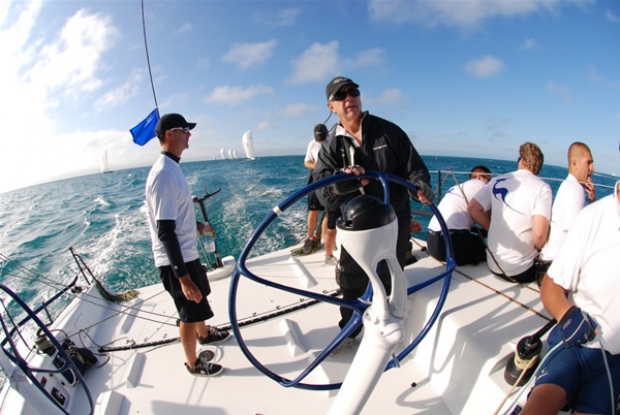
“The IRC rule is now part of sailing at all levels, ranging from club races to major offshore events,” said US-IRC President John Brim (above), who successfully skippers his RP55 Rima2 in national and international events. “US-IRC exists to both educate American sailors about the benefits of the rule and encourage race organisers to utilise IRC in their events.”
Brim noted that in addition to the new US-IRC Championship of Long Island Sound, there are regional US-IRC Championships for the Great Lakes and on the Pacific and East Coasts, together with the national championship, which rotates among regions each year. IRC is also featured as the principal handicap system in many other major regattas and distance races, including the Acura Key West Race Week, the Miami Grand Prix, the Bayview Port Huron to Mackinac distance race, the Pineapple Cup-Montego Bay Race and the Rolex Big Boat Series in San Francisco.
The annual US-IRC Gulf Stream Series, which starts in January and finishes in November, offers a comprehensive season championship that includes 18 IRC events in Florida, the Caribbean and along the East Coast. Newly added for 2010 is the RORC Caribbean 600 Race, which had its exciting inaugural race this year.
In Southern California, the newly formed SoCal52 class (for TP52s of different vintages and with varying modifications) chose the IRC as its rating rule and used it at the first-ever SoCal 52 Regatta in September.
“I believe IRC to be fair, simple and portable,” said Andy Rasdal, owner of the San Diego-based TP52 Valkyrie. “IRC seems to reward designs that make sense--designs that are exciting to race and will be relevant into the future. But, perhaps most importantly, IRC seems to reward well-prepared and well-sailed yachts.”
"Beyond the US, IRC is by far the leading handicap system, offering great opportunities to sailors interested in trying international competition,” said Brim. “With sailors racing around the world under identical handicap rules, it facilitates traveling to foreign events, knowing in advance exactly how you will be handicapped. Conversely, it is important for big events in the U.S. that attract foreign entries."
In early October, Brim will travel with US Sailing’s Offshore Director Dan Nowlan to represent the US at the World IRC Congress in Paris. The primary focus of the Congress, which will be attended by IRC representatives from 27 countries, is to review the year’s developments and consider proposals for IRC Rule changes. One important topic for this year will be the issues of powered winches and 'stored power'. “We will see what the other countries have to say,” said Brim, “but US-IRC does not favor the complexity and expense of powered winches, except for really large boats.”
The US delegation to the World Congress is likely to receive a warm welcome, since IRC officials believe that the US-IRC’s accomplishments here are critical to furthering the rule’s international appeal.
"It is very encouraging to see the increasing international success of IRC as exemplified by the USA,” said Andrew McIrvine, Commodore of the Royal Ocean Racing Club, which manages the IRC rule. “The foresight of the leading clubs in the USA to adopt and promote IRC, and the establishment of the US-IRC to foster its development, have made this the rule for all U.S. offshore sailors who wish to race seriously both at home and abroad."
Most Read
Most Commented
Comments
Businesses

Pro businesses
-
United Kingdom
-
United Kingdom
-
-
Netherlands
Editor's choice
Member blogs
-
 Ned Collier Wakefield: MOD70 round BarbadosWell that was intense. 12 hard fought for seconds for the win. In idyllic conditions, Tony Lawsons MOD ...
 -
 Mini Transat leg 2 reportThe second leg of the Mini Transat started on 31st October, just over a month after ...
 -
Leg 1 reportI’ve been working towards the Mini Transat now for three years. In 2013 I was part ...
Business blogs
-
 The Island Sailing Club in Cowes, Isle of Wight, is delighted that Prince Michael of Kent ...
 -
Peta Stuart-Hunt chats with the 25 year-old British solo sailor Lizzy Foreman before she sets sail ...
-
The 2015 Student Yachting World Cup (SYWoC), an ISAF-recognised event hosted and run by students for ...
Editor's Choice
All time favourites...
-
 Three legs down into Ian Walker’s
 -
 Winning all but two races at
 -
 For the first time in its
Latest Comments
Add a comment - Members log in