
Steady as she goes
Wednesday October 21st 2009, Author: James Boyd, Location: United Kingdom
Nine years on from the introduction of IR2000 and the IRC, Mike Urwin down at the RORC Rating Office in Lymington is sitting pretty.
The recent IRC meeting in Paris, hosted by the UNCL, was attended by 25 countries with reports submitted from a further six. This year IRC certificates have been issued in 45 countries compared to 38-39 in 2008. The world might be going through global economic meltdown, but the RORC’s all-encompassing rating rule is still on the rise.

According to Urwin, numbers are down in what he terms ‘developed nations’ although that was to be expected given the present economic situation. Where growth is being seen is from countries further afield, where the rule has been adopted more recently. He cites the example of Japan where the number of IRC certificates issue has grown from 117 in 2008 to 208 so far this year.
By with the numbers of IRC certificates issued being down in the West, this is affecting the overall total. In 2007 and 2008, certificates were sent out for 7355 and 7740 boats. This year up until the end of August 6224 certificate were issued, down from 6746 over the same period in 2008.
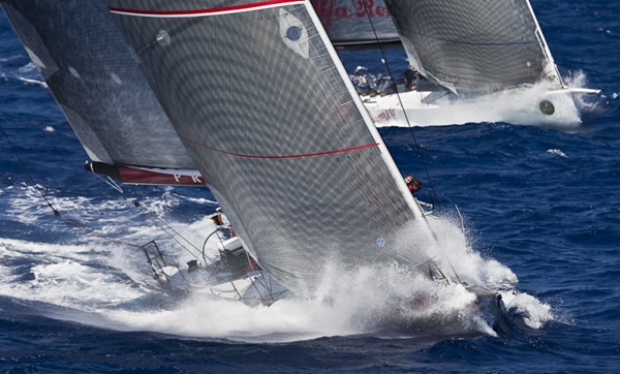
The biggest coup for IRC over the last couple of years is the advent of the Mini Maxis, hotly contested under IRC with many teams operating a step beneath America’s Cup campaigns. Having attended several regattas this year where the Mini Maxis were competing, we didn’t hear any complaints about ratings - which must be a first…
“Every boat in the Mini Maxis has its chance of winning given the right conditions. They are stunning boats. When have we ever had Maxis of that sort of speed before,” says Urwin.
At the Maxi Yacht Rolex Cup in Sardinia last year there had been complaints from the subset of the Mini Maxi class, the STP65s, that some of the features allowed under their box rule were not covered by IRC, one example being their ability to rake their mast during racing. However this specific issue has been covered for 2009.
“Very few of them are actually rating for it, but the provision is there to do if they wish to,” says Urwin. “The idea is to be able to play the rig numbers upwind/downwind or in varying conditions, but the general consensus view is the usual one: when the numbers became apparent at the beginning of the year, half the fleet said ‘bloody hell, that’s cheap’ and the other half said ‘bloody hell, that’s expensive’ which says to me that we probably got it right.”
Generally Urwin says that there are always likely to be some issues when box rule boats or one designs attempt to get an IRC rating, unless that class has set itself up to operate within the framework of IRC and is philosophy. “The problem the STP65s have is that their rules require them to have a lifting keel - which is fine, we can deal with it, but what you end up with is the structure within the boat being slightly compromised, because it is just a little bit heavier, 300kg something like that, which in the context of a boat weighing 15-17 tonnes is not huge, but with the competition at that level of intensity it starts to become relevant.”
Meanwhile the TP52s are introducing rule changes progressively over the next couple of seasons that will make their fleet more competitive under the RORC’s rule. “And the GP42s are beginning to make clucking noises in the same direction, but they have a much more major problem because their boats are so extreme,” says Urwin. “They are very light and very over canvassed and they have spinnaker poles instead of bowsprits. Why would you put a spinnaker pole on a boat like that? It would be like putting a spinnaker pole on an International 14. To get them to fit within IRC is going to be a bit more of a challenge. And they are a bit low freeboard. They are Mediterranean day boats.”
In terms of events, IRC continues to be adopted around the world, but the big news is that the International Maxi Association, a body based out of the Yacht Club Costa Smelelda that also represents the Mini Maxis, has been granted permission by ISAF to hold a World Championship in 2010…
A point going before the ISAF Conference this autumn is whether a World Championship could be held for IRC as a whole. Urwin wonders what form such an event might take. “How would you do it? Where would you do it? How many classes? Is it one champion or lots of champions? How do you race a TP52 against a Contessa 26? If you race them on the same course, the TP52s will spend three quarters of the day waiting around for the small boats to catch up. So yes, it can be done, but do you end up with five world champions? I don’t know the answer.”
Despite Urwin’s reservations, this event seems likely to go ahead as there is already a club (not the RORC and not in the UK we understand) with funding ready to stage it.
Other than the Mini Maxis, Urwin is pleased that another area of growth in IRC has been “what you might call white sail or gentleman’s classes, what Hamilton Island calls the ‘performance class’. That to me is very good news because it is saying that IRC is for cruisers as well as the maxi racers as well, so that is encouraging.”
Design points
Probably top of the agenda at the moment is the issue of stored power. We have seen this on the Maxis, some Mini Maxis and the general trend is for electric or hydraulic winches to be fitted increasingly to smaller boats. Obviously this doesn’t effect straight line speed, nor does it affect the skill required to trim sails, but powered winches does have a performance benefit in making manoeuvres faster.
So in their ability to play God with our sport, the Rating Office is feeling the need to legislate, to dissuade smaller boats from feeling they have to go down this path. “It is a conundrum, because by the time you get to a 60ft Swan, you don’t want to dissuade people, because that is what the boat comes with and it is the natural thing to have. By the time you get to the 100+ft superyachts, they have ALL got electric and hydraulic stuff and they have to have it, so we don’t want to disenfranchise those guys. So it is quite subtle what we need to do. What is inappropriate is that every 30 footer has to have electric winches.”
At present this issue is being examined by the IRC Technical Committee.
The beginning of another trend is for boats to replace bulb keels with very deep fins. The Technical Committee is also revisiting that area of the rule. “Is that sensible? Not sure,” questions Urwin. “So we are taking another canter through that again. Whether there will be much change on that, I don’t know. I don’t think it will be huge, but maybe more subtle tweaks.”
Generally Urwin observes race boats are being designed with ever deeper draft, but this may just be a trend in yacht design rather than a technique used to optimise for IRC. “There is a school of thought that draft in IRC is cheap. I’m not sure I agree with that. We had a look at it early this year and I couldn’t see a grounds for changing it. Boats are generally getting deeper, but that is because they are getting lighter with bigger rigs, so they need the righting moment. One thing drives another and everything is interlinked.”
There may also be subtle tweaks to the secret IRC rule when it comes to bowsprits, but opinion seems divided on whether or not they are a benefit in terms of the rule, which again Urwin takes as a positive sign.
Similarly they are also about to leap on boats attempting to fit non-structural fairing around keel struts, something that obviously cropped up in the last Volvo Ocean Race, but which is beginning to spread to other race boats.
Measurement
From 1 January 2010, the Rating Office are also planning to fully adopt the ISAF Equipment Rules of Sailing, something that Urwin says that they have been moving steadily towards over the last few years.
“What we want and need to do is to work with countries and national authorities, and so on, to improve measurer training and improve the standard of measurement and the best way to do that is to use standard terminology and everything. So over the last two or three years we have been working with ISAF to get the equipment rules to a point where they are usable by big boats – when previously they weren’t.”
Hand in hand with this they have been working with ISAF on an international measurer training course, with the aim that measurers get trained to use the equipment rules as a matter of course, so that as Urwin puts it “they can then measure anything from an Optimist to a Maxi. To us it makes perfect sense, but in the course of doing that what we are also concerned about is that we don’t confused people and make them think that they have got to have two documents. So we are working on the presentation of the rule in an electronic format so that the whole thing is bound up in one document and everything hyperlinked to everything else. You click on ‘J’ and it takes you to the diagram and all that sort of stuff.” That will be available on the rating office website in due course.
So, all in all, very positive times for IRC.
Most Read
Most Commented
Comments
Businesses

Pro businesses
Editor's choice
Member blogs
-
 Ned Collier Wakefield: MOD70 round BarbadosWell that was intense. 12 hard fought for seconds for the win. In idyllic conditions, Tony Lawsons MOD ...
 -
 Mini Transat leg 2 reportThe second leg of the Mini Transat started on 31st October, just over a month after ...
 -
Leg 1 reportI’ve been working towards the Mini Transat now for three years. In 2013 I was part ...
Business blogs
-
 The Island Sailing Club in Cowes, Isle of Wight, is delighted that Prince Michael of Kent ...
 -
Peta Stuart-Hunt chats with the 25 year-old British solo sailor Lizzy Foreman before she sets sail ...
-
The 2015 Student Yachting World Cup (SYWoC), an ISAF-recognised event hosted and run by students for ...
Editor's Choice
All time favourites...
-
 Three legs down into Ian Walker’s
 -
 Winning all but two races at
 -
 For the first time in its
Latest Comments
Add a comment - Members log in