
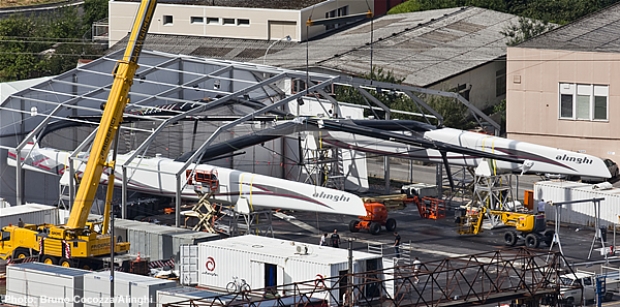
21st century maxi-cat
Monday July 6th 2009, Author: James Boyd, Location: United Kingdom
According to Alinghi’s design head, Rolf Vrolijk they have on their office door a photo of
Team Philips with her bow snapped off - the no1 yachting carnage shot of 2000. He seems to enjoy taunting the team’s engineering head, Dirk Kramers, with this image, a powerful reminder of how it can all go so terribly wrong when working with giant ground-breaking multihulls.
While the new Alinghi 5 giant cat shares many structural similarities with Pete Goss’ ambitious catamaran, a decade on and technology has come on in leaps and bounds. The Swiss machine also benefits from being well resourced and having a combined brains trust that Team Philips designer Adrian Thompson and her engineers at SP Systems could only baulk at.
Very specifically, understanding the loadings within their revolutionary new catamaran is going to be the single most important aspect of its success or failure, for without this it will be only too easy to break it, as was found sadly with Team Philips. And some of the loadings are going to be very very impressive. The big numbers are not going to be so much from the mast step as you might imagine, but from within the compression tubes forward, particularly for the reachers, says Rolf Vrolijk. This could be seeing 70-100 tonnes and of course there is also the dynamic loading, the scales going up and down as gusts hit or the boat encounters waves - fortunately dampened out to a large degree by the pencil-thin, wave piercing nature of the hulls (as was also the idea with Team Philips). And of course this being the America’s Cup and the height of technology within our sport – and it can genuinely claim this now with these extraordinary 21st century machines – the tolerances will be way slimmer than you would see on any other race boats.

Bare in mind too that the Cup will be held in relatively flat water and stable-ish wind conditions, admittedly on a Deed of Gift race course substantially longer than what we have become used to in recent Cups, so the span of the dynamic loadings will be very much less than what would be seen in an offshore boat. So both the Alinghi and BMW Oracle Racing multihulls will be very very much more finely tuned instruments than their offshore brethren. And this is why Alinghi are placing so much emphasis on getting as accurate and all-encompassing data on their new boat as they can.
As Vrolijk puts it: “You have to make sure the boat’s not exceeding it [the max load], because these boats are really designed on the limits. There is no room to play.”
 Fortunately to handle the CFD they have many of the best in the business, headed by the guru himself, Michael Richelsen (right), and his new recruit ‘superboffin’ sidekick, Daniel Bernasconi, (Cambridge degree in Engineering, PhD in fluid dynamics, six years at McLaren Formula 1, etc), supported by Jim Bungener and code developer Mark De Gids. On the engineering side there remains Dirk Kramers, Brett Ellis and Aaron Perry, with the new addition of Will Brooks. On composites they still have Kurt Jordan and on performance analysis there is Luc Dubois and Jean Claude Monnin. Once again the mast program has been put together by Kurst Feddersen working with Murray Jones. And this is ignoring the not inconsiderable additional talents of Tom Schnackenberg, Grant Simmer and sail designer Mike Schrieber.
Having spent most of the last decade creating and refining to the nth degree his model for ACC monohulls, so Richelsen and his team had to start from scratch in creating a program that could model their radically different and structurally way more complex multihull.
To do this Richelsen and his team have come with what is known as a ‘six freedom VPP’. We have no idea what this is, but rather like the amps in Spinal Tap going up to ‘11’ rather than the normal ‘10’, we understand VPPs typically have around three to five freedoms. Six must be better. Vrolijk certainly thinks so.
“We had to rethink how performance works and how forces work and it is a very big help to have someone that really writes and understands the VPP and all the forces,” he says. “That allows us to simulate everything, because all the data comes off the VPP and you can see it on the simulator. You can sail the boat, you can bear away, you can do everything.
“The other complex thing with multihulls is their manoeuvrability because that is so different to a monohull because if you tack, you have two hulls in the water and suddenly you have a huge deceleration and huge windage and all those things suddenly make everything very different. You worry about acceleration and how to push the boat, but this is a very different story: How do you accelerate after the tack, how do you get through the tack fast?”
 Vrolijk (right) says that the early iterations of the VPP were essential in their deciding which path to go down. “When we went through the first stages of developing the concept we could do everything. Okay a trimaran is different from a catamaran, but we could have the boat on foils, on four foils, three or two foils and sail it around in different winds. And it is all visual on the screen, which I think is very unique. From that point of view I think we are very far ahead of mainstream designers.”
In fact Vrolijk isn’t convinced foilers are any faster and they did the research. In the early stages they employed designer Sebastien Schmidt to do a study on what it would take to make Bertarelli's 41ft cat, Le Black, foil and they also had a meeting with the L’Hydroptere team who were keen for them to build a bit inshore version of their foiler tri. According to Vrolijk their VPP has shown the foilers to be occasionally as fast, but no faster than their cat with its long and exceeding fine hulls.
“This system is not easy to put on two foils, so you have to put it on more foils and then you add it up and it doesn’t work. It flies, but it is not fast! Plus all the problems with controlling the foils. Maybe in 10 years….”
In the initial broad brush phase of the design process as they looked at all the options, one of the key factors was deciding upon something that was achievable within the time frame available. Remember that when the Supreme court initially decided against Alinghi (before the appeals) it was February 2008 and the schedule at that time was to start building in May 2008 with a view to sailing it in October…
“We didn’t want to put ourselves at a point where we were not 100|% sure that we could handle the size of the boat,” says Vrolijk. “And of course we looked at 140 footers and huge rigs and sail plans and three masts and five masts, but you have to be realistic that with the concept at the end you can get at least 90% out of it. We had concepts that were faster on paper, but if you can only get 70% out of them or you can’t build it or there is a problem, you will never be as fast as this one at 90%. So having development time and making sure you can get 100% out of it is the goal. Next time if we do another one, we’ll do something very different!”
To build the load case, they had a good platform from which to glean real data in Bertarelli’s 41ft Bol d’Or winning cat, Le Black. However even this only has a beam of 8m or a 65% beam:length ratio and not the 80 or 90% of their new machine. They also had the Decision 35 cat and last year their Extreme 40s from which to collect load data.
In addition to this they carried out tank testing and as every part of the new maxi-cat was built it was subjected to a series of load tests. All the data from all of this testing ended up in Richelsen’s VPP, further refining it.
But perhaps the most innovative part of building up the load case was fitting most of the high load areas of the boat (ie pretty much all the boat…) with a fibre optic lattice that can, in the right hands and provided it is calibrated correctly, portray a very accurate 3D picture of the load case. Load cells are now a thing of the past. According to Vrolijk this fibre optic lattice is something they used in places on board for the 32nd America’s Cup, only on the cat its use is far more prolific. They are continuing to work with the École Polytéchnique Fédérale de Lausanne (EPFL), Switzerland's Federal Institute of Technology, the college that has been Alinghi’s long term engineering partner since their first Cup campaign, but now they have the EPFL’s Daniele Costantini full time on their design team. His sole job is to monitor output from the fibre optic grids. Considering the amount of data that this will produce, this sounds like a job for more than one….
Already this has been put to the test. Within the floor of their build shed in Villeneuve is a special area of reinforced concrete and last November Alinghi 5 was to be found flipped upside down, suspended by her beams, as enormous downward forces were applied to the key parts of the boat - chain plates, runner and head stay attachments, etc - to simulate rig loads. Again this data was pumped into the VPP.
But now the big day is rapidly approaching where the design team will find out how accurate their model already is given all this pre-arming, compared to what will actually happen out there on the blue crinkly stuff.
“All the parts have been tested, but we really want to get on the water and put the mast on it and the sails on it to do non-destructive testing,” says Vrolijk. “We’ll record all the forces and slowly go up with all the loads and then after the first two or four weeks sailing then we make decisions about what we can do, how we can increase the loads or push the boat more, like sail areas and floats, boat length, stuff like that. You can look at higher stability. But first you need a database to work off.” As we mentioned on Saturday, it sounds like the team are not afraid of giving their new cat some severe surgery if they think it is required.

Above: forward half, below: stern half

Some things we haven’t mentioned about the structure
According to Dirk Kramers (below) the main and aft beams are different shapes for different reasons. The main beam is shaped as it is to counter the bending moment in the hull generated by the daggerboards. It is also a substantially larger section since the loads passing through it are VERY LARGE. Meanwhile the aft beam is curved merely to keep it clear of the water. (Another unusual aspect of the beams that is the perspective of the helmsman forward – he will be looking at the leeward bow some 40m away from beneath the main beam…)

The hulls are thin but essentially cigar-shaped, like Team Philips’ were. This is for structural reasons, the large cross section of each hull mid-ships at the main beam encouraging the bow to remain attached to the rest of the boat.
On Saturday we provided the analogy of a mast for the complex rigging that is to be found beneath all the beams between the hulls. However Vrolijk provides more explanation: “The biggest problem with cats, and any multihull, is racking and stiffening it out with the hulls and the beams is nearly impossible. Sometimes you have this cross [the X beams found on ORMA 60s like Gitana X], you have angled beams and all kinds the solutions people were trying. Here all the rig loads are going straight into the spines and the rigging. There is no mast force going into the hulls. The only load [from the rig] going into the hull basically is the forward thrust of the sails. All of the others are not going into the hulls straight. That is the biggest difference with this kind of structure, which makes this a very different solution for hull connections.”
So to reiterate – the loads from the headsails and headsails are handled by the forward beam/bowsprit while the runner chain plates and the headsail sheet leads are mounted on the diagonal beams reaching aft from the mast step to the aft beam, with the carbon beams and the rigging beneath them (rather than the hulls) tying these loads together.
Vrolijk continues: “The highest loads are in this spline system, in the diagonals, because you have the headstay in the compression here, because you have the reacher on it and the backstays there - which is a very good system because we can sail with a lot of tension. You see Oracle pulling on hulls, it is very difficult because you have to angle the hulls and then you have the dynamic flexibility and this is really what you want to separate completely here.”
So could the Alinghi set-up handle forestay loads as high as the tri could? “You can go really high. There are hydraulics and everything. You can really pull it up to max tension. You have to. It is like an ice boat - the more you pull on the sheets, the flatter you make the sails, the faster it goes. And downwind it is the same: your apparent wind comes around the front and it is only a 10deg difference - that’s all. It is always apparent from the front and its always flat sails and max tension makes you go fast. That is the whole system.”
So Vrolijk appears to be well aware of the ‘lock and load’ approach to racing multihulls, where trimming in the monohull sense is not possible because of the load and how much faster things happen on a multihull, the result being that the trim tends to be set up roughly and the helmsman then steers to it. The question remains if Alinghi have a cunning system for sheeting in rapidly and whether they think powered winches are legal. “We have grinders. We have not many but we have grinders,” is all Vrolijk will say on the subject.
As to the crew, the Alinghi sailing team currently stands at 23 and Vrolijk reckons it will could come down to 15-20. However this will be entirely up in the air [excuse the pun] and could go up or down. What is certain is that they will be carrying possibly only a quarter the number of sails that they would on a V5 monohull.
In our first look at the new Alinghi 5 cat on Saturday we contemplated whether with the extra large cross beams, the fore and aft beams and diagonal beams, plus the added cabling beneath these, their cat would end up any lighter than the trimaran equivalent. Vrolijk reckons it does. However there are some ifs and buts. He maintains that the structure on their cat is substantially more rigid than BMW Oracle’s trimaran. However stiffness with multihulls (just as with monohulls) on the one hand comes with a weight penalty but on the other holds a significant performance bonus. Somewhere between these two is a sweet spot, a Richelson VPP-endorsed compromise.
Another area of compromise is in the issue of beam. Cats are only quick when they are flying a hull and yet on the one hand cats with narrow beam fly a hull more readily and in less breeze than wider ones. Narrow cats are also lighter. And yet when it comes to ultimate power its pays to be wider with more righting moment available, although of course this is also a function of just how enormous the sail plan is.
Vrolijk reckons Alinghi 5 will be flying a hull in 8-10 knots of TWS. “The thing is if you talk about six, that means about eight [at the top of the rig] and on the water there is zero! It will be flat water…”
Another unusual aspect of what makes multihulls tick is their length. “Length is frictional drag and not obviously faster as it is on a monohull, unless you go heavier with more sail area and all those other things. Length is not the speed limitiation. These boats, they sail on their length but they don’t use their length as normal boats do. So length is not really the factor for speed – and that is what people have to realise that is different to a monohull. These boats have very low drag hulls but the frictional drag is very very high, like 80% or more of the total drag of the hull. So you have to be careful when you put frictional drag on it.”
Sadly, Vrolijk is reluctant to talk about maximum speed simply because that is not the function of the boat and it will never sail in those conditions during the Cup match. Bertarelli however is exceedingly keen to break the ‘Blue Riband’ record on Lake Geneva for the fastest boat on the Bol d’Or course, so this may be something that happens after the Cup. However Vrolijk is still reluctant as the boat is simply not geared up to sail at 50 knots or upwind at 25 even if it is almost certainly capable of such speeds.
Water ballast and the rules
We talk to Vrolijk about water ballast and while he gives the impression Le Grand Chat doesn’t use it – or at least doesn’t at present - he says that he reckons they could, and this brings us neatly on to what rules he thinks they are racing under and building their boats to.
On this topic the Deed of Gift states: “…These ocean courses shall be practicable in all parts for vessels of twenty-two feet draught of water, and shall be selected by the Club holding the Cup; and these races shall be sailed subject to its rules and sailing regulations so far as the same do not conflict with the provisions of this deed of gift, but without any times allowances whatever.”
Since the class rules for racing on the lake preclude almost nothing – take the Pharos 40 monohulls that typically win the singlehulled division of the Bol d’Or, and have a canting keel, water ballast and even allow the crew to trapeze… - then this also applies to their boat in Vrolijk’s view. However you try finding a document that lays down in black and white what is and isn’t allowed.
In our recent interview with him, Jo Richards said that water ballast was very useful for providing Le Black with additional mass and therefore inertia to help going through tacks. However Vrolijk says they have moved on since then.
“That is a slightly different boat to what we have because that has a lot of rocker, so it has manoeuvrability. I don’t think they use water ballast for tacking anymore now on the 41. We didn’t and we were actually very good at tacking it at the end, but that is very much a technique, it is a lot more complicated than on a monohull. The windage is so big, because you have this huge tall mast and suddenly if it is not pushing anymore, it is just stopping you, like you hit a wall. So at the correct moment you have to be at the right angle and that is the whole point: When the boat stops, you have to be at the right angle to accelerate again. If you aren’t, you’ll go backwards. You really have to work hard on it but in the end the guys were doing it easily.”
According to Vrolijk the BMW Oracle Racing tri didn’t tack for weeks when it was first launched. “We have to tack here every 10 minutes otherwise we’ll hit a rock! For us we will have to tack quite soon.”
Made in Switzerland
Impressively pretty much everything on Alinghi 5 has been built or sourced within Switzerland in accordance with the Deed of Gift. Originally says Vrolijk they had hoped not to have to build this giant sailing machine in land-locked Switzerland, but the nationality rules stipulated in the Deed gave them no choice. This leaves them with the interesting problem of how to get their boat out of the country with option a) being it lifted to the Med beneath a giant Russian helicopter and b) it being sent 400km down the Rhone on a barge fitted with two cranes to lift it over bridges, an operation that could take weeks.
While Decision built the hull shells in their autoclave, all the rest of the build work was carried out down at their facility in Villeneuve by Alinghi’s own 40 strong build team led by Silvio Arrivabene, Gary Hutchinson and Tim Webster, who have been with the team since their first campaign.
The carbon rigging both for the mast and the support beneath the beams, forming the central structural between the hulls has been made by Carbo-link in Zurich, a company they have been working with since 2002. This is so vital to the new boat that the company’s Andreas Winistoerfer is now on their design team. All the metal fittings were made in Switzerland.
On site in Villeneuve they have their own autoclave too, which they have used to build the mast and some of the other carbon parts. According to Vrolijk their autoclave is big enough that they could have made the mast in one piece. “Everything is done here, which is quite amazing,” he says. “It is all done here in this little village.”
In another tent behind where the cat has been slowly coming together over these last months, they have their own sail manufacturing plant.
Followers of the last Cup may remember that Alinghi were trying out a new black sail cloth rumoured to have emanated from Switzerland. In fact this has subsequently turned into the new North product, 3Di and is essentially 3DL without the film. Funded by Bertarelli it was ready for the 32nd AC, although in the end they didn’t use it.
“3Di was an amalgam, the fibre spread really thin with the resin already on it and the resin effectively became the film,” says Vrolijk, who compares it with the pre-preg cloth used in boat building. “If you look at a 3DL sail only about 30-35% is the actual fibre. The rest is glue and film to keep it together. So proportionally this is only fibre and glue.”
So was there anything particularly hard to source within Switzerland? “Actually not much,” says Vrolijk. “It was just a problem to get enough labour in one place. Normally you spread it - you have a mast builder here, you have a builder for those other parts there, but suddenly now you have to do it all here. We built everything.”
Time and money
Vrolijk reckons that 100,000 manhours have gone into the building of their new catamaran and this equates to four V5 boats or two campaigns-worth of the old Cup monohulls. In terms of carbon alone there is probably five times more in Alinghi 5 than in a V5 boat. However he acknowledges that they will also spend considerably less time in sail testing and development and there is no two boat testing.
“So in the end it is not that much more expensive. And we don’t have 120 sails or a 5 million Euro budget on sails. We are happy to have three mainsails. So it is different. And it is a short period with just four or six months of sailing.”
Conclusion
So will the new Alinghi kick BMW Oracle butt? We are still sceptical, although there are some monstrously intelligent people working on the Alinghi boat and if ever there was a team that could make this work… Ultimately it could come down to how well it is sailed for whenever the cat is not flying a hull the tri we think will be faster.
Come the 33rd AC in February next year or whenever the conclusion from the next round of Court action deems it to be, we can expect a phenomenally exciting spectacle of the world’s two fastest boats drag racing around the race track, but one thing it won’t be is anything remotely approaching an exciting match race. From the pre-starts to tacking duels to luffing matches, about 90% of the standard match racing manoeuvres will be simply not be possible due to the manoeuvring difficulties of these boats. It will be the equivalent of trying to race dragsters around a Formula 1 track.
More photos on the page 2...

Most Read
Most Commented
Comments
Businesses
Pro businesses
-
United Kingdom
-
United Kingdom
-
Netherlands
-
France
Editor's choice
Member blogs
-
 Ned Collier Wakefield: MOD70 round BarbadosWell that was intense. 12 hard fought for seconds for the win. In idyllic conditions, Tony Lawsons MOD ...
 -
 Mini Transat leg 2 reportThe second leg of the Mini Transat started on 31st October, just over a month after ...
 -
Leg 1 reportI’ve been working towards the Mini Transat now for three years. In 2013 I was part ...
Business blogs
-
 The Island Sailing Club in Cowes, Isle of Wight, is delighted that Prince Michael of Kent ...
 -
Peta Stuart-Hunt chats with the 25 year-old British solo sailor Lizzy Foreman before she sets sail ...
-
The 2015 Student Yachting World Cup (SYWoC), an ISAF-recognised event hosted and run by students for ...
Editor's Choice
All time favourites...
-
 Three legs down into Ian Walker’s
 -
 Winning all but two races at
 -
 For the first time in its
Latest Comments
Add a comment - Members log in