
Crystal ball gazing
Thursday May 22nd 2008, Author: James Boyd, Location: United Kingdom
While the wrangling between Alinghi and BMW Oracle Racing has destroyed the America’s Cup as we had become accustomed to it last summer, about the only saving grace of the present situation is that two of the most heavy weight yacht design groups are now doing the unimaginable and focussing their attention on breaking new design barriers in our sport as they conjure up two giant multihulls in which do battle in the 33rd America’s Cup when ever, where ever that may be.
Obviously at present neither side is saying anything about what they have designed and are now building. We do know that BMW Oracle Racing have challenged in a 90 by 90ft vessel, but whether or not the vessel they actually pitch up with will be of these dimensions remains to be seen. According to Alinghi/Societe Nautique de Geneve lawyer Lucien Masmejan - since the Golden Gate Yacht Club’s challenging yacht has been specified as 90 x 90ft it must therefore be of this size, and one suspects that if the BMW Oracle Racing multihull proves not to be of these dimensions, the whole debacle may be heading back to the New York Supreme Court yet again. In reality it seems likely that the BMW Oracle Racing challenger will be 90ft long but may not need to be 90ft wide (if this proves true - surely throwing some racks on either side to extend it out to the required BeamMax would be a cheaper alternative than a couple of hours of New York law firm fees?)
While in theory the BMW Oracle Racing boat has to be 90 by 90ft, the only constraint on the Alinghi/SNG defending yacht is that laid out in the Deed of Gift - if a singlemasted yacht, then no more than 90ft at the load waterline (LWL) and if fitted with two masts, then of no more than 115ft LWL. Otherwise it appears to be anything goes -– or almost. Although it has not been confirmed it is assumed that racing will take place under ISAF rules and if this is the case - and without mutual consent between the two teams to do otherwise - then potentially useful items on such a large boat, like powered winches, will be prohibited.
Designing to what is effectively an open brief, compared to the tight constrains of Version 5 of the ACC rule, is a refreshing challenge for both design teams. As Alinghi’s multihull enthusiast head of engineering, Dirk Kramers, admits - the Swiss design team have been “like kids in the candy shop”.
“The problem is really not so much the perfect design, it is the best design we can achieve in a given amount of time,” Kramers says of their new project. “A lot of our work is designing together with the boat builders, to work out what we can achieve to go racing in May [2009]. So the kid in candy store has a limited amount of time to get his candy.”
Design teams
To tackle this fresh challenge Alinghi have substantially enlarged their design team, while with the introduction of Russell Coutts into the equation BMW Oracle Racing have revised theirs from the bottom up.

New faces at the Alinghi design team
Alinghi still have many of their successful personnel from the 31st and 32nd America’s Cup, led by Grant Simmer and Rolf Vrolijk and with Kramers running the engineering and Michel Richelson the CFD. They have also brought in multihull specialists Nigel Irens and Benoit Cabaret as consultants, while Alain Gautier is employed as a consultant on the sailing side, but is also likely to have input on the design. While they have lost Mike Drummond to BMW Oracle Racing, they have supplemented the design team with design guru and former Team New Zealand head Tom Schnackenberg, construction and planning manager Silvio Arrivabene (ex Mascalzone Latino), load and strain measurement engineer Daniele Costantini, VPP expert and engineer Andrew Mason, VPP engineer Daniel Bernasconi (ex-McLaren F1, Team Germany) and composite rigging expert Andreas Winistoerfer.
Within their existing team Kramers has past multihull experience - he worked on the mast program on Dennis Conner’s 1988 Stars & Stripes cats along with Alinghi sail designer Mike Schreiber - while structural engineer Kurt Jordan worked on Steve Fossett’s maxi-cat PlayStation.
BMW Oracle Racing on the other hand set up a design team specifically to work on their new multihull. The main designers Marc van Peteghem and Vincent Lauriot Prevost have been the leaders in recent years in the ORMA 60 trimaran class and are working with Design Co-ordinator Mike Drummond and Mick Kermarec, who was with the team for the 32nd AC, and now leads their performance prediction and appendage design team. In addition to this they have Groupama skipper Franck Cammas and a wealth of their own heavily PhDed men in labcoats on the payroll.

BMW Oracle Racing's design team - they've definitely removed their spectacles
Build teams
We know that the construction of the new BMW Oracle Racing boat is substantially further progressed than Alinghi’s. The new American boat is being built by a team led by Mark Turner (not the Offshore Challenges one) and Tim Smyth in a shed in Anacortes (between Seattle and the Canadian border) close to Janicki Industries who built their yachts for the 32nd America’s Cup. Alinghi are once again building their new multihull at Decision SA in Switzerland, where their previous challengers and subsequent defenders were built.
Crystall ball gazing
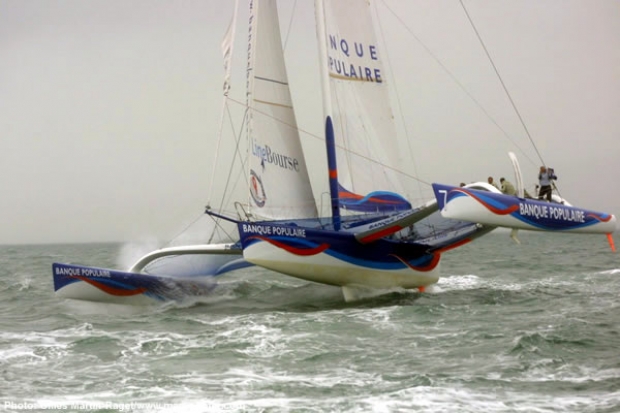
 So what will the new multihulls be like? Dirk Kramers gives us some broad brush insight: “These boats will be something you have never seen before. They are basically inshore versions of Groupama 3 and Banque Populaire. That is what we are looking at. Of course you are trying to get the maximum amount of stability for the minimum amount of weight to improve the performance, but when it comes to loads there are limits. Hardware needs to get developed to deal with the loads and there is a reasonable baseline with these offshore boats – to buy winches, to get hardware, ropes, blocks, etc developed for these sized boats. Then again that is one of the limitations we need to put ourselves under.
“The other side of the development is the whole sailing side. How do we sail these boats? What manouevres are going to be usable? How do we take the sails down? How do we furl them? All these details need to be worked out. So we are working quite closely with the sailing team and we have brought in people like Alain Gautier and so on to really help us how to figure out the sail handling and that all needs to be incorporated into the boat.”
 An additional problem is that the boats are much much bigger than the 70 something foot V5 boats used previously. As Rolf Vrolijk explains: “On the materials, the weight is about three times the amount of carbon fibre that we were using on the old AC boats. The parts are multiple numbers of what we had. The hours are at least twice the hours to build this boat.”
Nigel Irens points out that while there is obviously huge experience in France designing and building multihulls, to date this has really only been for offshore use. No one has previously designed or built a multihull of this size to race inshore.
The expert's view - Marc Lombard
With no concrete information coming from the two camps and with Irens/Cabaret working for Alinghi and VPLP for BMW Oracle Racing, thedailysail turned to Marc Lombard, the only contempory French ORMA trimaran designer not (yet) employed by either team, for his views on what the two teams might come up with.
 Lombard has been designing large racing multihulls since the mid-1980s when he penned the 75ft foiler trimaran
Ker Cadelac II for Francois Boucher and of the final crop of ORMA 60ft trimarans he was responsible for
Banque Populaire and
Sopra Group.
Lombard has been designing large racing multihulls since the mid-1980s when he penned the 75ft foiler trimaran
Ker Cadelac II for Francois Boucher and of the final crop of ORMA 60ft trimarans he was responsible for
Banque Populaire and
Sopra Group.
As we suspected Lombard is unequivocal when it comes to the cat versus tri debate. Historically looking at length restricted multihull classes like the ORMA 60s or the Formula 40s of the 1980s, trimarans have always proved dominant. “If you can design any kind of multihull I would definitely go for a trimaran rather than a catamaran. The first reason is that with a catamaran you are limited with the power you can have, by the weight and the width and as long as you don’t fly a hull you carry a lot of wetted area for the power. With a trimaran you can get more power, so you can carry more sail and in light air and if the wind is not sufficient to go to the maximum righting moment, you end up with less wetted area. So therefore there is no discussion in my opinion. Even in the range of around 14 knots of wind, I don’t believe a catamaran will have a chance, unless they are very lucky and are exactly in the range where the cat is efficient.” So, as we suspected - two 90ft long trimarans.

Since he designed Ker Cadelac back in the 1980s with straight retractible foils in each of the trimaran’s (small) floats, on Banque Populaire in the late 1990s, Lombard pioneered the curved retracting foils that all the ORMA teams subsequently adopted for use in their trimaran’s floats. “I’m sorry not to have had a patent on that - that was the biggest mistake of my life!” he admits.
 Used in conjunction with wingmasts that can be canted to weather, the curved foils dramatically improved the performance of the ORMA 60s. Their use effectively increased righting moment when the trimarans were powered up but could be retracted back into the float to minimise drag in light winds. In powered up conditions, the foils, used in conjunction with the rig canted to weather, reduced the drag of the weather float and in particular lessened the tendency to nose dive and ultimately pitchpole. While ORMA 60s of the mid-1990s sailed along at speed in a ‘ball of spray’ from the leeward bow, suddenly boats after this with the foil and canted rig became much drier. From time to time on reaching legs during ORMA grand prix the trimarans could be seen sailing with ONLY their leeward curved foil (and hopefully a small amount of rudder) in the water. It seems certain the new boats will have with similar retracting foils in their floats.
While Franck Cammas’ new 105ft Groupama 3 is said to weight 18 tonnes, Lombard reckons that a 90ft trimaran designed for inshore use should be in the order of 10-12 tonnes and reckons they will be looking to keep the righting moment under 200 ton/m. “There will not be, as I have read in several articles, enormous loads - these are common loads on the maxi Jules Verne designs. We know we can achieve this sort of power without too many problems.”
But Dirk Kramers has a view on this: “If you compare it to Groupama the dynamic loads, of falling off waves, is going to be reduced. Inshore you tend to sail much tighter and sheet things much harder because you are not reaching for the next weather system, you are sailing VMG. So the static loads are going to be quite high compared to the offshore boats.”
Given that both Alinghi and BMW Oracle Racing’s offerings are likely to be 90ft long (on the waterline at least - maybe they won’t have plumb bows?) then the fundamental variables, says Lombard, will be the relationship between mast height/sail area versus beam and establishing which works best with the expected wind conditions. A problem of course is gauging what the expected wind conditions will be, given that the venue and date have yet to be finalised. If it is May in Valencia then the Windfinder website indicates that there is only a 17% chance of the wind being more than Force 4 (ie more than 17 knots) while the average wind speed is just 7 knots, but then there could be a big variation if racing is held in the morning or afternoon when the sea breeze has established.
In part two of this article tomorrow, Marc Lombard looks at more specific aspects of what the new boats might look like
Most Read
Most Commented
Comments
Businesses

Pro businesses
-
France
-
-
United Kingdom
-
Italy
Editor's choice
Member blogs
-
 Ned Collier Wakefield: MOD70 round BarbadosWell that was intense. 12 hard fought for seconds for the win. In idyllic conditions, Tony Lawsons MOD ...
 -
 Mini Transat leg 2 reportThe second leg of the Mini Transat started on 31st October, just over a month after ...
 -
Leg 1 reportI’ve been working towards the Mini Transat now for three years. In 2013 I was part ...
Business blogs
-
 The Island Sailing Club in Cowes, Isle of Wight, is delighted that Prince Michael of Kent ...
 -
Peta Stuart-Hunt chats with the 25 year-old British solo sailor Lizzy Foreman before she sets sail ...
-
The 2015 Student Yachting World Cup (SYWoC), an ISAF-recognised event hosted and run by students for ...
Editor's Choice
All time favourites...
-
 Three legs down into Ian Walker’s
 -
 Winning all but two races at
 -
 For the first time in its
Latest Comments
Add a comment - Members log in