
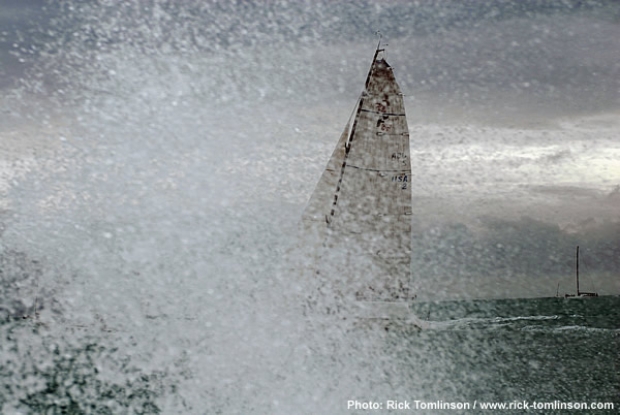
Blown orf
Monday January 21st 2008, Author: Jeanne Kleene, Location: United Kingdom
- Winds in the upper 20s with stronger gusts did not fade as expected through the day
- Rough sea conditions also a factor on day one of the regatta
- Chris Larson, tactician for Alex Roepers on Plenty: “Considering this was the first day of the first regatta of the year and all the teams are still shaking out the cobwebs, it was the right move.”
A storm front hit the southernmost point in the continental United States in the wee hours of Sunday morning and lingered over the Key West area. When Monday dawned and the largest winter regatta in North America was due to begin, a fierce northeaster was delivering consistent winds ranging 25-30 knots and routinely gusting higher.
Event chairman Peter Craig huddled with his four principal race officers and the decision was made to postpone sending the 262-boat fleet out for two hours. Because the Corsair 28 class has a maximum wind range of 22 knots for racing, regatta organizers and skippers agreed to keep the lightweight trimarans on the beach. While some of the Corsair 28 owners were anxious to test themselves in extreme conditions, common sense prevailed.
“If you’re out in survival conditions, it just makes it too difficult to compete. No one wanted to break gear on the first day,” said class veteran Bob Harkrider of August, Ga., who placed second at this regatta last year.
Premiere Racing sent out two committee boats first thing in the morning to take wind readings and gauge the sea conditions. They were recording waves at 6-8 feet and Harkrider said the spirited, high-performance Corsairs spend all their energy preventing disastrous knockdowns in such a sea state: “In those types of conditions, safety becomes a serious concern,” he said.
Just after 11 a.m., Craig and company sent the remainder of the fleet to the four racing circles with the pronouncement that no racing would begin until 1 p.m. By noon, the Division 1 signal boat was reading regular puffs above 28 knots, exceeding the upper end of the wind range dictated by the Melges 32 class so those 27 boats were sent back to shore.
Regatta officials had hoped the wind would stabilize at a reasonable level in order to hold one race for the remaining 10 classes, but all four principal race officers reported conditions that were clearly “on the edge” and the decision was made to abandon all racing without beginning a starting sequence.
“These are the toughest days for our race committee because we recognize that people have spent considerable time, effort and resources to come to Key West. We want to do our utmost to give them five full days of racing,” Craig said.
“However, on the first day of a five-day regatta, we do not want to push the envelope. We want to err on the side of caution. All four of our principal race officers are extremely experienced and in their collective opinion, the conditions today were just too severe for the majority of the fleet.”
Craig admitted the decision may have been different if it was Thursday and one day of the regatta had already been lost due to lack of wind or too much wind. “Certainly, the fact this is Monday was a major factor. You don’t want all sorts of boats breaking equipment when they still have four more days of racing to go,” said Craig, adding that rough seas were also a “significant consideration.”
Forecasts call for winds to decrease to the high teens on Tuesday morning then ultimately drop to 8-10 knots by the afternoon. Craig said the organisers will “work very hard” to complete two or three races on Tuesday.
“We announced this as a 10-race series, but we will not sacrifice quality for quantity,” he said. “If we get in eight or nine quality races that are a mixture of heavy, medium and light air, I think most of the sailors will be satisfied.”
One would expect the professional sailors in the Farr 40 class to be most disappointed about the cancellation of racing on Monday, but the majority understood and agreed with the decision.

“I’d say the wind was definitely in the upper limit of what we can race in. There’s a difference between sailing and racing. When you have 25 boats rounding marks in tight quarters, things can get pretty hairy in 30 knots of breeze,” said Chris Larson, tactician for Alex Roepers on Plenty. “Considering this was the first day of the first regatta of the year and all the teams are still shaking out the cobwebs, it was the right move.”
Roepers is a new owner in the highly-competitive class, having made his debut at the 10th Anniversary Regatta off Miami in December. He also races a Swan 45 and is making the adjustment from helming with a wheel to a tiller.
“This was still a good day for us. Our owner had never been out in these types of conditions in this boat and with a tiller,” Larson said. “It was quite challenging, but Alex was able to gain some valuable experience. We were planing at 14 knots with the main and small jib. We sailed upwind and downwind, did a couple tacks and a couple spinnaker sets then called it a day.”
Dave Ullman, four-time winner in the Melges 24 class, said there could have been carnage in the 46-boat fleet had Division 3 PRO Dave Brennan decided to race.
“It was absolutely the right decision. The wind was well over the top and there’s no reason to go out there and drop rigs or break up equipment,” Ullman said.
The IRC, Farr 40 and Melges 32 classes take their first step toward the highly regarded Acura Grand Prix trophies, awarded to the combined winners at the conclusion of the Acura Miami Grand Prix in March.
For more information see the regatta site

Most Read
Most Commented
Comments
Businesses

Pro businesses
-
France
-
France
-
United Kingdom
-
Italy
Editor's choice
Member blogs
-
 Ned Collier Wakefield: MOD70 round BarbadosWell that was intense. 12 hard fought for seconds for the win. In idyllic conditions, Tony Lawsons MOD ...
 -
 Mini Transat leg 2 reportThe second leg of the Mini Transat started on 31st October, just over a month after ...
 -
Leg 1 reportI’ve been working towards the Mini Transat now for three years. In 2013 I was part ...
Business blogs
-
 The Island Sailing Club in Cowes, Isle of Wight, is delighted that Prince Michael of Kent ...
 -
Peta Stuart-Hunt chats with the 25 year-old British solo sailor Lizzy Foreman before she sets sail ...
-
The 2015 Student Yachting World Cup (SYWoC), an ISAF-recognised event hosted and run by students for ...
Editor's Choice
All time favourites...
-
 Three legs down into Ian Walker’s
 -
 Winning all but two races at
 -
 For the first time in its
Latest Comments
Add a comment - Members log in