
And the rest...
Wednesday June 20th 2007, Author: James Boyd, Location: United Kingdom
This article follows on from page 1 published
yesterday
...
While Coutts may not have been involved in the America's Cup recently, as he says, he has not been twiddling his thumbs...
For the third season he is again campaigning a TP52 on this occasion for Swedish owner Torbjörn Törnqvist (below), who derives his money from the oil industry. Törnqvist drives and while he has sailed for some time according to Coutts he is relatively new to competitive sailing. "He just absolutely loves it. It’s great to see. He’s a pretty competitive guy. He plays a lot of tennis."
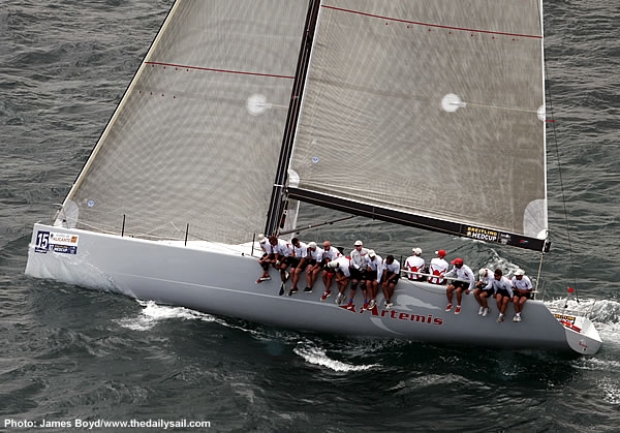
Were it not for a controversial DSQ for missing a mark in the second half of the first coastal race on Friday, Artemis would have comfortably won the Trofeo Alicante. In the event the new Swedish Judel-Vrolijk design finished fourth overall despite her DSQ gaining her 24 points. Aside from this the white hulled TP 52 was the only boat in the regatta to score two first places.
Within the TP 52 circuit, perhaps thanks to the close proximity of Valencia where there are now rather a lot of out of work sailors, generally there is an increase in top level talent this year and on board Artemis it is no expection with a considerable amount of particularly ex-BMW Oracle and former Team New Zealand talent including: Anthony Merrington, Chris Hosking, David Brooke, Goran Collman, James Baxter, Jared Henderson, Joe Spooner, Mickey Eckhart, Peter Bresnan, Philip Jamieson, Richard Bouzaid and Ross Halcrow.
Artemis is just one of five brand new Judel-Vrolijk boats launched this year. Their hull shapes appear more or less identical - so what is going to make the difference in terms of the boat? "I think there is a lot in the building of the boats and the finishing of them," says Coutts. This is partly a weight accuracy issue but also one of alignment - almost a one design approach. "...making sure the boat is nicely symmetric and the appendages are put on properly and haven’t got twists in them. And making sure the rig is in the right place and on centre line. It all adds up."
Artemis was built by the ever reliable Mick Cookson in Auckland, who Coutts has worked with extensively in the past building Team New Zealand's Cup boats. "I think his guys did a good job," compliments Coutts.
Unlike previous years where Coutts' TPs have been fitted with Quantum Sails, this year they are almost exclusively North. So are TP 52 sails standardising? Not to the Coutts eye. "There is still a lot of difference, particularly in the downwind sails, just the way they fly on the boat, where you are putting the area - that can transform into quite a big performance differences."
While some of the new boats have been 'upranged' due to the potential for encountering stronger winds at some of this year's potentially windier venues, as Adrian Stead told us in our interview with him last week, Coutts says this hasn't affected the fundamental design of their boat, although there might have been some consideration in this respect in the sail wardrobe.
Coutts is impressed with the TP 52 class, particularly the number of boats and the standard of sailing, however he makes familiar comments about the performance of even these relatively quick boats, given their use almost exclusively in the Mediterranean. "I think the TP 52s should have square topped mains," he says. "If we are going to sail around the Med in 8 knots of breeze, they need more horsepower and they should have allowed bigger girth in the jibs. To me it was just crazy not doing that - just increase the girth so that at least they are as big as they can be."
Coutts also reckons that crews should be able to use the G0 - large, furling upwind headsails - whenever they want, rather than just in the coastal races. "Everyone has bought the sail anyway. Why do we sail around in 6 knots of breeze with small headsails? It's senseless. We are all using them in the coastal races and we’ll be tacking with them and going upwind with them if it is light winds. So why not use it all the time?"
TP52s, while quick, still suffer from having their roots in the IMS and thus have relatively useless features on a boat of their kind including a minimum sized cabintop and a single backstay - this naturally limits mainsail roach and thus makes it impossible at present to use a flat head main.
The good news is that while box rules such as the TP 52's have a tendency to become out of date after a few years, at least these kind of suggestions indicate that there is still room to turbo the boats in the future.
Artemis, with Coutts on board (perpetually wearing his popular Omega baseball cap), will be competing in all the Breitling MedCup events as well as the season finale at the Rolex Global Championship.

World Sailing League
The ball continues to roll on with the Coutts-Cayard uber-fleet racing circuit. At present Coutts says he is still working with designers Marc van Peteghem and Vincent Lauriot Prevost and various other specialists such as Mick Kermerac on finalising the design.
"It is quite a complex issue to get that design right. They are talking about building 19 boats actually at this point., but if you build 14 with 12 teams, it is a huge investment so you want to make sure the design is correct." One can imagine that even getting a small item wrong on a boat such as this and having to change it on 14, let alone 19 boats would be time poorly spent. Instead Coutts is forging on with the idea of a prototype to put through its paces ready next year.
When discussing the design, one catches a glimpse of the engineer/pioneer Coutts as the child in the yacht design sweet shop, almost dumbfounded by this 'blank sheet of paper' approach, something presumably he has never come across in the rules heavy world of the Olympics or America's Cup.
The boat, as we wrote at the launch, is to be a 70ft long catamaran with a D35-style centrehull (like a trimaran with the middle hull permanently out of the water). On the 70 this is not only to provide a stiffer base to take fore and aft rig loads and a good anchor point for the bowsprit, but it will also house the single daggerboard.
At present the design team are still trying to finalise the main variables such as beam versus sail area. However there are some more complex decisions to be made.
Coutts is keen on the idea of the boat having lifting foils similar to the 60ft trimarans and it will be interesting to see what they come up with, because Coutts says it will likely that in addition to the foils going up and down they are also developing a system to alter the foils' pitch/angle of attack, something that is at present outlawed in the ORMA class (or what's left of it). "The foils lift the 5.5 tonne boat out of the water once the boat speed is up to around 8 knots… it is amazing..."
As we are only used to trimarans of this type, the design team is to some extent entering into new territory with this catamaran. For example because catamarans heel less, would you have both lifting foils down while sailing downwind? In fact due to the apparent wind being a long way forward still it is most likely the boat will still be flying a hull downwind.
One wonders what type of foils the boat will eventually have. If Coutts is serious about getting the boat flying, then it will need not one but two sets of lifting foils on each hull as with just a single set the boat will hobby horse around its single foil (as the present OMRA 60s do to some extent). Presumably a Moth or International 14 style T-foil on the rudder with an adjustable trim tab (to alter fore and aft pitch) would be the answer and might also get rid of the need to carry 1.5 tonnes of water ballast (never great on inshore course boats as it is slow to deploy/dump) in the centre hull. And would the curved ORMA 60-style lifting foils be the best choice on a catamaran that has a tendency to sail with less heel?
At present Coutts is talking about the crew manually adjusting the pitch of these foils, but surely some automatic system could be developed, like a scaled up version of the Moth wand system, attached to a trim tab on the back of the foil?
"For someone like me who is sitting on the outside just listening to it, it is really interesting and much more intesting than a lot of the monohull programs, because you have so many different major factors. It is pretty cool," says Coutts.
As ever one objective close to Coutts' heart is to make the boat so that it can be raced in anger in the widest possible range of conditions - something like 6 to 25-30 knots.
In terms of speed Coutts reckons the boat will perform in a fairly similar way to the 60ft tris, sailing upwind at around 17 knots (in fact Groupama II claim to go upwind at around 19 knots) and should be 'real fast downwind'. If the boat is going to lift out of the water we suspect it could end up being very much faster than a 60ft trimaran...
The schedule is also falling a bit behind and realistically Coutts says that the World Sailing League is more likely to get underway in 2010 with the prototype boat launched sometime next summer-autumn. "These things take time and you just have to make sure it is done right."
Clearly there is a lot of interest from competitors but Coutts says it is too early for this side yet and they are still waiting to put it out into the market. So when can potential entries start to get serious about it? "As soon as everything is finalised. The original timing - September, but I’m not sure that is still the case. I’ve been focusing on the concept, on the boat and that side of it. There is a whole other arm working on the conceptual side of the marketing and selling and sponsorship and all of that."
RC 44
Meanwhile the Russell Coutts (RC) 44s are now into their second season on a circuit that is visiting a few more diverse locations from Cascais, to Dubai and most imminently lakes in Switzerland and Italy (Garda). While numbers have ranged or will range from four to seven for recent regattas and the ones to be held on the lakes, Coutts says that by October there will be 10 or 11 boats racing, including a few more Cup teams. Already Mascalzone Latino boss Vincenzo Onorato campaigns one, but then there are few serious race boats of this size Onorato doesn't campaign...
From Garda the RC 44s go to Porto Finot, Trieste and then to the Middle East.
As with all but one of the boats, they all now seem to be being built by the Paga facility in Hungary, where at present Coutts says they have five boats on the order book. "They have done a good job, stuck to their time line and produced the goods. They do great products and are very innovative - a lot of the carbon fittings, they developed."
A new development for the boat is that they have now added checkstays and Coutts says this has dramatically improved the whole rig set up.
"The thing about the 44s, I just get huge enjoyment out of that whole program. It is a lot of work, as anyone in the boating industry will tell you, it takes a lot of work to get a new product of the ground.
In some ways perhaps it is good that Coutts isnt in the America's Cup, because if he were it is unlikely we'd be writing about all of the above.
Most Read
Most Commented
Comments
Businesses


Pro businesses
-
-
Italy
-
United Kingdom
-
Editor's choice
Member blogs
-
 Ned Collier Wakefield: MOD70 round BarbadosWell that was intense. 12 hard fought for seconds for the win. In idyllic conditions, Tony Lawsons MOD ...
 -
 Mini Transat leg 2 reportThe second leg of the Mini Transat started on 31st October, just over a month after ...
 -
Leg 1 reportI’ve been working towards the Mini Transat now for three years. In 2013 I was part ...
Business blogs
-
 The Island Sailing Club in Cowes, Isle of Wight, is delighted that Prince Michael of Kent ...
 -
Peta Stuart-Hunt chats with the 25 year-old British solo sailor Lizzy Foreman before she sets sail ...
-
The 2015 Student Yachting World Cup (SYWoC), an ISAF-recognised event hosted and run by students for ...
Editor's Choice
All time favourites...
-
 Three legs down into Ian Walker’s
 -
 Winning all but two races at
 -
 For the first time in its
Latest Comments
Add a comment - Members log in