
33rd America's Cup
Thursday May 17th 2007, Author: James Boyd, Location: none selected
One of the quirky, some might say antiquated features of the America's Cup is that until such time as we know who has won we have no firm idea where or when or how or in what boats the next event will be held. So wisely or unwisely given the proximity to early July and the end of the 32nd America's Cup when the victor will be known and this situation becomes clearer, now seems as good as any to theorise about what might happen for the 33nd America's Cup.
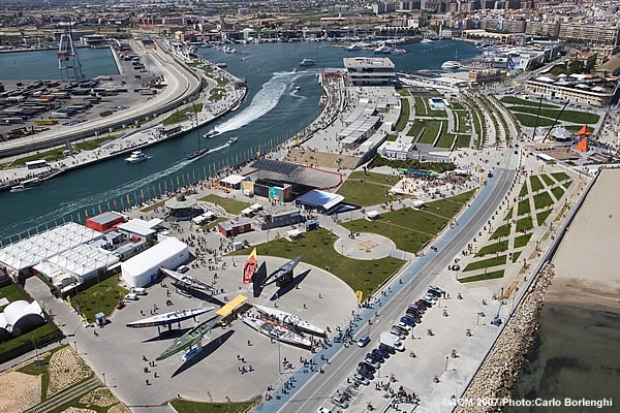
We write this from the media centre at the heart of Port America's Cup, which is not so much a port as a small town with a crescent of giant Cup team bases, bisected by the half empty superyacht pontoon with the Veles et Ventes building, incorporating the swanky Foredeck Club, providing a futurustic backdrop feature as we look out to sea. While there are many within the smaller teams who grumble about the expense of it all one look out of the window here suggests that firstly the America's Cup event is very much bigger than it has ever been, the whole scene very much more akin to Formula 1 than anything similar in yacht racing.
At this stage of the Cup cycle a lot of politics are going on. Whether the 33rd America's Cup will be held again in Valencia remains highly uncertain. This multi-billion Euro infrastructure has been put in place and it would seem a shame to move it on. But as ever with the America's Cup politics and money are likely to take precidence over sense and reason.
Last week Formula 1 mogul Bernie Ecclestone was in Valencia announcing the new European Grand Prix to be held from next seven years on a new 'harbour side street circuit' a la Monaco. The proposed track (click here to see a map of this) is 4.1-4.3km long and includes a lap of Port America's Cup before heading off on a new road on the north side of Valencia's dried up river bed (due west from Port America's Cup), with the pits situated off to the north of this new road. This part of the old river bed at present is unused.

Rita Barberá, Mayor of Valencia (centre) with Michel Bonnefous, CEO of ACM (right) and Manuel Pizarro (left), President of sponsor Endesa
The announcement has caused furore in Spain as Ecclestone has said that this deal is dependent upon regional President Francisco Camps and Mayor Rita Barbera, remaining in office after the local and regional elections, due to take place here on 27 May. Camps and Barbera are with the Popular party (in opposition to the main Spanish government) and many journalists and politicians are viewing this as political blackmail. Interestingly Valencia's contribution to lay on the European Grand Prix is said to be 26 million Euros, a drop in the ocean compared to what has been spent hosting the America's Cup.
Hosting a Grand Prix that laps Port America's Cup might seem to average mortals to represent a boost for the America's Cup event, exposing legions of petrol heads to grand prix yacht racing but back in the political business-driven world of the America's Cup this seems irrelevant. As America's Cup Management CEO Michel Bonnefous explained to us earlier: "Formula 1 came here a little bit because of the America’s Cup. We are very happy because the America’s Cup is not the same project as Formula 1 in terms of infrastructure. [With the AC] it is a place where people live, they spend time, etc etc. A Formula 1 Grand Prix is three or four days. For us it is more important to know what is going to be the development of this area. It is what kind of new vision and motivation we could have with Valencia to continue to host this event here."

Despite the size, complexity and astronomic cost of what has been put in place in Valencia for the 32nd America's Cup, the present arrangement with the city, regional and national goverments is a one Cup deal. If Alinghi win ACM will continue but Bonnefous makes no bones that the hosting of the 33rd America's Cup will be put out to tender once again.
As we have said previously, that Alinghi and ACM can do this is a unique aspect of the Swiss team defending the Cup from a landlocked country that under the Deed of Gift for the America's Cup requires them to defend it on the open sea (ie not a lake). Thus Alinghi can choose a venue that best suits them and the event, whereas BMW Oracle are committed to holding an event in San Francisco, Emirates Team NZ would definitely hold the event in Auckland and for Luna Rossa it would be somewhere undefined in Italy.
So what attributes would ACM be looking for in a new Cup venue? According to Michel Bonnefous this will depend upon what 'model' they decide to use (if Alinghi win and they're still in business come the end of July, etc etc). What ACM have done in their creation of the 32nd America's Cup is to use what Bonnefous calls 'the Olympic model'. This is where a major sporting event is used as the vehicle to regenerate an area as for example will be the case with east London for 2012. This way the event is used as an inspired way for the national and local governments to pump money into a deprived area, to attract sponsorship to assist this process, the money recouped over the long term through business and with the area in question ending up with the legacy of assets (ie a port and two marinas in the case of Valencia, world class sports facilities in the case of east London).
However if the next America's Cup increases the importance of the Acts, giving them equal emphasis to the Louis Vuitton Cup, the whole thing becoming more of a Formula 1-style roadshow with say its own ship to transport the fleet around the world, then this is certain to lessen the demands on the next America's Cup venue. In our interview with him in January, BMW Oracle Racing's Tom Ehman, one of the main political movers and shakers within Cup circles, threw up the possibility of the next Louis Vuitton Cup only being contested by the semi-finallists drawn from the Acts. However we suspect that this would be too extreme a move - having only five teams (four semi-finallists and the defender) will not be a large enough jamboree, in fact it would make this ultimate part of the contest of a smaller scale than the Acts. Besides, the non-semi finallist challengers are certain to demand some involvement in the competition at the Cup venue.
"We have discovered something interesting during the Acts," says Bonnefous, indicating that his preference is pointing in this direction. "Before we didn’t believe that we could organise a Cup in the way we did with the Acts. It challenged the idea that a team needs a Taj Mahal (sized) base, security, etc etc. Now after this experience of the Acts we have seen that it is attractive, teams are able to live next to each other without killing each other - it is something that works. We could easily imagine something in the middle, a super super Act concept. That is something we are exploring due to what we have learned from those Acts."
So it is entirely possible that the next America's Cup venue won't be as massive or require the enormous infrastructure it has in Valencia. If this is the case then the 33rd America's Cup venue could be somewhere that doesn't require fundamental redevelopment in which case the deal with the chosen city could be a less costly affair. Bonnefous refers to this option as the 'communication model', presumably meaning that the host city uses the media attention of the event to promote itself.
"It will be interesting to see what will be reception of a place in case we introduce more of a communication model rather than a deep infrastructure changes model," says Bonnefous.
If ACM decide to stick with their 'deep infrastructure changes model' then we suspect Valencia will not be in the running as the deep infrastructure changes have already been made here. But if ACM did decide to change to this 'communication model', with more emphasis on the Acts, then Valencia could well be in the running, but then this model also opens the Cup to being hosted in many other potential ports. The outcome will depend upon negotiations with the cities in question - aside from Valencia, Athens is believed to be one of several potential locations already visited by ACM.
In reality we find it hard to see how the next Cup venue could be much smaller than what we have in Valencia, unless the Acts effectively become the Louis Vuitton Cup and the bulk of the focus is removed from the final America's Cup venue. Whichever venue is chosen all the teams are going to want to base themselves there in order to train. Unless drastic action is taken to curb costs (which seems unlikely other than possibly limiting new builds to one boat per team) Cup teams are unlikely to be smaller than they were this time and they are certain to require every bit as much space for their sail lofts, baot sheds, corporate hospitality areas, etc.
Another option that has been mooted is the possibility of having the Acts all over the world and the Louis Vuitton and America's Cups held in the 'new venue', but keeping a more basic version of the infrastructure in place here in Valencia with teams using the present Port America's Cup as a general base for the Cup teams. Again we can't see how you would stop a serious challenge from setting up camp at the earliest opportunity in the new venue. This ultimately is where they want to train and this will substantially outweigh the convenience of having a ready-made base and all the services in Valencia.
Given the money-grabbing nature of ACM we suspect they will try to make the deal for the venue as large as it can be while at the same time elevating the scale and importance of the Acts prior to the 33rd America's Cup.
Time frame
If Alinghi win and ACM continues then Bonnefous this morning confirmed that the shortest time frame they could move ahead in is two years, but again one suspects this will depend upon which of the models is chosen. If the event moves lock, stock and barrel to a new venue in need of development then one suspects it might take them longer than two years to create and build another Port America's Cup. If the two years is fixed then it seems the America's Cup lite version possible in Bonnefous' 'communications model', with more emphasis placed on the Acts, will be the preferred course of action.
Money
There is a view among certain parties that the America's Cup is just too big as an event and too expensive to campaign for the teams. "With the Cup back in Europe after so many years with just 11 challengers and three Italians is not a great success," Mascalzone Latino-Capitalia Team boss Vincenzo Onorato told us prior to the Louis Vuitton Cup. "It is too expensive. I am talking about my team - it is a medium-low budget, 64 million Euros and that is ridiculous. That kills the sport." And the budget of Onorato's team is believed to be less than half what the four big teams (including Alinghi) have spent this time around. An America's Cup held in two years time rather than four would dramatically reduce team campaign costs.
"I think private people can’t support such a game," continues Onorato. "There are too few people in the world [who can do this] and that’s not good, because it will look like the sport of rich guys."
Historically hasn't it always been like that? "Yes, but it is not the future. The future is to have professional teams supported by sponsors."
Bonnefous, naturally, is happy with the present scale of his event (having expanded it from a spend of around 35-40 million € in Auckland to 240 million € this time. "We certainly have made a step, but the step was made because nobody had tried to do it in the past. This value was not used at all. Now we are here and obviously the next steps will be smaller and smaller - sure, it will be a bit more complex to progress - there are still a lot of areas where we can progress. We can continue to grow. It is the first time in Europe - it is on the television in the middle of the afternoon and we are pretty happy with the reaction. We have to build on this."
In fact while it is easy to target questions about the next America's Cup to Bonnefous, ultimately they are not his decision if Alinghi win. If this comes to pass then the next Protocol (the document defining the America's Cup - the boats, Acts, etc) will be written by Alinghi (ie: Ernesto Bertarelli, Grant Simmer, Brad Butterworth, etc) and whoever they get together with as the next Challenger of Record (we see no reason why this shouldn't BMW Oracle Racing again).
Bonnefous says he personally isn't involved in the conception of a new Protocol. "We are certainly giving some feedback to Alinghi but it [the Protocol] is something which is designed by the defender. We are not involved with the negotiations of the new protocol, but the feedback on the way the event has been run, and the things we could be involved to be easier in running the event, yes."
Boats
It is also highly likely that there will be no significant development let alone a change with the boat if the time frame is two years or otherwise if Alinghi win. "Is that bad or good?" says Bonnefous. "We’ve never had such close races. If I remember well the comment from four years ago that it was only Alinghi and Oracle, then one year after, ah no there is Team New Zealand and then Luna Rossa and then six or seven teams able to be competitive. So in the end we had quite a close challenger series. We have seen teams improving a lot and being able to challenge. So it is better to stay like this."
Academically we would love to see much faster state of the art boats being used for the America's Cup, 100ft maxis, modern equivalents of the J-class yachts, whatever is the latest state of the art, canting keelers, maybe even multihulls as Coutts and Cayard are advocating with their World Sailing League. But there is something oddly appropriate about this most ancient of sailing competitions being contested in these ridiculously over-developed lumbering lead mines.
If raced in fast boats it would dramatically alter the unique sport of America's Cup match racing. Dave Dellenbaugh, tactician with United Internet Team Germany this time, but previously tactician and starting helmsman on Bill Koch’s America3 in 1992 and with Koch’s Mighty Mary in 1995, reckons that even the present generation Cup boats, now able to use asymmetric spinnakers have altered the game too much.
"It is more difficult with a boat with symmetric spinnaker. [With asymmetrics] downwind it really changes what you can do, because it is really hard to get on the other boat’s wind because they can just heat it up and get their wind in front of you, so there is something to be said for symmetric displacement boats like you find in many traditional match races because I think it opens up that downwind tactical thing - it is harder for the boat ahead. That is one of the things I don’t like about these boats. If you went for more speed you’d lose that part of the game. Maybe it is worth it to have more exciting boats, but there are other places where there are more exciting boats, like the Volvo race, so maybe this is alright."
Aside from altering the fundamental sport, a new generation of maxis would again result in much greater disparity in performance between the boats and it would take at least two more Cup competitions before the event became a competitive one. This time for example there are three challenges with an even chance of getting to meet Alinghi and perhaps three more with an outside chance and this does make for a much more interesting event.
Perhaps the most important aspect is one of cost. Introducing a new substantially larger state of the art boat would hike prices dramatically, making campaign costs all the higher. Here once again Vincenzo Onorato doesn't mince his words: "If you change the boats the America’s Cup will be killed. Next time the [number of] masts must be cut to cost otherwise it will be too difficult. In my opinion there should be one boat, less sail battens, two masts maximum and put a limit on the hours on the water."
Reluctantly we agree.
What do you think about all this? Email us here
Most Read
Most Commented
Comments
Businesses


Pro businesses
-
Italy
-
-
Netherlands
-
United Kingdom
Editor's choice
Member blogs
-
 Ned Collier Wakefield: MOD70 round BarbadosWell that was intense. 12 hard fought for seconds for the win. In idyllic conditions, Tony Lawsons MOD ...
 -
 Mini Transat leg 2 reportThe second leg of the Mini Transat started on 31st October, just over a month after ...
 -
Leg 1 reportI’ve been working towards the Mini Transat now for three years. In 2013 I was part ...
Business blogs
-
 The Island Sailing Club in Cowes, Isle of Wight, is delighted that Prince Michael of Kent ...
 -
Peta Stuart-Hunt chats with the 25 year-old British solo sailor Lizzy Foreman before she sets sail ...
-
The 2015 Student Yachting World Cup (SYWoC), an ISAF-recognised event hosted and run by students for ...
Editor's Choice
All time favourites...
-
 Three legs down into Ian Walker’s
 -
 Winning all but two races at
 -
 For the first time in its
Latest Comments
Add a comment - Members log in