
The virtual 90
Thursday November 15th 2007, Author: James Boyd, Location: United Kingdom
While several teams yet to challenge were hoping for one more America's Cup in the existing generation of boats, particularly with the 33rd AC having a cycle of just two years, a new boat for the America's Cup will certainly add a new dimension to the event - assuming that is comes to pass. For at present whether ACM's vision for the 33rd AC comes to pass and whether the new AC90 sees the light of air is of course in the hands of a New York Supreme Court judge.
The rule for the new 90ft long America's Cup boat was discussed in more detail at last week's press conference in Valencia attended by Alinghi's Rolf Vrolijk, Juan Kouyoumdjian from Team Origin and Augustin Zulueta from Desafio Espanol as well as Cup design guru and former Team New Zealand head Tom Schnackenberg who has been working as a consultant on the rule, managing discussions with the challengers.
Background
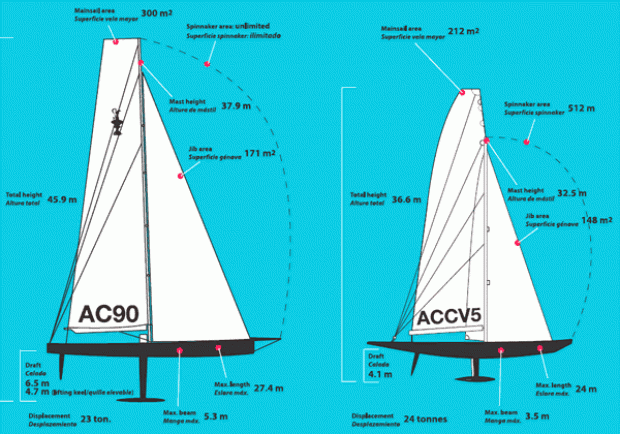
To recap a little over how the rule came about: In the controversial Protocol announcement back in July, it was stated that the 33rd America's Cup would be held in a new boat that would be 90ft long and would have a lifting keel changing the draft from 6.5m in racing trim to 4.1m lifted. At the Protocol announcement it became apparent that Alinghi had asked their design team, led by Rolf Vrolijk, to come up with the rule, leading to an outcry from the challengers over Alinghi getting an unfair advantage in their development of the new boat.
Since then there have been four official challengers for the 33rd America's Cup in addition to the Challenger of Record, Desafio Espanol, in Team Shosholoza, Team Origin, Emirates Team New Zealand and United Internet Team Germany.
With the Golden Gate YC bringing their lawsuit against the Societe Nautique de Geneve, the rule for the new boat has become something of a political issue. Partly to demonstrate that the rule was by no means finalised, but also in a bid to get more challengers to commit, ACM for example stated that they would only allow registered challengers the opportunity to make amendments to the new rule. And so it has been that since mid-September, under the chairmanship of Tom Schnackenberg, the challengers have had this opportunity, culminating in the announcement of the new rule on 31 October - although this nearly didn't happen as in the weeks leading up to this date, getting to see the rule was one of the negotiation points between the warring factions.
Rolf Vroljik has an interesting observation to make over the possibility of Alinghi having had an advantage in creating the rule: "They [BMW Oracle Racing] have acquired three people from the different areas of our design group. If we had been that far ahead they should have exactly the same information now." These three are designer Manolo Ruiz de Elvira, all-round mast design and technical man Mike Drummond and former shore crew co-ordinator Michel Marie, who joined BMW Oracle Racing at the end of July. "So if we’d done much work before the end of July, then they would have that information," says Vrolijk.
Tom Schnackenberg
Vital statistics
Since the discussions with the challengers have taken place, Vroljik says that pretty much every parameter of the AC90 has changed aside from the ones originally announced in the Protocol.
The 90ft length is based on the 'maximum load waterline length' allowed for sloops under the Deed of Gift for the America's Cup. In the process of creating the new rule, Schnackenberg based it on the Version 5 rule but as well as changing the numbers attempted to simplify it dramatically. One example of this is the change from waterline line to length overall and this one thing is likely to create the most profound change in the look of the new boat. As Vrolijk puts it: "If you do something with overhangs you have to try to control it, try to measure it, try to float it - we just wanted to get rid of it completely, because that is the bad part of this kind of racing. If you put the 90ft overall length - which we made 3cm shorter than 90ft, which we had to because you have to retrim the boat - basically no one can ever get outside of the load waterline length of 90ft. So you don’t have to worry about anything else. How can you simplify it any more?"
The maximum draft is also a constraint of the Deed of Gift, although only by implication. "It says that the water should always be 22ft deep, so if someone challenged with a boat with a 25ft draft then the defender could say 'we’re sailing in 22ft of water'," explains Schnackenberg.
The lifting keel was introduced not so much to allow the boats to reduce draft to get in and out of the Port America's Cup, but to allow them to do so in other venues they might visit during Acts or in training. We understand that Team New Zealand were particularly keen on this feature whereas TeamOrigin would have prefered to have kept the keel fixed.
The maximum beam of 5.3m was not conjured up by any profound yacht design calculus but was simply what would fit into the existing set-ups within the team bases. Originally BMax started out at 5.7m but this was before someone was sent out with a tape measure to size up the travel lifts and docks exactly. "There were two that were exactly 5.7, or 5.71 and that meant the boat couldn’t be 5.7, so we went down to 5.3," says Schnack.
One of the most un-America's Cup features of the new rule is its sail area and in particular downwind where area is now unlimited... "That means there is no limitation and that is a huge area of development and it is a big call for the teams what the sails will look like and the sizes," says Vrolijk, who adds that in their original proposal of the rule there were no measurement for headsails either.
Perhaps the most political parameter within the new rule was displacement. Alinghi at one point in their negotiations offered BMW Oracle Racing the opportunity to choose the displacement for the new boat (but at the same time wouldn't let the US team see the rule in its entirety as it was then - just 10 days or so before the rule was finally published).

Rolf Vrolijk and Juan K
Vrolijk says that originally he was thinking of a displacement of 25 tonnes, but after negotiations with the challengers it ended up at 23. This figure in particular will dictate the character of the new AC90. Bearing in mind that the version 5 boats weighed in at 24 tonnes (v4 were 25) on a smaller boat, the boat is substantially lighter for its overall length and sail power.
It is widely thought that for the sport of match racing a heavier boat is preferable as Vroljik explains: "you get closer relative speeds because the influence of trimming and acceleration is very similar. Also the change of shape in the sails has less influence on boat speed. We think that is a better type of match race boat."
However a lighter weight boat creates a craft that is more spectacular to sail and to see sail, much faster, but with a greater variation in its performance upwind versus downwind. This will certainly affect the way the boats are sailed downwind with bigger gains to be made from gusts and the view is that this will result in more lead changes - welcome, as this is one of the most gripping features within Cup boat racing.
As Rolf Vrolijk puts it: "The speed differences compared to the last class, upwind the boats will probably got at least 1.5-2 knots faster and also in the VMG and that means that the courses have to be longer than they were last time, but the times the boat will be sailing will be the same. Downwind the speeds will be a lot higher than the old boats. At the same time because the speed is higher and the acceleration of these kinds of boats is a lot better the boats are coming with the wind and with the pressure and overtaking. So there will be a lot of overtaking happening in this kind of match racing." Vrolijk reckons that downwind the new boats will be sailing at true wind speed.
In terms of displacement Tom Schnack says it has been down to the challengers and defender to 'pick their poison'. "You could have a 20 tonne boat but that I think would be unfortunate as it would be slower than the old boats upwind. But to me would be good - they would be cheaper with smaller sails, smaller rig, all the gear would be lighter!"
Another factor in the lower displacement is that it means that the gear on board can be smaller - the rig size was scaled down in line with the new displacement for example. It makes it slightly easier for the crew to handle and could also result in offering more possibility of racing in lighter winds.
The overall result, as Tom Schnack sums up is a "boat that is about 25% longer and a little bit lighter. The stability is up by nearly a half, but because of the big sail plan the heeling moment from the sails is up by 70%. So it is going to be very responsive to the wind, and upwind, because the stability hasn’t gone up nearly as much as the heeling moment of the sails, it is going to be very difficult to keep nicely powered compared to the old boat. And the crew numbers are only up by 18%, so everyone has got a lot more to do than they did on the last boat."
Aside from its new enlarged dimensions we can expect the new boats to otherwise look quite similar to previous boats in terms of their deck layouts with the boats decked forward of the mast and deep cockpits that are as wide as possible, with the crew 'in the boat'.

Juan Kouyoumdjian
A tight box - this time
Another change from V5 to the AC90 is that is the new rule is a box rather than one based on a formula. After several iterations of the V5 rule it had become essentially a box but even so it was still possible to have a longer boat than the norm, although this came with heavy penalties on the other parameters.
This Version 1 of the AC90 rule is also a very very tight box that attempts to shut off as many design loopholes and areas for design teams to research as possible. Thus for example the displacement box is 22.9-23 tonnes (ie with just 100kg of variation). "In this version there are restricted development areas because there is no time for it," says Vrolijk. "Allow more boards and rotating masts, etc - to develop a rotating mast you need a year. To develop board positions you need two years. The idea is to first fix the rule so the boat exists and you have platforms and then to open up the rule. The next one should be more innovative and open we think."
He adds that when it came to discussions over the rule, teams seemed keener on containing design development avenues than there were the actual numbers finally appearing in the rule. "This is the only way to guarantee that in the first version to get close competition."
However most ultimate parameters are fixed, there is still a great number of variables for designers to play with, particularly volume distribution through the hull. For example, no doubt thanks to the Juan K influence, boats can have twin rudders.
Amendments
Another significant feature of the AC90 rule, unlike the rest of the rules for the 33rd America's Cup, is over future amendments. From 1 January 2008 changes to the rule can only be made with unanimous consent of all the challengers. Up until this time amendments are made by majority vote.
To date it has been unclear quite how democratic the process is. As Juan K puts it: "I would like to say we have been invited by Alinghi to participate in the rule process but by no means have we been granted the final choice of the decision making. We were there giving our expression, which was treated very fairly and democratically by Tom. But there are plenty of things in the rule that I would have preferred to be different such as the sail area and particularly the headsail sail area. I would have preferred it to be bigger, but they disagreed. Nonetheless that is not important, what is important is that the boat that the new rule produces is a much better boat than the one which was done last time. That is key. The capacity for a new team like Origin to perform, or a team that has a smaller budget, is substantially greater than if you had carried on with the old rule. It would have been impossible for a new team to compete."
As to the teams - more number crunching
Obviously at present the future of the AC90 is in the balance awaiting the outcome of the court case in New York. However design teams are already blazing away at work on the their new AC90 designs and are having to apply techniques very different from those they used on V5 to develop the new boats.
Generally there is a move towards substantially more VPP work. At Juan Yacht Design for example, Juan K's entire design office has been employed by TeamOrigin (as it believed to be the case with Farr Yacht Design and Desafio Espanol - a different arrangement from Bruce Farr himself being employed by BMW Oracle last time around). Juan Yacht Design has grown substantially to 23 people, the principle area of growth being centred around their new 256 CPU supercomputer, to be used exclusively for CFD work.
"There are a lot of people who take care of that and people who prepare candidates to throw into that," explains Juan. "So the whole thing scales up exponentially. There are a lot of resources that go into the numerical analysis which are run by Rodrigo Esqueta who was in Oracle with me." At Alinghi Michel Richelson's team have been boosted with two extra personnel.
Part of the problem is that while there is endless VPP data on V5 boats, backed up by hundreds of tank tests, this as yet doesn't exist for AC90s.
"We are working on optimisation programs which is new, with neuro-networks," says Vrolijk, getting into realms beyond the understanding of this simple journalist. "We started doing that last time. That’s an area where we will put more emphasis - just let the computer do the optimisation. At least we’ll give that area a try. All the advantages that everyone is talking about - you have to get tools that will work. That is the same for us and all the other teams. Someone might hit the perfect boat without knowing why."
Intuition among design teams will certainly be a vital part in the development of the new boats which Juan K says have more in common with Volvo 70 than V5 Cup boats.
Both Juan K and Vrolijk agree that crucial to development of the AC90 will be time on the water, although this time they will not be allowed to two boat. So how will that change developing the boats, we put it to Vrolijk? "It won’t make it easier. We have to rely on the best people on the boat, on their feel and how to do that and adapt very fast to what we seen the water and rely on experience. The job will be how you speed up any boat, like in all these other classes and how you do that by sailing alone. The biggest part of it will be development not just optimising. You want a platform in the water, you want a mast and sails and then you need 3-5 months to learn...but then we are in 2009 already, when you just have enough time to get your second boat ready."
To make it easier for teams to get up to speed quickly the rules allowing only limited changes to boats have also be relaxed. As Vrolijk says: "We gave options to do changes and modifications to the hulls without restrictions on modified areas, you can cut it up, we have made it a lot more open in that area."
We very much hope that the AC90 becomes a reality.
See the animation of the new AC90 here
Most Read
Most Commented
Comments
Businesses

Pro businesses
-
-
Italy
-
-
United Kingdom
Editor's choice
Member blogs
-
 Ned Collier Wakefield: MOD70 round BarbadosWell that was intense. 12 hard fought for seconds for the win. In idyllic conditions, Tony Lawsons MOD ...
 -
 Mini Transat leg 2 reportThe second leg of the Mini Transat started on 31st October, just over a month after ...
 -
Leg 1 reportI’ve been working towards the Mini Transat now for three years. In 2013 I was part ...
Business blogs
-
 The Island Sailing Club in Cowes, Isle of Wight, is delighted that Prince Michael of Kent ...
 -
Peta Stuart-Hunt chats with the 25 year-old British solo sailor Lizzy Foreman before she sets sail ...
-
The 2015 Student Yachting World Cup (SYWoC), an ISAF-recognised event hosted and run by students for ...
Editor's Choice
All time favourites...
-
 Three legs down into Ian Walker’s
 -
 Winning all but two races at
 -
 For the first time in its
Latest Comments
Add a comment - Members log in