
Big rig gig
Wednesday May 9th 2007, Author: James Boyd, Location: none selected
A mast - a simple pole-like device from which to hang sails? Hardly. As the old simile goes - if the sails are the engine of a Cup yacht, then the mast and rigging are its transmission and as with everything about their campaigns, so the big America's Cup teams have once again gone to the ultimate extremes in developing their rig technology.
Some background
At the outset of the present America's Cup class in the early 1990s, masts were generally light and flexible compared to what was allowed by the rule. But for 1995 Team New Zealand was the first to go for a larger section while maintaining the same weight in order to have better control of mast bend, as for this Cup boats were using more powerful and less stretchy carbon fibre 3DL sails for the first time.
With the Cup moving to Auckland for 2000 where it would be sailed in stronger conditions, so once again the size of rigs increased went up again, none more so than those fitted to Young America's boats which had around 300mm more cord than the rigs seen on most of the boats at the time.
Now mast designer with Alinghi, Kurst Feddersen was then working for Hall Spars in Rhode Island and was the brains behind the Young America spars: "The long cord was to get more effective sail area while there were some features of that mast that enabled it to twist a great deal. This was to do with how the headstay was attached - it had a strop-style forestay attachment which a lot of the teams have now. And there were some devices, the way the spreaders were attached, etc which have been outlawed now."
However the biggest rig development for the 2000 Cup was the so-called Millenium rig featured on Team New Zealand's NZL 60. Tom Schnackenberg formerly of Team New Zealand and now a performance analysist with Luna Rossa remembers: "In Auckland the whole thing was more demanding on masts, sails and boats because of the stronger winds. And we were having trouble with mast tuning."
Instead of conventional diagonals, Mike Drummond had the idea of the diagonals passing through the mast to the end of the spreads below and above. This not only allowed the diagonals to be more efficient, assuming a less acute angle to the shrouds but for them to attach to the mast as they passed through it, providing more anchor points along the length of the spar.
"We were so used to seeing the mast flexing a little bit like a noodle," continues Schnackenberg. "A particular problem was when the mainsail luffed the load on the head of the mast at the very top would change and that would change the whole tuning situation down the mast. When the mainsail unloaded it would jump to windward at the top and then at the point of intersection with the jumper would dive to leeward and the mast would take up this nasty shape and it would go backwards and forwards like that. I remember the first real proof of the pudding was when we went around North Head one day with the Millenium rig on the boat for the first time and the boat jumped off a wave and the mast instead of noodling it just shook a little and then it stopped. It was very different. And we looked at each other and said ‘we’ve got something’."
Schackenberg says that in light airs the Millenium rig offers little advantage over a conventionally rigged spar and although it might seem that it should have more windage on NZL 60's new rig they were able to shed a set of spreaders (even this time around rigs still have either three or four spreaders) and rigging elements could be made smaller. "When you added up the whole thing the windage was about the same, it just got a lot more complicated to make and lift in and out of the boat," says Schnackenberg.
While a brilliant piece of creativity, the Millenium rig as a design is something that has mostly remained a feature solely of Cup boats due to their physical characteristics being very different to other contemporary yachts. The loads in the rig are enormous thanks to the 24 tonne displacement around 80% of which is carried around in the bulb. In addition to this the latest generations of Cup boats buck modern trends in yacht design but havin very little beam - and thus a small shroud base - and in having overlapping headsails.
Of course since 2000 the Millenium rigging configuration was adopted by teams in 2003 and now all the teams racing in Valencia have it.
For this Cup Version 5 of the America's Cup Class rule has modified the rig parameters. Physically the spar section can now be no more than 430mm fore and aft and a minimum of 150mm across and there are three measurement points up the spar where the section is both limited by maximum and minimum dimensions (at the top for example it is 210-150mm fore and aft by a minimum of 130mm across).
The rule specifies a centre of gravity 12.25m above the mast datum band.
The minimum weight of the rig package in measurement trim (ie including standing rigging, spreaders, jumpers systems, standing rigging, all backstays, runner fly blocks check stays, instruments, instrument sensors, cameras, cables, hydraulic rams and pipework - ie a lot of gear) has also been reduced from around 825kg to 750kg, immediately allowing an extra 75kg to be put into the bulb.
In fact the minimum weight of the spar package is still highly conservative compared to what modern technology would allow today (the next iteration of the rule, assuming the present generation of Cup boats remain, is expected to allowed full use of composite rigging). This weight saving is mainly taken up by the use - allowed for the first time - of composite rigging: typically PBO or Southern Spars carbon fibre Element C6 rigging (read more about this here) which has been allowed for the forestay and the jumpers.
Higher modulus carbon fibre is also now allowed in the spars. The highest fibre modulus permissible under Version 5 is 385GPa (anything above 350GPa is considered 'high modulus' and the modulus typically used in TP 52s rig is higher than that allowed under the Cup rule) and takes in M40J, but not some of the highest modulus fibres which can go up to around 450GPa. As a result, masts are stiffer for the same weight compared to Version 4 masts and this, for example, has allowed Alinghi to lose one of their checkstays.
Aside from the new developments allowed by the new rule much additional work has been going on. As Tom Schnackenberg summarises: "People are a lot more aware of the mast being integrated with the sails and there are ingenious minds all around the Cup world trying to improve that."
Part of this is trying to induce twist into the rig. The principle rule limiting this is that the spars cannot rotate by more than +/-2degrees at deck level. It is also prohibited if it "has a device to move the athwartships or rotational position of the mast at its heel or at
the deck." (Using any movement at the bottom of the rig to help prevent the keel from falling off - the America's Cup 'canting' keel - however does appear to be legal - "no comment" says Feddersen when we ask him about this).
Twist is induced in the rig in a number of ways. We imagine that how the spar is engineered plays a major factor in this but prising this type of information out of Cup designers is like drawing teeth. Most obvious is the location of the rigging and particularly this time is the fore-aft location of the diagonal as they past through the mast - the diagonals on many spars now pass through the forward part of the mast (rather than the centre of the spar as it tended to be in 2000 and 2003) to allow the aft section of the spar to twist off.
However twist is far from the only consideration as Kirst Feddersen warns: "If you just chase twist you are going to give up some other features of your mast that are perhaps more critical to the performance of the sail-rig combination."
Obviously a team's mast designer will work closely in conjunction with their sail designers to ensure that the bend and twist characteristics of the spar behave in the best way together. "The most potential that there is remaining in these rig designs is getting that dynamic correct - getting the sail and mast behaving together correctly," says Feddersen. This is all the more important this time around as the centre of effort of the sail plan has moved up with the rig thanks to the increased use of flat topped mainsails and the increased sail area packed on to the roach of the headsails. As a result while tube section sizes are similar at the bottom on most Cup spars at the top there is more variation.
The largest top mast is certainly to be seen on BMW Oracle's jumperless rigs, that they have been using in in the Round Robins. The jumperless rig was originally 'outed'' by Alinghi and impressively within two weeks the men in white coats at BMW Oracle had stepped their own.
While we could all be surprised come the America's Cup, Alinghi appear to be happy with their jumpered rigs. Feddersen describes the pros and cons of it: "Having the higher modulus carbon fibre allows you to get the stiffness that you need to support that big topmast and you get rid of a lot of weight and complexity that you have with the hydraulic jumpers."
Obviously the downside is that without jumpers the topmast could have a greater tendency to fall off to leeward. "You lose a little bit of control of how you control your mainsail," says Feddersen, "yes, you lose the windage of the entire jumper system, but you have a bigger tube to push through the air. There are some conditions when the jumperless rig is faster than one with."
In terms of usability Feddersen says that having jumpers is extremely useful not only to support the mast laterally but depending upon how the jumpers are swept, they have a great deal of influence on the shape of the luff curve and the sail behind it.
While Alinghi appear to have abandoned jumperless rigs, BMW Oracle Racing have been using it in anger and one man who has spent the last months looking up at it is Gavin Brady: "How a jumperless performs compared with a jumpered one are completely different and you are on the extreme sides of the ledger. How you design your sails and how your sails react are very different." Within BMW Oracle Racing they have carried out development of a jumpered rig program in parallel with their jumper-less one and Brady says that both programs have benefitted because of this. "Our jumpered rig is extremely strong as well. If we put our best jumpered rig on I suspect it is one of the fastest masts here."
So why have they gone with the jumper-less rig? "We like the way it performs around the race course. Sails don’t get caught on the jumpers. There are a list of advantages and a list of negatives and we worked very hard on eliminating the negatives.
"Because it has got less stays on it the reaction it has to different mainsail shapes is very extreme - how it reacts in light air is very different than a jumpered program and vica versa, so we have to be very careful which sails we put on it. The jumpered rig program you can put any sail on it and twist your jumpers around and make the sail fit. You go down the jumperless rig program you have to have a very good sail making team that can nail the sail shapes, the luff curves and the mould shapes and the battens and everything else because once we go out there and pull the sail up we don’t have any controls on it – so it puts a lot of pressure on the sail making team and our guys have nailed it."
In fact Brady says the jumper-less rig has come about solely because the minimum weight restriction on AC spars is so high - to the extent that most have lead corrector weights in them. Using the latest technology it might be possible to build a AC spar half its present weight and in this case having a jumper-less rig wouldn't be an option because the amount of carbon fibre required in the top mast would make it overweight.
In terms of windage one might think there is a benefit however the bigger topmast section that having no jumpers requires almost negates this. "A team that didn’t have the extensive resources and time, wouldn't bother with it. If you get it dead right you can hit it out of the park, but if you get it wrong it can be a pig real quick..." warns Brady.
One other variation in the jumpers is Luna Rossa who have chosen to stay with stainless steel for their jumpers as presumably their team believe there to be a windage reduction (composite rigging it typically fatter than stainless steel).
Another obvious variation between the rigs on Cup boats is in the philosophy of spreader design. As Team Shosholoza Principle Designer Jason Ker puts it: "There are two schools of thought. One school (Luna Rossa and Alinghi) says that spreaders are just drag and you need to make them as small as possible. And the other school which includes Emirates Team New Zealand, BMW Oracle and ourselves is that they are driving force. When the boat is heeled over you can capture a forward driving force benefit out of them. So we believe it makes us go forwards, whereas the others think it makes you go backwards!"
Feddersen puts Alinghi's point of view: "One school of thought is that if you make them big and aerofoil shape, maybe even asymmetric you can generate lift out of your spreaders and produce forward thrust. But it is pretty tiny and potentially if you get it wrong it could be drag and there is a weight penalty. It is much heavier to make big spreaders."
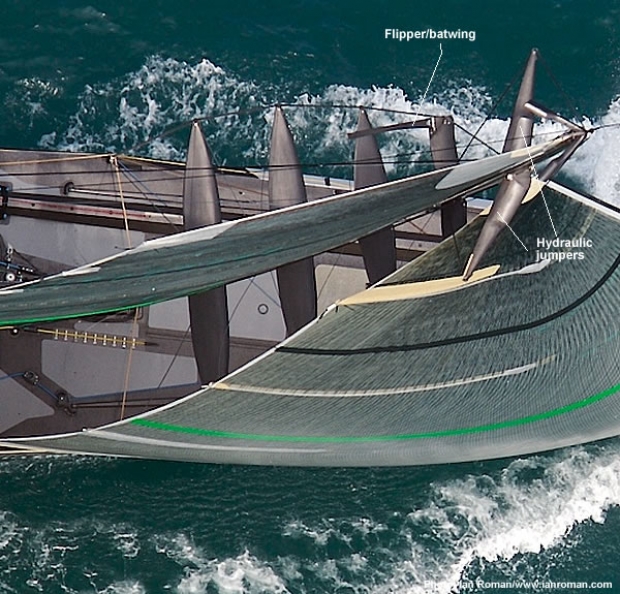
Another facet of the Cup rig minimum weight and the way it is measures is just the amount of hydraulic systems packed in there. Typically at the top of a Cup rig there will be rams to hydraulically move the jumpers back by up to 40 degrees and forward up by to around 35 degrees. The reason for movable jumpers is to get them out of the way of the roach of the larger headsails by 'relaxing' them aft.
Almost all the teams have some sort of hydrualics on their flippers - the odd piece of carbon that extends aft from the end of each top spreader and used to support the roach of the larger headsails. At a most basic level hydraulics are used to get the flipper out of the way when the mainsail is ease - either by flipping the flipper up or outboard. However the flippers more sophisticated Cup teams have developed this time also have the ability to push the end of flipper (and the roach of the headsail) away from the mast to increase the slot.
Then of course there are hydraulics for the checkstays, cunningham, etc all packed within the mast, as this is effectively free under the rule.
So apologies - ask a technology-related question in the Cup and if you get an answer at all, it tends to be a long one...
On page two are the rig shots from unveiling day

Most Read
Most Commented
Comments
Businesses


Pro businesses
Editor's choice
Member blogs
-
 Ned Collier Wakefield: MOD70 round BarbadosWell that was intense. 12 hard fought for seconds for the win. In idyllic conditions, Tony Lawsons MOD ...
 -
 Mini Transat leg 2 reportThe second leg of the Mini Transat started on 31st October, just over a month after ...
 -
Leg 1 reportI’ve been working towards the Mini Transat now for three years. In 2013 I was part ...
Business blogs
-
 The Island Sailing Club in Cowes, Isle of Wight, is delighted that Prince Michael of Kent ...
 -
Peta Stuart-Hunt chats with the 25 year-old British solo sailor Lizzy Foreman before she sets sail ...
-
The 2015 Student Yachting World Cup (SYWoC), an ISAF-recognised event hosted and run by students for ...
Editor's Choice
All time favourites...
-
 Three legs down into Ian Walker’s
 -
 Winning all but two races at
 -
 For the first time in its
Latest Comments
Add a comment - Members log in