
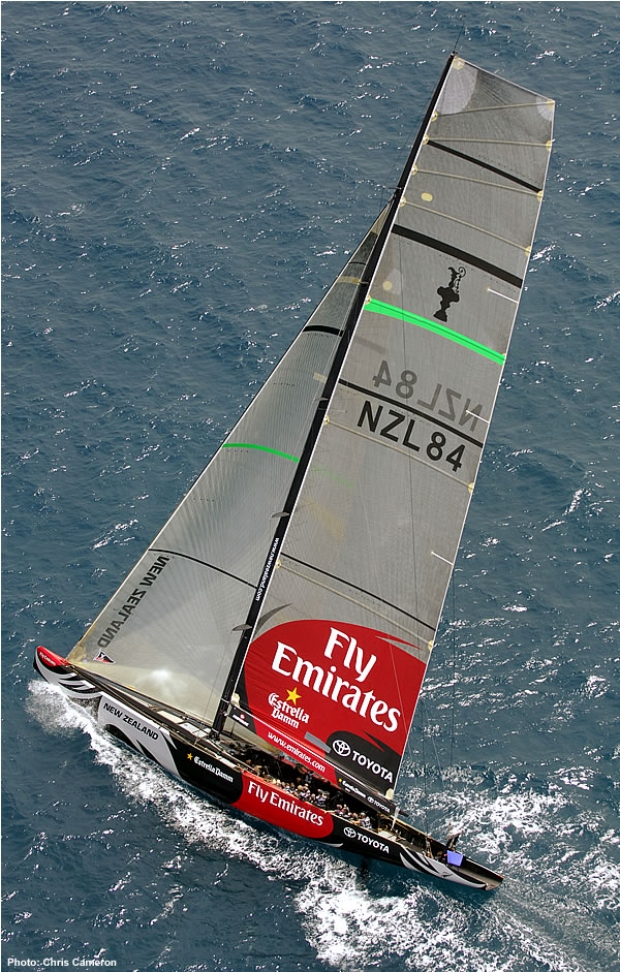
The engine
Thursday June 28th 2007, Author: James Boyd, Location: none selected
As in all areas of the America's Cup, sail development - the research and development into mainsails, headsails, spinnakers and their handling systems - takes place with a sophistication, down to the minutae, like nowhere else in our sport. Two figures leading the charge within this arena are Alinghi's Mike Schrieber and Emirates Team New Zealand's Burns Fallow.
Schrieber, a true Cup veteran out of the Grant Simmer mould, had his first Cup back in Newport in 1983 and has been involved in every one since (ie this is his seventh Cup) while New Zealander Fallow candidly admits that he has spent one third of his life working for Team New Zealand, ever since 1993. Both are technically North people, Schreiber from the San Diego loft, Fallow from Auckland, although they spend their lives seconded to Cup programs.
Mike Schreiber

Burns Fallow
To give some idea of the magnitude of their jobs within their teams then perhaps we should look at the size of the sail programs: Over this last Cup cycle Emirates Team New Zealand have built over 200 sails in total, roughly half of them headsails, 35% spinnakers and the rest mainsails. Mainsails have full length battens to keep their shape, tend only to be hoisted once a day and don't get hauled around the forward side of the mast every minute or so, thus their longevity is better. In comparison Schreiber reckons that since Auckland they have built close to 300 headsails alone at Alinghi. "But remember that's with a two boat program and we've been sailing since 2004 and been building sails in earnest since the beginning of 2005," he says.
That is a LOT of 3DL. Say Cup teams on average went through 150 sails each - that's 1,800 sails. And this is only the Cup market...
To recap a little about 3DL, a couple of teams got a sail each in 1992, while the famous Nevada plant opened up mid-way through the 1995 Cup cycle. One of the reasons attributed to Team NZ's win in 1995 was through Coutts' insistence that they went fully 3DL for that historic campaign. Fallow says Team NZ built 35 3DL sails plus 20 spinnakers for that entire program! This time round 11 of the 12 teams have been using just 3DL while China Team went with UK Sails.
The basic process of manufacturing 3DL has remained much the same over the intervening years, however there has been much refinement, with materials, adhesives efficiency of manufacturing and reducing the number of rejects. "Materials haven’t changed a lot since the last Cup cycle," says Fallow. "Carbon is the yarn of choice in the mains and headsails. There is also some aramid in there but not much, only where you need it, such as reinforcement down the leech where it gets a beating."
At Alinghi Schreiber says that they have tried to optimise the fibre orientation in their sails to reduce their weight as much as possible.
Typically raw 3DL sails arrive in Valencia where they are finished off in each team's in house sail loft.
The only major development with sail materials this cycle has come from Alinghi's 'black' headsails. Schreiber is a bit cagey regarding any detail about this: "We’ve been investigating another process done in Switzerland. It is a black material, a different type of construction process completely from 3DL. It is really interesting. NSA is the name of the process. We’ve had a few sails out, but we can’t say a lot about it, but it is an in house development. It is a different material and construction process. You can orientate the fibres."
Burns Fallow reckons that it is a pre-preg type material. "Whether it is built over a mould or not I don’t know. Potentially it is very light, but one of the problems we saw was that it was too uni-directional and wasn’t coping with off-axis loads well. There is a gain to be made there, but how much time do you spend refining the product? We haven't seen them using it for a couple of months now, so if they use it in the AC they are brave because they should have been using it all the time."
The black sails first appeared last summer at which time Alinghi made no effort to hide it - in fact quite the contrary. "They were very public with it, hoisting it inside the harbour, sailing it just off the course," says Fallow. Perhaps another technological red herring to display to the competition, like jumper-less rigs? "When it came out we had to take notice of it, but we couldn’t develop it ourselves, so we tried to figure it out what its pluses and minuses were and carried on our merry way. That was our attitude towards it. It may be a few kilos lighter. I don’t think it could be half the weight."
Developments for 2007
While the present style of Cup boat dates back to the early 1990s, there have been some significant developments with the sails in this America's Cup cycle. Aside from straightforward technological advancements, these are partly down to changes within the rule and the move from Auckland to Valencia, where the wind range tends to be narrower but oddly the sea state greater. Burns Fallow says they had to be careful when they were training in Auckland: "We had to be very diligent when we went out in Auckland last summer because you can get an 18 knots sou’wester and flat water and the sails will be trimmed on hard and flat and the boat is trucking away. We were diligent to monitor that..."
Added to the sea state is the wash from the spectator fleet. "Especially in the Louis Vuitton Cup, the spectator wash was just unreal for them on board. In the last couple of rounds we were able to follow up on the tender on the course and we were still quite a long way back and you get to the top mark sometimes and it is just peaks," says Fallow.

Headsails
Jibs have got substantially larger as battens are now allowed to be used in them in Version 5 of the rule.
"The rule has always allowed the mid-girth to be 60% of the foot - so a serious amount of roach," says Fallow. "But you weren’t allowed battens so what happened in the last Cup was that we got into this ridiculous situation where a few teams, including ourselves, started pushing the definition of what a spreader patch was. And so they thought 'let’s clean it up and allow battens'. There is a now a full page in our rule book just for battens, angles they can be, how far they can project through, etc and one of the key things was that they could be inflatable." More on this tomorrow.
Fallow reckons that their headsail sizes have increased by around 14-15sqm or 10% compared to 2003, although he admits they were relatively modest with roach sizes last time around at Team NZ.
In terms of how much jib roaches have increased at Alinghi, Schrieber says that typically in 2003 they were up to 53% mid-girth. "Now we are at 60% mid-girth and the upper girth limit is noticeably bigger. The limit there is 37% - you are a metre or so wider than they used to be, so it is huge. So the flippers have all of a sudden have gone from being 300mm long to a metre and a half long."
The flippers are the unique-to-Cup-boat devices attached to the outboard end of the top spreaders, used to support the abnormally large roach. In many cases these are fitted with hydraulic rams or a purchase system that enable the flipper to push the jib leech away from the mast, altering the slot and twist in the jib (see photos of the topmasts here)
A downside of going for maximum headsail roach is that they become increasingly hard to tack. "Some teams have pushed their genoa roaches to the absolute limit," says Fallow. "We’ve chosen not to go quite that far because then it is a trade off over how easily it tacks versus a tiny bit of area."
Mainsails
The rules governing mainsails hasn't changed, however last time under Version 4 there was much more flexibility in being able to trade off length and draft with sail area (hence why Oracle BMW, as was, started with a small mainsail and every round got bigger and bigger...) Today there is around a 4sqm trade off only with the mainsail.
The most noticable development has been the size of the flat tops and how they have dramatically increased. While the longest top battens, also known as the 'gaff' batten, were around 3m in Auckland, today they are in the 3.5-4m range
Alinghi were the first to go down this route in Auckland, with technology taken from the multihull world (ha!). At Alinghi this came about from the mainsail development work carried out by catamaran sailor Patrick Mazuay, from the North loft in Geneva, who today drives the Swiss team's mainsail program.
"I guess you’d have to say, it is an evolution of the mast and the mainsails together that has made that possible and the batten systems," says Schrieber of the flat top developments this time around. Thanks to the use of high modulus carbon fibre in them, masts are around 20% stiffer under Version 5. "If you watch the teams, especially the guys who have money to experiment a lot, you see everyone creep out to really extreme proportions and then back off to a number that is workable. You can go really extreme in the roach, but then you can really be caught out. It depends what your philosophy is. If you don’t want to push the limit on the head width and have a more versatile sail that is one of the games you have to play."
Schreiber says that one team, not Alinghi, tried a mainsail that was virtually rectangular. "We saw them out with it a few times and now people have evolved to pretty similar proportions. There is perhaps 0.5 or 0.75m difference in the extremes."
Obviously supporting a large square top requires considerable scaffolding from the battens. "You can make them really stiff, but then you pay a weight penalty and also they are not very forgiving if you go with a high modulus carbon to try and make a stiff light batten," says Schreiber. "The trouble is that they become thinner wall, bigger diameter and they are very unforgiving. So you develop it until you see more breakages than you are willing to accept then you back off - you are always trying to trade off weight versus durability.
In terms of batten alignments, Alinghi carry out much of their development work using specialist software written for them by their genius CFD guru Michael Richelson. "We spent a lot of time working on different combinations of positions and angles and settled on something which worked for us and gave a good predictable performance," says Schreiber.
Mainsail battens used by all the teams are supplied by New Zealand company C-Tech. So is it true they're indestructible? "It can be done," says Burns Fallow. "But in the context of racing on AC boats, they are really really good compared to what we’ve had previously." (Read more about C-Tech battens here).
In terms of how he sees the mainsail batten development Fallow says: "They are certainly stiffer up there than they used to be, particularly the top batten. There is quite a change there. I think compared to last time, the sails used to pant an awful lot in a seaway. We’ve just worked on things to settle them down because you have a lot more unsupported outside the triangle between the clew and the head."

Spinnakers and A sails
While headsail battens are allowed another significant turboing of the AC class rule with version 5 was increasing the size of the spinnakers. "The boats definitely feel quicker and more lively now," says Schreiber. At Alinghi they have added a few personnel to the sail design team, poached from Prada, which was strong in their downwind sail development department in 2003. Their kites are built by North Sails Spain, while at Emirates Team NZ they build them in house.
Within the Kiwi sail department their personnel line-up has changed dramatically for this cycle. While Burns Fallow did 90% of the design for 2003 with trimmer Grant Loretz, this time they have brought in the talented Robert Hook, who's Cup involvement dates back to Kookaburra in 1987 and has included OneWorld, AmericaOne, etc. His claim to fame (in our mind at least) is his having developed Paul Cayard's Code 0s on EF Language in the Whitbread.
"I’ve known him all by working life," says Fallow says of his co-designer. "We have areas we are naturally strong in individually and the other person compliments." While Fallow is known for his 'white' sails, Hook is known for his kites, but they don't work exclusively on their parts of the inventory.
As the Kiwi sail program has virtually doubled in size since 2003, so their personnel has increased this time with Dick Parker looking after the sail loft floor and Craig Phillips as co-ordinator.
The new sized kites have principally led teams to re-appraise their crossovers. "They have come along," says Fallow. "They are still like the wild west. Across the fleet, the sails become more and more standard with time but spinnakers are the last to settle down because they are only held on at the corners."
The kites are divided between asymmetric kites and the rarely seen in Valencia symmetric kites used in stronger winds. While the change from A sails to S sails used to happen in around 12-13 knots in 1995, now it is more like 16-17 knots. "It is much more uprange now, because the gennikers are better and the driving techniques are better," says Fallow. "I think we’ve only used spinnakers in one race so far which was that last semi-final against the Spanish."
Race day
Typically a Cup sail wardrobe will comprise heavy, medium and light mainsails, although Schrieber says it would take fairly exceptional circumstances to get the heavy one out of its bag. The range of the main can be bigger as it is attached to mast and boom and thus there are all manner of ways to change its shape.
Jibs each tend to have a design range covering a 4-5 knot window with a knot overlap at the crossovers, so therefore they have around six or seven codes. According to Fallow this is similar for kites. "The range gets a bit more squashed in the light air because the apparent wind changes pretty quickly as you go from 6-8-10-12 knots. The wind ranges there are a lot more compressed."
One imagines that lavish teams like Alinghi and BMW Oracle Racing could be hoisting fresh 3DL each day, however even in the America's Cup there are sail buttons and for the Cup itself they are limited to 30 sails (it was 45 for the LV Cup). "The problem is that we have about 15 different codes of sail," says Schreiber. "So you have to be really smart about how you play your sail cards. At the beginning of the regatta on the first day you’d put a few sails on the card that would be the ones based your forecast that day and you are very conservative about when you add sails. For example it would be a mistake to put every code on there because maybe you wouldn’t have heavy air the whole regatta but you’ve spent a ticket on that. It is quite a challenge to manage the sail card. Fortunately our trimming team are masters at getting the most life out of a sail card."
Fallow describes how they decide what to measure in for the Cup: "We have to assume it is going to go to nine races. We have to assume there is going to be a light air days, medium air days and a heavy airs days. We have to assume there are going to be a bunch of 30 tack beats. But equally in the last race in round robin two against BMW Oracle we assumed we were going to have a 30 or 40 tack race and we had five. That was a huge boon, it set us up nicely." In terms of the longevity of their sails Fallow and Schreiber both keep a tally of the number of manoeuvres a sail goes through and use this to determine its life span.
In terms of what is taken on board for a race this is limited to the maximum weight limit for all sails, battens, furling gear and bags of 650kg allowed under the rule. "For the genoas you’d have six different codes to cover the whole range of wind speeds," says Schreiber. "But in Valencia the breeze is normally predictable enough that you wouldn’t have every code of sail [on board], you’d have duplicates of the main ones and then one either side."
If a Cup mainsail weighs 100kg, then the kite and headsail trimmers get to fight over the remaining 550kg worth. On a variable day, pretty much all the sail wardrobe is taken out on the water and in the minutes leading up to the start once the final weather call has been made, there is often a scramble to load sails on or off between the race boat and the chase boat, particularly if there is a change in the weather call. "Usually it is not a close thing, until Clouds does one of his 'we’re going to have 8 to 22 knots' calls!" says Fallow.
In the hour leading up to the start the sail teams have to get their calculators out to tot up sail weights and totals. Then the measurers must then be told prior to the start of each race what sails each boat is carrying. No simple 'let's just go yachting' in the America's Cup.
R&D
In terms of Alinghi R&D into sails be it in wind tunnels or CFD, Mike Schreiber says: "It comes on every cycle mainly because of computing speeds and the ability to be able to analyse things in a practical amount of time. That has helped us a lot. We haven’t done a lot of wind tunnel work of sails over the whole campaign. We did some early but we haven’t done any more since the early part of the campaign."
Impressively Schreiber says that they haven't done a huge amount of CFD work on the sails because "with the schedule with a lot of racing and a lot of sailmaking we just feel like we are just better off building the things full scale." Why not, indeed.
As with everything else with Cup boats or gear development, there comes a cut-off points when you must stop developing and starting learning how to get the best out of your boat/gear. "You have to get settled on what you are building because part of it is learning the crossovers and ideosynracies of those sails," says Schrieber. "Say you get the A3 a little bit over range, and the other guy has an S3, you have to learn by racing each other with these sails how to compensate for those things. If you are fiddling too late in the game you discover all of a sudden, you don’t really understand your downwind inventory as well as you should."
Perhaps one of the reasons that Schreiber prefers 'real world' development is because while creating fast sails in the virtual world is one thing, whether they are fast when used in anger on the race course is quite another. For example with spinnakers there is the classic trade-off between stability and straight line speed relating to the depth of the kite. Generally a deeper sail isn't the fastest in a test environment, but can be on the race course. As Fallow puts it: "you can design a fast sail in ideal conditions and the boat is pitching and rolling or you are sailing hot, high or low. So you end up designing a sail that is a practical sail as well and often that is the best sail. So as we go through racing we tend to make sails more practical."
At Emirates Team NZ they are still using the wind tunnel facility at the University of Auckland, says Fallow: "We used it probably a similar amount to the last campaign probably not as much as we did in the glory days of 1995, the wild west. No one had even gone west in 1995! You are just further down the track and you are chasing smaller increments. Saying that the time we spent there was pretty valuable in developing our sails, because all our sails are a lot different from last time, in particular our downwind sails. In fact I would say there is no legacy from the 2003 Cup at all. Hooky brought his thinking into it and I wasn’t happy with where our work was and the ones I contributed to early on - they were quite different. Last time we were very flat in the head and we didn’t have very user friendly sails."
On board most of the teams have video camera set up to monitor the trim of their sails (hence why you see a stripe along the sails). "We have had two packages," says Fallow. "We have our green stripe - that is the live system so we end up with four cameras on board for that, looking from the top down, one each side for the main and genoa. They feed live information on the green stripes. We use just one stripe, other packages BMW Oracle and Prada ran which were trying to do three stripes in real time. But let’s walk before we can run. One stripe is very relative to the overall set-up. And then on board the yacht we had another three cameras, two back in the cockpit and another in the middle of the foredeck looking up. Where we could take photos at will - there was a button back in the cockpit the trimmer could push. That was a manual set-up."
Fallow says that this time around there is considerably more telemetry taking place between boat and tender, allowing for more development to take place 'live' as they are out on the water.
On some boats these video systems work in the reverse and are used to tell the trimmers when they are at optimum trim. "They get told what the trim is and then use that as part of the input, just like forestay load or runner," says Fallow. "You have wind sheer going on - it might be say 12 knots at the top but it might have a very thin wind weight, so if you just say 12 knots = 7.5% camber it would be very dangerous thing. It is much more complex than that. It is just there as another tool."
One feels with this subject, we have bearly scratched the surface of what is going on in the highly complex world of America's Cup sails...
Most Read
Most Commented
Comments
Businesses


Pro businesses
Editor's choice
Member blogs
-
 Ned Collier Wakefield: MOD70 round BarbadosWell that was intense. 12 hard fought for seconds for the win. In idyllic conditions, Tony Lawsons MOD ...
 -
 Mini Transat leg 2 reportThe second leg of the Mini Transat started on 31st October, just over a month after ...
 -
Leg 1 reportI’ve been working towards the Mini Transat now for three years. In 2013 I was part ...
Business blogs
-
 The Island Sailing Club in Cowes, Isle of Wight, is delighted that Prince Michael of Kent ...
 -
Peta Stuart-Hunt chats with the 25 year-old British solo sailor Lizzy Foreman before she sets sail ...
-
The 2015 Student Yachting World Cup (SYWoC), an ISAF-recognised event hosted and run by students for ...
Editor's Choice
All time favourites...
-
 Three legs down into Ian Walker’s
 -
 Winning all but two races at
 -
 For the first time in its
Latest Comments
Add a comment - Members log in