
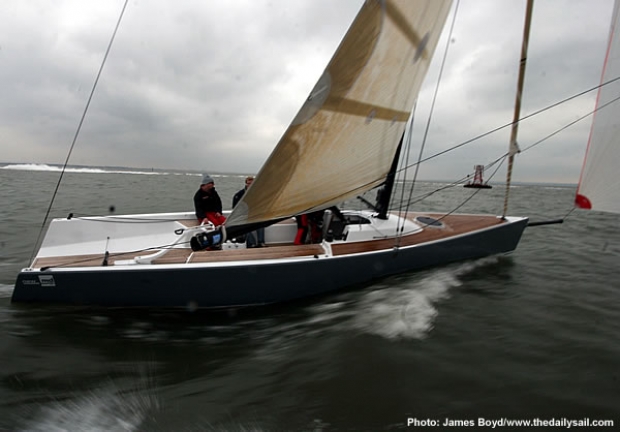
21st century gentleman's daysailer
Thursday October 18th 2007, Author: James Boyd, Location: United Kingdom
The new Mark Mills-designed MD35 is a sleek-looking new weapon that immediately appears it would be at home in the glamorous surroundings of the Cote d'Azur, or moored among a fleet of sisterships off the Royal Yacht Squadron or the New York YC's Newport bolthole, Harbour Court. But the MD35 is not just a looker. Considerable thought has been poured into the concept and delivery of this boat by some of the most experienced figures in the business.
Our initial impression seeing the MD35 is of a large 21st century day boat and this is partly due to the lack of guardrails and stanchions, as well as the narrow hull shape and the long cockpit trench open ended at the transom. The slab sides of the hull are very Cup boat, while the sleek lines and the high cockpit coaming relative to the bottom of the cockpit is mini-Wally.
In short, the overall package is pretty much unique and because of this one would query whether there is a demand for such an animal were it not for the credentials of those behind it. These include heavyweight marine industry luminaries such as Boat Sales International's Peter Morton, former Mumm 30 and Farr 40 builder in the US, Barry Carroll, and Kiwi sailmaker turned project manager Mike Relling.
The MD35's genesis has been a two pronged affair. On the one hand Peter Morton had been discussing the concept of such a boat with designer Mark Mills on and off since around 2000. But the project really got off the ground when entirely independent of Peter Morton Gavin Maber, owner of the Swan 55 Valhalla, and Mike Relling approached Mills around a year ago looking for the exact same concept of boat.
"It was one of those rare occasions when I could say ‘I’ve got exactly the boat you are looking for'," says Mark Mills.
Having been involved so heavily with the Mumm 30 and Farr 40, Peter Morton was looking for a boat to compliment those. Mills explains: "The important thing was that the quality of fleet racing was perhaps being sacrificed with higher performance boats. There were lots of light boats with huge kites that were getting more sportsboaty. The Mumm 30 is a good example - you have to be fairly athletic to get the most out of a Mumm 30 and that disenfranchises a significant group of people who would love to be involved but aren’t ever going to be interested in that physical kind of sailing experience. And with the high offwind speeds it limits the tactical element of it somewhat. So Morty’s vision was to try and do something that would be like a modern 6 metre."
By making the boat relatively heavy (it weighs 2.45 tonnes) and narrow (Bmax is 2.2m), the crew on a MD35 need not hike to coax the boat upwind. As a result the boat can be competitively sailed not only by a crew of a much wider age group but significantly also a wide range of weights (the class rule, presently in draft form, includes no crew weight restrictions for this reason).
"Because it is so narrow once you heel over, the centre of gravity is getting pretty close to the boat’s centre of gravity, so crew weight doesn’t have the same influence they have on wider, lighter boats," says Mills. "And if it works out well in reality - that the boat is competitive across a wide range of crew weights - it would be a very powerful thing for the class. That has been a holy grail for a lot of classes."
Mills adds that as there is no hiking requirement, there is no reason to add flair to the topsides. Beam can be maximised at the waterline to improve form stability and thus the result is a slab-sided hull, similar to the existing generation of Cup boats.
Aside from the non-hiking and displacement aspects of the MD35, part of the reason for the narrow beam is to allow the boat to fit into a container and to make it towable. The present boat in the UK is the plug and this was built by Partridge Yachts up in the Bay of Islands in New Zealand. Boat Sales International's Mike Richards says that because it can fit into a container, shipping the boat to the UK from NZ, cost around £1,200, around one tenth the cost of shipping it deck cargo.


To dismantle the boat and put it into a container, Richard says, takes about 90 minutes but requires a crane. The keel lifts up, the top of the foil protruding through the companionway with the bulb just below the hull - rather like the Melges 24 arrangement. The lifting point for the boat is an eye on the top of the foil, and the foil lifting is restricted so that once it is fully up the crane starts to lift the boat as well. A crane is needed to lift the boat out - one wonders if a hydraulic lifting mechanism on the keel wouldn't eliminate the need for this.
While the MD35 has very much got a 21st century look to it thanks to her Wally/AC Cup boat features, her handling and the way she feels on board is very much like something from a past era of sailing. Thanks to her displacement she doesn't feel as twitchy in the water. On board one can feel from her motion the 1.2kg of lead/antimony (counting for 50% of the displacement) packed into her bulb. While her bow is fine, her stern is not as powerful as one might see in a modern race boat, but the result of this (and her displacement) is a boat that should ride waves more comfortably than a lightweight sportsboat. Sadly we were not able to assess this for ourselves - when we sailed the boat it was between 8-15knots of breeze and flat water (apart from the odd wash from the Red Funnel ferry).
In addition to her seakindly features, her helm feels very positive, again something one associates with older keelboats, and we suspect her rudder is bigger than the spindly high aspect ratio affairs found on modern day race boats. Again this is bound up with the core philosophy of the boat - to make it more enjoyable and less challenging to sail.
This philosophy has also dictated the sail plan. The jib is on a roller furler and while a even a modern day 6 metre equivalent might be expected to have a symmetric kite, the MD35 uses two asymmetrics - big and small - for ease of handling. The tack for the kites is flown from a retractible bowsprit.
While these are hoisted and dropped in the conventional way at the moment, the team behind the boat are looking at ways to make this easier and it may be that on production boats the kites will be hoisted in snuffers or possibly even partial snuffers.
Thedailysail's expert bowman (retired) Andy Nicholson reckoned of the spinnaker hoisting on the MD35 that "the main issue is to keep the tack clear of the water as there are no guardwires to protect it till it reaches the forestay - like the Melges 24 and J/80. The 1720 has no guardwires and the technique was to hoist the sail full and then pull the tack out, but this boat is too big - perhaps pull the tack out on the electric winch like the mainsail [see below]. Why not have one of the primaries electric too for this purpose? It would require a tack retrieval line for the drops (and this again could be dragged in with the electric primary)."
Another area likely to be tweaked before the boat goes into production is the backstay where the present multiple purchase arrangement may be replaced by a more grunty Magic Wheel.
On some boats we have seen the ease of handling has been taken to the extreme where it actually can get quite boring for the crew to sail. In this respect the MD35 represents a sensible compromise. While the jib has a barber hauler, the car system may not be as tweaky as one might be used to, and there are no jib battens in order to make roller furling possible for example - there is still enough rope pulling to be done to keep four crew busy on the race course.
Another 21st century ingredient is the concept of having a small inboard diesel, something lacking in existing day boats and even 6 metres. As a result no tender is needed to get the boat swiftly back into the marina or on to its mooring in Cowes Roads and more importantly there is no ungentlemanly faffing with a noisy outboard.
Aloft the mast is in carbon fibre with two spreaders slightly swept back. The spar is a two piece affair, enabling it to be taken apart and fitted into a container.

The MD35 is designed to be sailed by four crew, seated on a bench in the forward half of the open-ended cockpit, inside the cockpit coaming/topsides. The seat on the prototype only has space for four with additional crew having to scramble around on the cockpit sole aft of the helmsman, rather like on a Cup boat. However on production boats this is to be modified, the cockpit seats extended aft allowing additional crew a proper perch. Aside from this the only aspect of the seating arrangement that needs to be resolved is some sort of foot chock for the crew. Again this detail is a work in progress.
With the crew a long way forward of the mainsheet track, controls for the mainsheet are led forward to the helm position. Another feature purposefully fitted to make the boat easier to handle is the powered mainsheet winch, mounted on a central island in the cockpit. This is operated by two pairs of buttons that cause the winch to wind in at fast or slow speeds. All lines running aft from the foredeck and mast pass below deck through tunnels to port and starboard to jammers and winch set-up either side of the companionway.
All this talk of old fashioned features perhaps leave the impression that the MD35 is a slug of a boat, but this is far from the case. While she is not a planing boat according to Mike Richards they have been out and one occasion the boat fully 'lifted her skirt'. "We had a little puff of about 24 and suddenly we were doing about 18.5 knots. There was no transition, no hump it just kept on accelerating and it was pretty impressive. Everyone on the boat seemed very upbeat about that. I was surprised."
But where the boat does show a real performance advantage over wider, more draggy, more modern hull shapes is both upwind and in light conditions. Although we (thankfully) didn't have the opportunity to try it, we imagine that slogging upwind in 20-30 knots aboard the MD35 might be a vaguely rewarding experience compared to trying to achieve the same in a modern day sportsboat, while in sub-5 knot conditions the boat just seems to keep going thanks to her displacement and narrow beam. She is truly a delightful, well mannered boat to sail.
While the concept of a 'daysailer' invites one to discount the interior, down below on the MD35 does have usable accommodation. There are quarter berths to port and starboard aft. The saloon area is divided by the keel box, again with berth-length seats. One scrambles around the keel-stepped mast immediately forward of this to an area where a top opening icebox is fitted and portable head.
From here
While the plug was built in New Zealand, the MD35 is to go into production at M Boats in Buenos Aires. This company is a spin-off from King Marine, who are building the King 40 (formerly the Summit 40), another Mark Mills design, also marketed by Peter Morton's operation in the UK and Barry Carroll's Summit Yachts in the US.
Construction of both hull and deck of the MD35 will be glass, infused with vinylester resin, and with a PVC foam core.
The mast on the prototype was built in New Zealand, but on production boats the carbon spars will be made by King Masts in Buenos Aires.
Other changes to the production boats, in addition to the ones we have already mentioned, are the cockpit bulkhead on the aft side of the coachroof is moving slightly further aft to provide more space for lifting the keel. There are some further modifications to make the boat more production-friendly (such as the fabrication of the keel foil) that Mark Mills says are going to add around 50kg to the overall displacement and as a result the hull shape has been slightly modified to accept the extra weight.
Price of the basic boat in the UK, VAT paid is £88,000, while fully equipped with a 3DL suit of sails and safety gear, etc is £101,000.
In terms of her racing potential, the MD35 has no pretentions of competing under IRC or even the Sportsboat rule. While a few may be sold individually, the aim is to get it off the ground as a one design class with boats bought in bulk by groups, typically this might be from yacht clubs. To this end Boat Sales International are planning a test sailing day in Cowes during November where one can imagine the present Etchells/Dragon/Daring owners will be lining up to have a ride. One thought currently is that the boats may be purchased by syndicates of owners.
At present a class rule is available in draft form ( here), and it is worth reiterating that those behind it include Peter Morton and Barry Carroll who have decades worth of involvement with such one design rules. In addition to the normal constraints, the MD35 will be an owner-driver class. Category 3 sailors can own boats but must prove (to a panel of other owners) that the boat and running costs will be purely paid for by themselves.
In conclusion
We loved the look of the MD35. While we could immediately imagine her moored up in St Tropez, we suspect enough UK owners of smaller, more traditional keelboats will be aware of that particular modern style of boat not to be put off by its more contempory look.
There are several comparible modern daysailors on the market, but mostly aimed at owners planning on keeping them in the Mediterranean. Some of these might be accused of being designed more for their visual impact than the thought that has gone into their sailing characteristics in comparison to the MD35.
The success of the boat of course rides on its take up by new owners. As Mike Richards puts it "there are a lot of one designs where they have only ever built one boat!" Thus the MD35 is more likely to be sold in bulk than to individuals. While the boat will certainly appeal to older owners who've had enough of hiking, it will be interesting to see the take up from the younger sportsboat crowd.
Mark Mills emphasises the demand by both Peter Morton and the prototype's owner Gavin Maber to come up with a boat that will enable top quality racing. However he thinks that the boat would also be extremely good for match racing, based on the traditional argument that heavier boats are better for this discipline of our sport. "It would perhaps test match racing skills better than some of the lighter weight boats that are on some of the circuit events. The heavier narrower boats more like 12m lead to clashes that test match racing skill rather than pure boat speed," says Mills.
The concept of being able to ship the boat in a standard 40ft container is probably the key to its success internationally - fleets will be able to meet up with comparative ease and at a much reduced cost. One wonders what the advantage currently of being able to ship it off to Key West on a whim with no others to race against.
So could this be a new Cowes Week class in a couple of years time? We think it will.
Read more about the MD35 here
See video of the MD35 sailing here
and video from on board here

More photos on the following pages...


Most Read
Most Commented
Comments
Businesses

Pro businesses
Editor's choice
Member blogs
-
 Ned Collier Wakefield: MOD70 round BarbadosWell that was intense. 12 hard fought for seconds for the win. In idyllic conditions, Tony Lawsons MOD ...
 -
 Mini Transat leg 2 reportThe second leg of the Mini Transat started on 31st October, just over a month after ...
 -
Leg 1 reportI’ve been working towards the Mini Transat now for three years. In 2013 I was part ...
Business blogs
-
 The Island Sailing Club in Cowes, Isle of Wight, is delighted that Prince Michael of Kent ...
 -
Peta Stuart-Hunt chats with the 25 year-old British solo sailor Lizzy Foreman before she sets sail ...
-
The 2015 Student Yachting World Cup (SYWoC), an ISAF-recognised event hosted and run by students for ...
Editor's Choice
All time favourites...
-
 Three legs down into Ian Walker’s
 -
 Winning all but two races at
 -
 For the first time in its
Latest Comments
Add a comment - Members log in