
Tying it all together
Friday January 5th 2007, Author: James Boyd, Location: United Kingdom
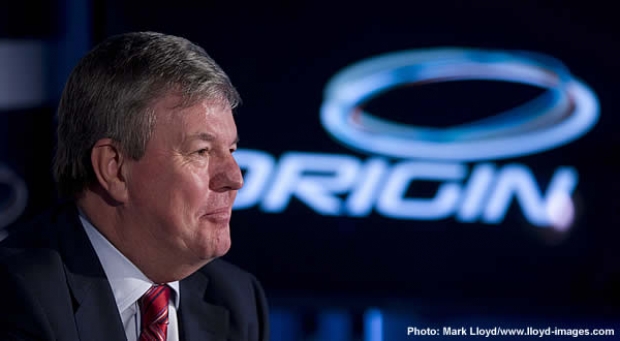
After numerous interview with TV, radio and the printed press, Sir Keith Mills is looking both exhausted and elated when we sit down with him.
"You’ve got some secret you’ve been keeping to yourself for some time and then you come out and now you can talk to people about it. So it has been very difficult for the last year or so talking to individuals in and around the America’s Cup about a theoretical possibility, making it clear that it is a case of just looking into it, whereas I knew in my heart that I had every intention of doing it, providing certain things fell into place. So now it is a lot easier. I can go and talk to yacht clubs. Whenever I went to talk to anyone about anything you had to persuade them it wouldn’t be a good to talk about it.
TDS: Why now?
KM: Unless we press the button now we wouldn’t stand any chance realistically of getting a team up and running and so we’ve got to put it together and be ready to hit the ground running and that’s why we did the announcement today.
TDS: How long has the America’s Cup been seriously on your radar?
KM: I seriously started looking at in 2003 with a view to getting involved in the current 32nd America’s Cup. I had some discussion with Peter Harrison and there was a prospect then of perhaps buying the GBR assets and using it as a basis to start on. But right in the middle of all that Barbara Cassani came along and said 'why don’t you run the Olympic bid?' So I remember going back to when de Savary was racing was when it first tweaked my interest, I kept a very close watch on the America’s Cup campaigns since then only as an amateur observer, the first time I put some time in was in 2003. I started to look at the economics, the practicalities, the logistics. Obviously teams approach the America’s Cup in different ways and there are those that seem to be successful and those that seem to be not so successful. Then the model was Team New Zealand which I thought was a much more attractive model than some of the previous models. And this isn’t meant to be disparaging, but it wasn’t a billionaire playing with his toys – I’m talking about structure and funding – and I think Team New Zealand took it to a different place and I think Alinghi have taken it to a whole new place very much for the better. I think it is a very more attractive competition now and it is certainly much more financially viable now. And I think the continuity which is necessary will change the nature of the competition forever. You are not going to have these three, four or five year gaps.
TDS: So it make more sense commercially now?
KM: It is not only commercially more successful, it is also more successful from a talent perspective. You build a team of people and then you say we’ll call you in two or three years when we do the next one.
TDS: It becomes relentless?
KM: Clearly you can do one, two or three cycles and then you are burned out.
TDS: What is you personal motivation for this? We could see this being at so many levels - pure sport, technology, the incredible history of these titans of industry - the tussle between the big guys?
KM: That is not what interests me at all. I am not interested in the Captains of Industry beating the **** out of each other. When I first started looking at it in 2003 what really drove me to focus hard on the America’s Cup was the irony of what I believe is the strongest sailing nation in the world having not been able to successfully win this competition ever - that was irresistible. Actually since 2003 through my Olympic work, I have seen what sport does around the world, particularly for young people and what sporting icons do for young people and I think the America’s Cup would provide a fantastic platform to inspire young people in sailing. And in particular if we win the America’s Cup and we then host the America’s Cup in this country, what that would do to sailing in this country would be phenomenal - beyond anything we’ve done before. We’ve got some great icons with the Ellen MacArthurs and Ben Ainslies. But this would put it on a different platform. In the same way as hosting the Olympic Games here will do for sport, I’d like to replicate that in sailing and there is nothing that is going to give sailing a higher profile than winning the America’s Cup and then hosting it in this country. It being the first time in this generation that the Games are going to be held in this country and within a few years hosting the America’s Cup - it doesn’t get much better than that really. [If we achieve that] I’d be a happy man. That is the vision and I think there are a lot of things falling into place now that means that we are in a better position than ever in history to win this. We have some great talent, a lot of them are getting great experience on boats in Valencia right now, the competition is in Europe, it is now a much more commercially viable proposition. I have a lot of experience in putting together teams, raising lots of money and managing a campaign.
TDS: And we have a new generation of sailors who have matured?
KM: Peter Harrison did us a great favour with the last GBR Challenge in giving those sailors their first taste of America’s Cup racing and the Ian Walkers and crew are now down in Valencia sailing and they wouldn’t be doing that had Peter not put his challenge in.
TDS: And those sailors have now dispersed in lots of other teams and that will provide a huge resource of different experience when they regather?
KM: Our team will be an international team, probably a majority will be British - but not by very far - but part of the reason you are bringing together people from different teams is that you are learning best practise. Each team generally excels in one area, the skill is bringing all those things together whether it is technology, design, on the water sailing skills, sailmaking, whatever it happens to be, bringing those best of everything together is what we need to do.
TDS: One of the key skills in putting together an AC team is getting the most out of people and who you believe - it is very easy to get bad information - I'm sure there are parallels with that in your business life?
KM: This sounds very technical - I use something called triangulation: That means I never take anyone’s word for anything. So when I am interviewing someone I don’t take their word that 'they’re great' - I ask four or five other people whether they’re great. If someone decides that they want to go and do something, I don’t take their word for it I ask four or five other people whether this is a good idea or not. By doing that you get a very good feel. So with the Olympic bid for example every member of the IOC will tell you they are going to vote for you, but you don’t take their word for it, you ask four or five other people whether you think they are going to vote for you and that technique of trying to filter out views and I think also, teams that are dominated by one individual are not necessarily the most successful teams. If they are a particularly dogmatic individual eventually the team turn off because you know the leader is going to make the call on this and so why should I bother contributing? As soon as that happens you’ve lost it. So bringing together superstars is one thing, but bringing them together and having them gel is something else and a team of superstars that can’t function properly or that are dominated by one strong individual is not the way we’re going to manage this team. And it’s not going to be run by a committee either, but it needs to be a team built around consensus.
TDS: It is like fascism versus democracy?
KM: You are trying to find someone to lead the team. I won’t lead the team, I will in terms of being team principle, but not on a day to day basis. Trying to find an individual that commands the respect and the trust of the rest of the team that brings the best out of that team, that asks for and responds to advice that he gets from the rest of the team but at the end of the day he makes the decision. That is very different from the autocratic style of "I think we should do this - let’s go". Someone who sits down with the team, gets their views, figures it all out and says "I think the best solution for this is to go in this direction and that’s what we’re doing". So being decisive but inclusive. And that’s where we are trying to get to.

TDS: Will Peter Harrison be involved at all?
KM: I have not spoken to Peter about this at all. I’m sure I’ll go and pick his brains on a few things, but I think Peter has moved with his life anyway now.
TDS: You have sail you are going to underwrite the whole thing, but recoup 50% through commercial avenues/ How do you plan to do this?
KM: The traditional route is to find one large and a few smaller sponsors - that clearly is the tried and trusted route and I think we’ll go down that route. But I am a marketing guy, I’ve spent my entire life building products and marketing products, I’d like to think we can take the Origin brand and commercialise it and generate revenues not just from sponsorship but from merchandising and licensing. Alinghi is doing that quite successfully now with skis and bikes. And there are other rights you can build in with a team, whether they are internet rights or rights for other products and services. I have some new ideas of ways to generate significant revenues from a team like this to fund its cost. Our business plan is based on generating 50% of our budget from commercial activities. I’d like to think it is a bit more than that, but it won’t get anywhere near close to covering the cost.
TDS: If you look at Emirates Team New Zealand or the Spanish, they seem to be pretty much entirely funded through sponsorship...
KM: Every team has a slightly different model and it is quite difficult getting to the bottom of what each model is. If you look at the models of Alinghi, BMW Oracle and to an extent Luna Rossa, there are things that happen within their team that are not core sailing expenses, in other words it is difficult to compare apples with apples. But the core requirement for a credible team is around 30 million Euros per year.
TDS: It depends upon whether that includes marketing?
KM: Some of the marketing is when it starts to creep up. If we decide to launch a range of whatevers that won’t be out of the 30 million - that’s separate. So that is core sailing, America’s Cup focussed stuff.
TDS: You mentioned that you might also get some other individuals in to help fund this - is this likely to happen?
KM: I have had discussions with some ‘prominent British businessmen’ who have expressed an interest in becoming shareholders.
TDS: How much of British effort will this be - it looks like you can fill two boats with top British guys? If there are gaps will you look at filling them from abroard or how will you approach it?
KM: We start from the position of who is the best person in the world to do this job. If they happen to be British, brilliant, if not, then so be it. You will notice in our branding that there are no Union Jacks, this isn’t called British Origin or Team GB. We’ve done that for two reasons, one so that we can attract international talent as well as British talent. So if you are a Kiwi or an Aussie or a Swiss you’ll be joining an international team. And secondly I know that some of the major sponsors we’ll be talking to are multinationals.
TDS: You're spoken about strong indivuduals, does this mean you don't seen the advantage of getting a Paul Cayard or a Russell Coutts involved?
KM: I’ve had a talk with most of them and if they can help us win the America’s Cup then I’ll be talking to them about being involved. I’ve been talking to a lot of people for the last year and there is strong interest in what we’re doing and I will be signing contracts with team members between now and July now we have gone live, but I won’t be announcing any until they are under contract.
TDS: It is nice to think, perhaps it is a British thing, that youl could come in and win with a small, but perfectly formed team, like Team New Zealand in 1995 maybe?
KM: In any sport an underfunded team isn’t going to go anywhere, but there is a law of diminishing returns of course and it is what you do with the money that is important. One of the things we did with the bid and what I’ll do with Origin is absolutely ruthlessly challenge every single penny is spent against winning. I used to say to people in the accounts department ‘if you see an invoice for something and you don’t think it is going to help us win, I want you to tell me about it’. I don’t want to spend a penny on anything unless it is going to help us win. Because that is the mindset you have to have.
TDS: You've obviously been spending a lot of time with Rod Carr - do you think you have a similar approach?
KM: I think there is going to be some great synergy between the RYA and what we’re doing. I think we have a lot to learn from the Olympic squad in terms of their performance and development and technology and I think we have a lot to give back to Team GBR. We should be able to feed off each other and we’ll be talking to them about some sort of Memorandum of Understanding. I will talk to the RYA as I will the yacht clubs about being our partner. The Spanish bid is through the Spanish Federation, not a yacht club. So we could do the same through the RYA, but we will go and talk to all the yacht clubs and see what is going to help us win the Cup.
TDS: Thank you.
What is your view? Join the debate: batmail@thedailysail.com

Most Read
Most Commented
Comments
Businesses

Pro businesses
-
Italy
-
United Kingdom
-
-
Editor's choice
Member blogs
-
 Ned Collier Wakefield: MOD70 round BarbadosWell that was intense. 12 hard fought for seconds for the win. In idyllic conditions, Tony Lawsons MOD ...
 -
 Mini Transat leg 2 reportThe second leg of the Mini Transat started on 31st October, just over a month after ...
 -
Leg 1 reportI’ve been working towards the Mini Transat now for three years. In 2013 I was part ...
Business blogs
-
 The Island Sailing Club in Cowes, Isle of Wight, is delighted that Prince Michael of Kent ...
 -
Peta Stuart-Hunt chats with the 25 year-old British solo sailor Lizzy Foreman before she sets sail ...
-
The 2015 Student Yachting World Cup (SYWoC), an ISAF-recognised event hosted and run by students for ...
Editor's Choice
All time favourites...
-
 Three legs down into Ian Walker’s
 -
 Winning all but two races at
 -
 For the first time in its
Latest Comments
Add a comment - Members log in