
The unlevel playing field
Thursday July 5th 2007, Author: James Boyd, Location: none selected
The new Protocol document for the 33rd America's Cup was revealed this morning and while it has answered a few (very few) questions about the next event, it has raised many more. The feeling in Valencia is that with the new Protocol document Alinghi have assumed even more control of the event than they did last time, skewed the playing field to ensure they have an even better chance to defend successfully and have got away with doing this because they picked Desafio Espanol and their hurriedly formed yacht club, the Club Nautico Espanol de Vela, as Challenger of Record. The impression is that the Spanish will sign anything, presumably to keep the event in their country. Odd, for instance, that Alinghi didn't choose the more experienced and powerful BMW Oracle Racing again, or Luna Rossa, as their effective partner in the next event.
Under the terms of the Deed of Gift for the America's Cup, the defending yacht club (in this case Alinghi's Societe Nautique de Geneve) must be challenged to get the ball rolling with the next event. In this process challenger and defender must negotiate and agree upon the nature of the competition - what boats, when, where, how, etc that ultimately is detailed in the Protocol document. However the defender usually has the upper hand in these negotiations. Alinghi for example hold the carrot of where they host the event. In theory it could be a lot worse - if the defender got a puppet challenger to throw down the gauntlet to them, thereby allowing the defender to write the rules entirely in their own favour. How about a scenario for example where the defender gets to build two boats while the challengers can only build one. How about even the defenders being able to sail a bigger boat or one with more crew than the challenger? This is preposterous but possible under the Deed of Gift if the defender gets it all their own way. Obviously no one would challenge if the Protocol were too skewed, but it is nonetheless a step in this direction Alinghi have taken with the new Protocol for the 33rd America's Cup.
One of the more controversial points of the new Protocol is that Alinghi have reserved the right to race not only in the Acts, as they did last time, but also the challenger selection series (surely it would no longer be called a challenger selection series?) We understand that this may depend upon whether one or two new boats can be built this cycle (this has yet to be decided). If two then they may be able to carry out in house trialling as they did this time. If not, then Alinghi could well be sailing in the round robins and all the way up to but, mercifully, not including the finals. Only two Cups ago the idea of the Defender having any contact pre-race on the water with the Challengers was considered abhorrent. How times change.
A new boat is to be introduced for the 33rd America's Cup. More on this later but another way Alinghi are ensuring that they get an edge is that the rules for the design of the new boat are only likely to be available by the end of the year. And who is creating them? Alinghi's designers Rolf Vrolijk and Grant Simmer. If they started work on this now the defender could get six months head start on the challengers on their design of and R&D into the new boat. And one can assume that the design team at Alinghi won't have only just conjured up this idea.
As Brad Butterworth tried to convince us: "Get all the designers involved, you never come up with anything. So we have to come up with a simple rule. Waterline length, sail area, displacement and the designers can go from there." When our Italian colleague Andrea Falcone pressed him on the people involved Butterworth added: "At the moment obviously Rolf Vrolijk and Grant Simmer are involved in that. And I’m sure they will be looking elsewhere. But we've had a little bit on just lately, so we haven't really given it much thought!"
And for challengers who are unhappy there seems to be increasingly less recourse to get things changed. As Areva Challenge boss Stephane Kandler told us: "Clearly there is no challenger commission any more but for me there was no challenger commission. It hadn’t any power before. We had to go to the jury and you won’t go to the jury to discuss stupid things because it costs time. Basically we have to accept it – it’s like Formula One, even the car makers have no power, even though they have an association. So the other thing we can do is ‘okay we quit and we do another thing’. No one did it ever. So I guess we are in the same position. ACM is ruling the event and we have to accept it."
The stupidity is that last time around there was the opportunity with BMW Oracle Racing to have had a Challenger Commission with a stronger voice but Kandler says it was their fault, as a group, there wasn't because they were rarely able to agree on anything.
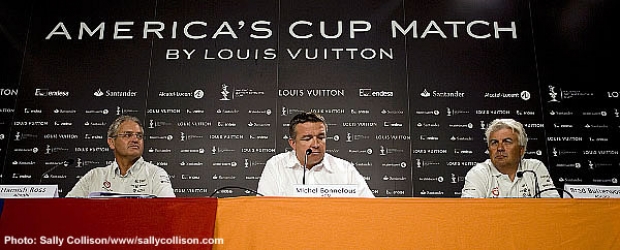
Hamish Ross clarified the role of the Commission this time around: "The reason we are having a competitor’s commission is to involve all the players. Before we just had a challenge commission which didn’t involved the defender or the organizing authority - so to try and have a central forum where all the players are involved. The objective is to get everyone around the table talking, rather than perhaps one group talking and perhaps sending email to the other. But it is simply a forum for the exchange of ideas and information. The commission does not have any voting power to change the Protocol or to change the rules. It is simply a forum for people to exchange ideas and to allow feedback to come through." So lots of talk, no teeth.
Last time around BMW Oracle Racing's policy as Challenger of Record was not to allow changes to the Protocol without a vote from all the challengers. It remains to be seen whether the Spanish will do the same.
Any way - why are we shocked about all this? It has always been the perogative of the winner of the America's Cup to ensure that it is as difficult as possible for the challenger for the Auld Mug to prise it off them. This is no different now than it was in the 19th century. It is no coincidence that it took 132 years for it to be lifted from the US. It is part of the event.
It is also the reason that while the America's Cup may be crying out for independent management and the prospect of some long term planning (impossible when the next competition is only decided at the end of the previous one), it is highly unlikely ever to get it.
As Alinghi's General Council and Cup historian Hamish Ross stated yesterday: "I'm afraid the donors back in 1857 wrote that rule and unless we persuade the New York court otherwise we are stuck with it. So the winner writes the rules after he’s won the event with the Challenger of Record. Yes it might be desirable to have a long structure, but the way it is structured just doesn’t permit that." The body that could change it would obviously be the defender - but why would they sacrifice their Golden Egg?

The protocol
At the press conference earlier ACM CEO Michel Bonnefous said that they are currently in negotiations with Valencia about holding the next America's Cup in the present venue. One key to these negotiations is the reshaping of Port America's Cup now that the race track for the Formula 1 Grand Prix is to encircle it. "Discussions are more on how to structure this in the harbour than on financial matters," said Bonnefous, although no one believed him... "We have always considered the fact that we could have a Formula 1 Grand Prix in Valencia as a plus for us and not a minus. We have worked on the detail and the planning for the infrastructure needed for that and its worked pretty well so its not a problem for us to live with F1, on the contrary. There is a list of things we have to agree with the city to ensure we’ll be happy here. For example there are plans to work on the port of Valencia and we have to make sure that the work they do on the commercial harbour will work with an event like the America’s Cup. So those things we are checking with Valencia."
Bonnefous reckons that the negotiations with Valencia will be sewn up quite quickly if they are to reach agreement. If not they have already started looking at other potential venues and this process will take longer - perhaps up to three months, he says. "We have a few cities already who have told us of their interest in hosting the America’s Cup but it is a complicated process for a country or a city to develop a bid, so they will need time to gather everything they need in order to commit. I see the process like this. We have a good chance to go fast with Valencia and if we don’t reach agreement we’ll have to wait another three months."
And the choice of venue will determine the date for the next America's Cup. Bonnefous says that if Valencia is chosen then the 33rd America's Cup could be held as early as 2009, if it is not it could happen as late as 2011. 2010 is the year of the World Cup football in South Africa and may also be a factor affecting the decision.
Yet another limitation of the venue is the number of challengers. "It may be that the venue can only take a certain number of challengers. So if we get 20 challengers and the venue is Valencia we’d have a issue," said Bonnefous. There is also talk of the weaker challengers getting flicked during the Acts if there is not room for all of them at the new America's Cup venue.
So no venue. No date.
The big news is that for 2009-2011 or whenever the new America's Cup is to be held it will be in a new genre of boat. Again details of this are extremely sketchy. We know it will be 90ft long, some 8-12ft longer than the present generation of boats and will draw 6.5m with a lifting keel that can be hoisted to reduce draft to 4m (present draft is 4.1m). Crew numbers are likely to be 20-21 and the wind range it will be designed for is 8-30 knots according to Brad Butterworth. This suggests that possibly one of the Acts might be at a venue where higher winds might be expected? If 30 knots then we could be looking at the first generation of Cup boats to have reefs!
We know little more than this about the boat at this stage, other than that they will have a more lively performance than the present boats. As Brad Butterworth put it: “Something more exciting. These boats have been fantastic and I certainly like sailing them, but I think they have got to the end of their life and people are looking for something that is a little bit bigger, a bit more difficult and more exciting. The canting keel, we thought about that, but it is a difficult option. We can do it a little bit better with this sliding keel thing; it is not better, just different. In the end the boats will be bigger, faster, and harder to sail - they’ll be 90 footers that won’t have electric or hydraulic-run winches. The guys will have to be athletic; they will be tough boats to sail. That’s what we are looking at." So presumably a boat with substantially lighter displacement than the current lead mine.
Will it be a more open design rule than the present one? "I think it will be a reasonably tight box rule," Butterworth tells us. "This rule is pretty complicated so it would be nice to open it up a little bit more. It will encourage the designers to come up with new innovative ideas because it is a design contest and technology race. I think that's the way the Cup has always been and we are going to keep it that way."
While these boats will be launched prior to the challenger selection series, the present generation of Version 5 boats will be used for the pre-regattas. The Protocol states that the rule will be issued before 31 December and there will be a gap of 18 months between when it is issued and the first race of the class.
It is hard to imagine that the very first race of the new class of boat would be the Challenger Selection Series (note that there is no mention of Louis Vuitton, who are known to be less than keen to sponsor the event again following their experience this time with ACM). So our view is that 2010 must be a more likely option. 2009 is too soon for teams to raise sponsorship too... Bonnefous - who wants to step back from his responsibilities at ACM (no successor has been named, but it is suspected that Chief Operating Officer Michel Hodara is in the frame) - said that details of the next AC being vague at this stage is not a situation very different to last time, when it didn't seem to create too many problems. However not knowing where, nor when, nor in exactly what type of boat will certainly create some short term problems for the teams who are trying to create their budgets.
In terms of money, a bigger boat sailed by a larger crew is certain to cost more but Brad Butterworth says he is keen on limiting the amount of sailing that teams are allowed to carry out between races - an idea similar to that used in Formula 1, and also being touted by Coutts and Cayard for their World Sailing League. "This last edition we tried to encourage the challengers to limit the amount of costs and got nowhere. One of the biggest costs is having these teams set up year in year sailing five to six days a week testing. That’s what we did. A lot of it, I think, is a waste of money. We want to limit that and that will be a direct limit to the costs of the team. We are trying to limit the amount of sailing people might do to get to the start line with any competitive chance."
An issue with the new boats will of course be how competitive this next Cup is. This time the event concluded with a race where the final delta was 0:01 and there were four lead changes. It seems highly unlikely that the next event will be anywhere near as close particularly given the small amount of time teams will have to short out, let alone develop their new boats.
Other changes this time will be to the jury and the reformation of an Arbitration Panel, as Hamish Ross explains: "The jury has done a fantastic job this time. It is felt with five people involved it can be a bit cumbersome, that is why we are looking to reduce it down to three people. The feeling was it was important to have an appeal authority that stands a bit back from the event and gives people the opportunity for people to appeal a decision. Also what we are trying to do here is to separate competitive issues with commercial issues of the event and trying to have the most qualified people deal with those issues. So we’re looking to have experienced sailing judges on the sailing jury and experienced commercial people on the arbitration panel."
Ross confirmed that the sailing jury would be appointed by mutual consent between defender and Challenger of Record while the regatta management is entirely an affair run by ACM.
So will the 33rd America's Cup be a success? In our view the slightly larger faster boat is welcome, it will be more spectacular, but races are certain to be less competitive, unless from a relatively early stage the creators of the rule conjure up a small box for it to sit in. Equally if they do this it will stifle the development of the boat. The main issue will be one of timing. It is hard to see the 33rd America's Cup being campaigned by too many people if it is to be run in 2009 as there will not be enough time to raise the necessary sponsorship, let alone get a brand new boat up to speed. But then maybe once again this is also part of the cunning plan.
Read the new protocol here....

What are your thoughts on the new Protocol? Email us here
Most Read
Most Commented
Comments
Businesses
Pro businesses
Editor's choice
Member blogs
-
 Ned Collier Wakefield: MOD70 round BarbadosWell that was intense. 12 hard fought for seconds for the win. In idyllic conditions, Tony Lawsons MOD ...
 -
 Mini Transat leg 2 reportThe second leg of the Mini Transat started on 31st October, just over a month after ...
 -
Leg 1 reportI’ve been working towards the Mini Transat now for three years. In 2013 I was part ...
Business blogs
-
 The Island Sailing Club in Cowes, Isle of Wight, is delighted that Prince Michael of Kent ...
 -
Peta Stuart-Hunt chats with the 25 year-old British solo sailor Lizzy Foreman before she sets sail ...
-
The 2015 Student Yachting World Cup (SYWoC), an ISAF-recognised event hosted and run by students for ...
Editor's Choice
All time favourites...
-
 Three legs down into Ian Walker’s
 -
 Winning all but two races at
 -
 For the first time in its
Latest Comments
Add a comment - Members log in