
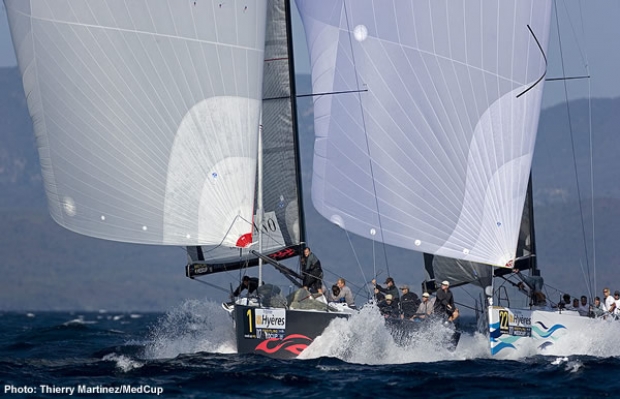
New hardware for 2008
Friday September 14th 2007, Author: James Boyd, Location: none selected
One of the burning questions for those seriously gunning for ultimate victory in the TP 52s' Breitling MedCup at present is - does a boat more than a season old stand a chance of winning or has the circuit already turned into such an arms race that it is essential to have new hardware each year?
One of the top contenders in the Breitling MedCup once again this year has been Peter de Ridder's Judel Vrolijk-designed Mean Machine Valle Romero, winner of the 2006 Breitling MedCup with a crew mostly comprising heavies from Emirates Team New Zealand led by the talented Ray Davies. Winning the circuit in 2006 was doubly impressive as de Ridder is an owner-driver, an amateur beating many of the world's top professional helms.
So can a yeare old boat win in the increasingly competitive TP 52 fleet? "Yes," reckons de Ridder. "We can definitely see that the new Judel Vrolijk boats [such as Artemis] are just a bit quicker upwind - maybe not quicker but higher. Downwind they are the same, maybe we even have a little bit of an edge, but the big gains you make on the upwind. The moment you can keep a lane a bit longer than the other guys, or you can make a course so that you don’t have to dip three other boats after your first dip, that puts you back in the fleet - that helps a lot."
Sadly this season de Ridder's prospects were effectively destroyed when he scored a double DSQ during the coastal race of the Breitling Regatta in Porto Portals. Were it not for this, he reckons Mean Machine would still be leading.
While going into the the latest regatta in Hyeres - the last race of this year's Medcup - they were in fifth place, they were within 11 points of third placed Bribon with Eamon Conneely's Patches in between.
De Ridder seems to be as enthusiastic as ever about his TP 52 racing and the MedCup, particularly as the game has been raised again this year. To this end he has ordered himself a new boat for 2008 and this will once again be a Judel-Vrolijk design. "We are now talking to Rolf about hull lines. He is making his calculations, so it will be a little bit of a next step compared to Artemis, but basically almost the same because he is almost there." A designer 'almost there'? Surely not...
While the present Mean Machine was built at Hakes Marine in Wellington, the new boat is to be put together at Salthouse Marine in Auckland. "Hakes did a good job, but they are Wellington and our boat captain and most of our boys like Ray [Davies] and Tom [Dodson] live in Auckland. So it makes life easier for them to check out the building and it makes it easier to bring in some of our guys. So it will be a kind of semi in-house built boat," says de Ridder.
With two boat testing banned from the 33rd America's Cup, the word is that several Cup teams are looking to other classes such as the TP 52 to get race training in, even if it is fleet racing. De Ridder is one of the benefactors of Emirates Team New Zealand, a deal which secures him his top crew, but at present he doesn't know whether his new boat will be flying the Kiwi (or Emirates) flag next year. "We haven’t spoken about it yet. My guess is that if they go TP 52 racing they will want to have Dean helming the boat and their tactician, probably Terry. But I'd like to helm my boat as long as I can." However it seems very possible that Cup teams could end up fielding two boats in the TP 52 circuit next year.

So are costs going up? "I don’t know - I don’t want to know!" admits de Ridder, who admits that if he studied the books and thought too much about it, he'd probably pull the plug on the whole program. His campaign budget is believed to be one of the bigger ones in the TP 52 fleet. "The build of the boats remains much the same. The quote from Salthouse is similar to what Hakes did two years ago. The rigs are maybe a bit more expensive because we go to the higher modulus carbon."
Impressively, the modulus of carbon fibre used in TP 52 rigs is higher than that permitted in the present (Version 5) America's Cup class... However this is likely to get stamped on the next time the owners get together for a class meet, due to take place at the Globals. "First they wanted to have the modulus at 400GPa but there are already 10 rigs out there which are more than 400," says de Ridder, 400GPa being the present AC class limit. "So now they will put it at 455 or something and you can grandfather out all the old rigs to keep life simple."
At present de Ridder hasn't found a buyer for his present Mean Machine, but says that the resale value is good. His boat will probably remain in the MedCup, however old generation boats are being gobbled up by those wishing to get a sound, well-built boat that can be easily adapted to go racing under IRC. "There is a nice after market developing in England at the moment," says de Ridder. "I heard there are more people interested in having a TP52 down there. They modify the boats a little bit - they get rid of the internal ballast, they put bigger bulbs on and put a bowsprit on. So it is nice for us that we have an after market." Bigger bulb, removing the 400-800kg of internal ballast - that sounds like a lot of bang for the buck...
If some Cup teams do come and play in the MedCup next year then fleet numbers might grown but de Ridder reckons that they are unlikely to top 25. The most we have seen this year is 24. Still this is a seriously impressive turn-out given that the boats cost in the order of 1.5 million Euros apiece, with hefty annual running costs on top of this .
While de Ridder's prospects of a podium in this year's MedCup might be slipping away with two days left to go of the final regatta, there remains one major competition this year for the fleet - the Rolex Global Championship in Porto Cervo at the end of the month. As this is a TP 52 'class' event rather than part of the MedCup (hence the clash of watch brand...) it is owner driver. This is another topic being voted on at the worlds - whether the Globals indeed should be an owner-driver event. Having demonstrated his ability last year - as Sweden's Torben Tornqvist is repeating on Artemis this year - de Ridder sees no reason why professional helmsman should be allowed to steer in all TP 52 regattas.
In terms of de Ridder's other sailing at the moment - after the Globals are over, he plans to stage a return to the Farr 40s. "In November we start our campaign," he says. "I have a new Farr 40 in build that will be ready in two weeks time. We start sailing end of November, there is a Rolex-sponsored Farr 40 event in Miami. We do that as our first event and then we go to Key West, then back to Miami to do the Acura Miami Race Week and then do the Worlds. And it fits nicely in with the MedCup circuit. By the time you are finished with the Farr 40 mid-April you jump on the TP." You can see why people reckon de Ridder does more competitive sailing than many professionals...
Once again the Mediterranean TP 52 fleet has failed to decamp over to the States. Many of the boats have European sponsors with no interest in campaigning outside of Europe or, in many cases, outside of Spain even. "We had the Worlds planned to be held in Miami in March but at the end of the day no one was willing to come," says de Ridder. "So you'd be sitting there racing against four or five US boats that are already old."
Instead the next Global championship is likely to be in the Canary Islands, probably at Puerto Calero, Lanzarote, at the end of the 2008 season. "A change of scene is good," says de Ridder. "I liked Portimao - get rid of Palma because you get a bit bored of Palma - ‘okay, you have to go left, you have to go left, etc!’ And to get a bit of breeze is also nice and have some fun going downwind."
De Ridder says he is happy with the present format of racing at the Breitling MedCup that this year dropped the 'offshore' race, but retains a two-part coastal race in addition to the relentless windward-leewards. "I like the coastals, because it gives it a difference aspect. I like the mix - the 30-70 rule [coastal-windward/leewards] is good and it is a wise decision not to have offshores any more here in the Med. You go out of the sea breeze window and it becomes a lottery," he says.

So has he got over the disappointment of having to pull the plug on his Volvo Ocean Race campaign? "I knew when we started, to give it a go was a calculated risk. I knew where our cut off was. We tried hard. Maybe the whole event has become a bit too expensive compared to what sponsors can get out of it. You are talking about big budgets - you need 20 million Euros to do it properly. I remember I was looking at it about 10 years ago and then you were talking about 7.5-8 million Euros to do a proper campaign. One of the things is that salaries are going through the roof compared to 10 years ago. Then there’s the building of the boat – they are a 70 footer compared to a 60 footer, they are carbon nor Kevlar, etc."
Despite this he was highly impressed by the Volvo Open 70 boat. Earlier this season he competed on board the former Pirates of the Caribbean VO70 in the North Sea Race and this proved a complete blast. "It was a fun boat to sail!" he says, visibly excited. "We did the North Sea Race and we had good breeze - 25 knots, planing conditions all the time apart from the last few hours which was upwind, just one long starboard. But it was really fun. If you are sailing Farr 40, Mumm 30 or TP 52 - that is ballet. If you are sailing a Volvo 70 in 25 knots that is roll ‘n’ roll. All the time. You push the boats and you like to push it because it asks for it."
Rumour has it that despite de Ridder pulling the plug on his campaign, his VO70 designers Judel-Vrolijk are not selling on the plans to any other teams. "We have sold some parts of it, but not the lines," says de Ridder.
So a new Farr 40 and a new TP 52 - 2008 is likely to be a big year for the world's top 'amateur' helm.
Most Read
Most Commented
Comments
Businesses

Pro businesses
-
France
-
France
-
Italy
-
Editor's choice
Member blogs
-
 Ned Collier Wakefield: MOD70 round BarbadosWell that was intense. 12 hard fought for seconds for the win. In idyllic conditions, Tony Lawsons MOD ...
 -
 Mini Transat leg 2 reportThe second leg of the Mini Transat started on 31st October, just over a month after ...
 -
Leg 1 reportI’ve been working towards the Mini Transat now for three years. In 2013 I was part ...
Business blogs
-
 The Island Sailing Club in Cowes, Isle of Wight, is delighted that Prince Michael of Kent ...
 -
Peta Stuart-Hunt chats with the 25 year-old British solo sailor Lizzy Foreman before she sets sail ...
-
The 2015 Student Yachting World Cup (SYWoC), an ISAF-recognised event hosted and run by students for ...
Editor's Choice
All time favourites...
-
 Three legs down into Ian Walker’s
 -
 Winning all but two races at
 -
 For the first time in its
Latest Comments
Add a comment - Members log in