
The Star of the Stars
Tuesday August 21st 2007, Author: James Boyd, Location: United Kingdom
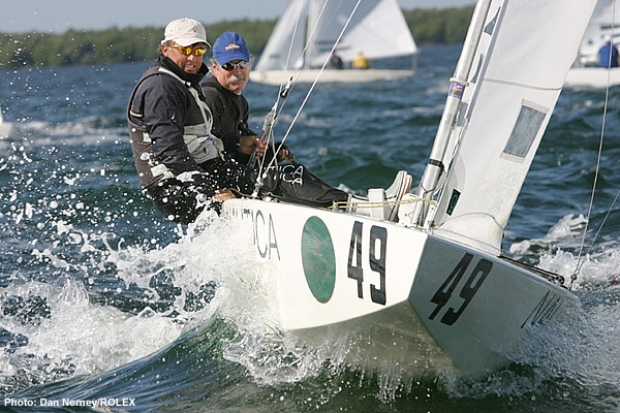
When you meet Mark Reynolds you could be forgiven for thinking you have walked in on the set the of a spaghetti Western. I want to see the man strike a match on his boot and light a cheroot or click his spurs and draw his six shooter. In fact Mark Reynolds is a living legend in Olympic sailing and specifically the Star class, where he won the World Championships in 1995 and 2000, and the gold medal in the class at the Sydney and Barcelona Olympic Games and a silver in Korea in 1988. The Star is his life in much the same way as it was for his father Jim who crewed for other iconic figures such as Malin Burnham and Dennis Conner, winning the Worlds with DC in 1971 and himself sailing three Olympic campaigns.
Reynolds Junior grew up around that hotbed of Star sailing, the San Diego Yacht Club, a club who's membership can claim something like 13 Star World Championship titles. Conner was a big influence in his sailing: "When I was a kid growing up in the early 1970s when my dad was crewing for Dennis, Dennis would come over our house every evening and I worked for Dennis on his boats. I went to the 1976 Olympics with him working on his Tempest when the Star was out and the Tempest was in. And I learned more from Dennis than probably from anyone."

He also worked at the sailloft next door to the Club run by five time Star World champion and 1968 Gold medallist, Lowell North - today quite a familiar name in sailmaking. In fact Reynolds' mother was in the same class at high school as North. Having sailed his father's boats for a number of years, Reynolds bought his first Star in 1983 and today the Star is also his business as his own Quantum loft in San Diego is the leading supplier of sails to the class.
In the last few days Reynolds has been in Qingdao coaching the US Star duo of John Dane and Austin Sperry but ironically it was he and his long term crew Hal Hanel who qualified the US last month at the Worlds in Cascais. "We had a qualifying system - a team ranking system and a few of our guys like Mark Mendleblatt, George Szabo, Andy Horton, they didn’t sail all the required event. John Dane has been right at the top of that group too, so he’s our rep there."
Having campaigned the Star at such a high level for so long, sitting it out in the coach boat is not an issue. Reynolds is still planning on taking part in the US trials in Los Angeles later this year, although his campaign with Hanel, with whom he sailed his first three Olympic campaigns, is minimalist at best. "We are doing it not really seriously. The last race we did was Bacardi Cup and then we did the Worlds and then we’re going to do the trials. There are no other regattas in there. Fortunately the trials are in LA where Hal works. He is a senior VP at Fox and so he has a lot of responsibilities there, so he’ll work in the morning and we’ll do a little sailing in afternoon and we’ll do some training with Mendleblatt and Szabo and some of those guys."
For US Star sailors, times, they are achanging. As Reynolds puts it, at one point at a Star World Championship US teams would hold nine out of the top 10 slots. In Cascais, Reynolds and Hanel were top US team and bearly qualified their country.
"I ended up 12th, which is not bad for the Star Worlds and we were the 11th country and 11 countries qualified. So it was nice - it is very difficult to qualify a country in the Star Class. I would have to imagine the Star has got to be one of the toughest. There were 32 countries entered in Portugal and I can tell you there are still some good countries that are going to have a hard time: Only four more can qualify and there’s still Canada, Bermuda, Denmark, Spain, Switzerland, Norway, Finland, Ireland, Croatia. There are a lot of guys who still have to qualify for those last four spots. So it was nice to get that out of the way and get the US in there."
Reynolds not only has interests in the class as a sailor and a sailmaker, he is also the current Star class representative on the US Sailing Olympic committee at present and having been around the class all of his 50+ years has seen how campaigns have developed.
He remembers speaking to a US Star sailor who competed at the 1948 Games in London. "He just happened to be going to school in London and he was called up by the Olympc committee and they said, ‘since you’re living there, would you mind sailing in the Olympics!’ And he said ‘sure I’ll do that’ and he got a medal."
When his father was campaigning in the 1960s and 70s, you could carry out an Olympic campaign part-time. "When my dad sailed with Malin Burnham and then Dennis Conner, he was working full time, supporting a family and did sailing at the weekends and maybe took his two or three week vacation for the Olympic trials. So things have changed a little bit since the 60s!"
The problem with Olympic sailing in the US in general is that sailors receive precious little financial support. There is none from the government and only minimal help from the US OC. There is no national lottery ploughing money into sports and getting sponsorship for yachting, or indeed many other sports, is hard when sailing receives next to no press coverage in the US, Reynolds maintains. "In fact we get virtually no media coverage, so for someone to sponsor sailing has got to do it more out of wanting to see their country to do well rather than wanting to see their company getting good advertising return."
So top sailors in the US have the choice of living on the bread line and scraping together enough to carry out an Olympic campaign or they can get a well paid job in the America's Cup or Volvo Ocean Race. Not a hard choice.
"We have guys like Kenny Read, one of the better sailors in the world, and he’s never done Olympic sailing," cites Reynolds. "Terry Hutchinson has done very little of it. He has started [some campaigns] and then has been sidetracked back into the America’s Cup or something like that. He is getting a Star right now and hopefully we can get him. but it is hard for a guy like that who can make so much money elsewhere. Last time around Cayard took a little time off from professional sailing - 'I’ve made enough money to fund this thing myself, I’m going to do a proper program' and he put forward a great programme. He was fifth, but he could have had a silver. So we have the potential, with young guys like Andy Horton or Mark Mendleblatt, but like this last time around they are all doing America’s Cup, whereas [Robert] Scheidt and [Xavier] Rohart are only thinking Star boat sailing. It is hard to compete with that kind of program if you are doing it part time."
While in the US it is hard to get sponsorship, elsewhere in the World, in particular Europe, it is possible for top sailors to get commercial backing for their campaigns and this has enabled many younger but well seasoned sailors to enter the class.
In past Olympics there were always 'Star nations' aroud the world, the US being the prime example, but now, Reynolds says, that despite its age interest in the class has exploded internationally with many new nations fielding top teams. "The US has always been really big in the Star and there used to be years whne we had nine out of the top 10 at the Worlds and this year we didn’t have anyone in the top 10 and the top 10 were 10 different countries."
The keelboat is also more forigiving when it comes to crew weight ranges. "That is one of the great things about the Star is that it really doesn’t matter - you need to be 170lb to have enough strength to do the main, but Schiedt is probably 180," says Reynolds. "Obviously the guy is as fit as you can be for that weight, but you can compete at that weight or at all the way up to Peter Bromby's level of probably 240-250lb. So the Star takes a wide range of sailors."
It is for this reason that it is important that a keelboat like the Star remains in the Olympics - without it Olympic sailing will become a competition to determine the world's best young sailors, not the world best sailors period. Without a keelboat Reynolds reckons many of the 'names' such as Torben Grael or Paul Cayard, wouldn't compete.
At present the future of Olympic keelboat racing remains uncertain with ISAF tasked to lose a class for 2012 and a strong compulsion to move towards faster, more visually exciting and TV-friendly classes like the 49er and Tornado. What it may come down to is the strength of the class' voice within ISAF. "In the old days we had a strong lobby, often the President of ISAF and Vice-Presidents being Star sailors. We don’t really have that any more," admits Reynolds.

TP 52s
Following Qingdao Reynolds is this week in Portomao, Portugal for the penultimate round of the Breitling MedCup. Having sailed pretty much the whole of the first season in 2005 with Russell Coutts on board Lexus, last year he raced three regattas on board the Italian TP 52 Anonimo.
This year Reynolds started out on the coach boat for the first two regattas but since Copa del Rey has moved on board as tactician. "We just decided to see what would happen because everyone is speaking Italian on the boat and I don’t speak Italian yet. I am starting to learn a few words, I know the words for tack and gybe now!"
This boat is campaigned by Riccardo Simoneschi, who, of course, is a former President of the Star class and is a Hakes Marine-built sistership to Peter de Ridder's 2006 series winner Mean Machine. Like several other of the Italian and Spanish campaigns, Simoneschi attempts to run his TP 52 campaign on a commercial basis and this year has backing from Anonimo, Q8, Bang & Olufsen, etc.
"He’s trying to make it work as a commercially sponsored program," says Reynolds. "I don’t think it is quite paid for, so it is a bit of a struggle, the budgets are a little bit tighter than it would be for a guy who can just write cheques. Of course Riccardo has to spend a lot of his time fund raising, the same old story. So that makes it tougher with a tighter sail budget, etc."
This year, possibly due to Reynolds' influence they have changed to Quantum and have Paul Tingle as their sailmaker who worked with movistar on the Volvo. "We didn’t want to repeat what happened last season, where we got a suit of sails delivered and they said ‘have a nice summer’. We wanted to try and keep progressing, but when you are on a budget it makes it a little hard to do that. So we've done a little recut on the spinnaker luff and the jib luff curve - we are trying to improve the sails throughout the season like all the other top programs are doing."
Reynolds says he is not fully on the case with the latest developments in TP 52 sails. In terms of spinnakers, when he was with Lexus the kites were too full down low and became increasingly flat over the season, whereas this year they were too flat in the clew. When it comes to mainsails teams are still trying to push the limit of their roach profile to find what will flip around the backstay. Like Coutts, Reynolds thinks the single backstay arrangement required under class rules is ridiculous.
"It would be easier in the end to have two running topmast backstays, because it is so hard in light air to flip it around the leech and in medium air to get the main to blow through and in gybes it gets caught and then you have to have a crane sticking out there. And our crane started to break off a little bit the other day. It make have been a cosmetic crack, but we had cracked in there so we had to pull the mast off and relaminate up there."
The Anonimo team is fairly representative of the top TP 52 campaigns in how it has upped its game for 2007. This is partly due to the America's Cup being done and dusted. "We have a good crew on the boat, a lot of Luna Rossa guys, a majority of our crew is America’s Cup guys from Luna Rossa, Marco Constant from Mascalzone Latino. Marco is the only non-Italian but he has been sailing with Italians and he speaks Italian. They call him Marc. We have three Marco and one Mark on the boat now," says Reynolds .
The fleet is definitely more competitive as a result and Reynolds finds himself increasingly comparing it to the Farr 40s. "Some of the boats that are three years old are still pretty competitive."
The question remains - does the TP 52 have a brilliant future or will the inevitable happen and it gets too expensive and owners take their sailing budgets elsewhere? "I don’t know - if you look back over the years, there’s always something else which comes along. I’ve always been more involved with Olympic sailing but I did sail on the 50 footers back in the late 1980s and early 1990s and that seemed pretty good and then it stopped and something else came along for a little time period. It is hard to keep it going. The 50 footers started to get a little too expensive and they tried to do a one design and it just didn’t happen. A lot of those people ended up with Farr 40s and the same people seem to move into whatever next comes along."
However with the TP 52 there are several ingredients that the IOR 50s lacked. There are a huge number of them - the 50s rarely numbered more than 10 boats, whereas the TP52s this year have a 24 strong fleet, the King of Spain is involved and in the right countries campaigns such as Anomino can be commercially funded. But at the end of the day it may be successful simply because it is just a high performance boat that is fun to sail...
Most Read
Most Commented
Comments
Businesses

Pro businesses
-
-
United Kingdom
-
Italy
-
Editor's choice
Member blogs
-
 Ned Collier Wakefield: MOD70 round BarbadosWell that was intense. 12 hard fought for seconds for the win. In idyllic conditions, Tony Lawsons MOD ...
 -
 Mini Transat leg 2 reportThe second leg of the Mini Transat started on 31st October, just over a month after ...
 -
Leg 1 reportI’ve been working towards the Mini Transat now for three years. In 2013 I was part ...
Business blogs
-
 The Island Sailing Club in Cowes, Isle of Wight, is delighted that Prince Michael of Kent ...
 -
Peta Stuart-Hunt chats with the 25 year-old British solo sailor Lizzy Foreman before she sets sail ...
-
The 2015 Student Yachting World Cup (SYWoC), an ISAF-recognised event hosted and run by students for ...
Editor's Choice
All time favourites...
-
 Three legs down into Ian Walker’s
 -
 Winning all but two races at
 -
 For the first time in its
Latest Comments
Add a comment - Members log in