
The real numbers
Wednesday May 30th 2007, Author: James Boyd, Location: United Kingdom
In recent articles we have been looking at the size of the America's Cup (including the Acts and the Louis Vuitton Cup) with the aim of trying to convey to readers just what an enormous event it is compared to not only other events in sailing but also other sporting events in general.
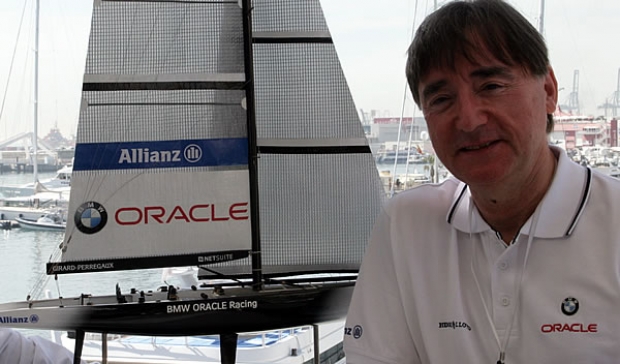
While we have cobbled together figures, there is a man who is an expert in estimating the size and value of major sports and events within them, who has been recently employed by the insurer and financial services company Allianz, a co-sponsor of BMW Oracle Racing, to analyse the America's Cup.
A Liverpudlian, Professor Tom Cannon is Dean of Business at the University of Buckingham. His work to date and the resultant report recently published on the America's Cup, comes after Cannon has carried out similar studies into the business and economics of other major sports such as soccer, horse racing and golf. In football this has included looking at the overall economics of the Premiership and Champions League in football, at particular events, at clubs and individual's investments. In golf Cannon has previoulsy been commissioned to examine at the overall economics of the game, the effect of the Ryder Cup and he has even done more specific studies such as the effect Tiger Woods had on golf in Britain when he visited for three weeks last year.
Aside from his analysis of sports, Cannon has also carried out research into general economic regeneration and usefully this and sport are two fields of analysis that meld with the America's Cup, where the event has been responsible for massive multi-billion Euro development of Spain's third largest city. While Valencia are carrying out research into their own event, as the New Zealand government did when the event was held in Auckland, with the Allianz report Cannon has approached it having no vested interest in inflating or deflating the numbers.
"This sport is interesting because it is going through some really fundamental changes which the economic analysis illustrates I think quite well," Cannon told thedailysail. "It is a change from being to some degree a club sport where the club was what mattered to being one where people were saying ‘well, there is a lot of resource tied up here - what is the return for business, the economy and the society investing in it?' The thing that surprised me was how much it costs to get to the start line. By the time you get two boats in the water it is $100 million." Cannon reckons that the biggest team in Valencia this time around was BMW Oracle Racing who's budget was $150-200 million.
Some of the key observations made by Cannon in his report are, that The America’s Cup is at present:
- The third largest international, competitive tournament after the Olympics and the FIFA World Cup. Formula One is fourth.
- The largest and most demanding sporting competition between clubs in the world
- The largest inter-club sporting competition in the world in terms of economic scale and impact
- the largest prize for winning a sporting event (ie you get to organise the next event).
According to Cannon's estimates the 32nd America's Cup will have an economic impact of around $8-9 billion. This is slightly below the figure the Spanish government recently published in their assessment of the event.
When analysing the finances of a major sporting event it is necessary to come up with some parameters to compare like with like. One of the questions Cannon regularly is asked in the UK is 'how does xyz compare to the Premiership?' "The Premiership doesn’t have a final so if you were to take running the Premiership over a year with gate income with television, revenues and then you multiply that by four… Or if you compare it with the Superbowl. The Superbowl is the biggest weekend event in the world, it is probably worth $1.5-2 billion over a weekend, but what if you include the play-offs that would add another $0.5 billion - or do you include the whole of the NFL season?"
The most direct comparison can be made between the America's Cup and the Olympics which occurs over similar time period culminating in one major event. Cannon's figures start that the economic impact of the Athens Olympics was $13-14 billion, while this is set to rise of $20 billion for Beijing and around $30 billion for London in 2012. With the last FIFA World Cup in Germany he puts a figure on of $10-11 billion although this was less than Japan or Korea where they built 12 new stadiums to host the event. However at what point do you apply a cut-off? Do you include the qualifiers? For the purposes of Cannon's calculations he did not.
A similar problem occurs when comparing Formula 1 with the America's Cup. Formula 1 obviously works on an annual cycle and in Cannon's ranking this is fourth because he has compared it to a one year Formula 1 cycle which he estimates to be worth $3-4 billion. Multiply this by four years and then Formula One is looking more akin to World Cup figures. So perhaps the America's Cup in fact should be fourth in the league table?
A significant difference with Formula One is that because it takes place on an annual basis a majority of the circuits and accompanying facilities are already built, therefore the 'impact' of the event according to Cannon's calculations is reduced. "There are some exceptions, for example, the Grand Prix in China, but generally you have got a very well established circuit and therefore you are not having to develop airport, rail links and roads and as expensive as boats and Formula One cars are - they’re not as expensive as airports!"
Cannon's calculations for the economic impact of an event also includes technology and while this is relatively straightforward to guage with the America's Cup it is much harder with Formula 1. "You can’t separate out what Honda, Peugeot or Ferrari would be spending on developing their cars from what they are going to spend specifically on Formula One. So how much of the R&D currently taking place at Honda in their big laboratories that would have spin offs into Formula One would they do anyway?"
For the America's Cup team investments in technology, Cannon reckons, took up around one quarter of total syndicate costs (or between $200M and $250M). These, he states, are likely to grow faster than any other for future America's Cups.
Cannon's studies are coming up with some large numbers because of the wide range of what he is including - from direct costs such as keeping a team together for three years, indirect impact such as Allianz carrying out testing of spars on behalf of BMW Oracle Racing or a team's wind tunnel or tank testing to 'induced effects' such as the effect of the Cup behind held in New Zealand on the marine industry there.
Using his categories Cannon says that between the last two Cups held in Auckland the event has only grown six to eight times larger as he maintains the New Zealand government underestimated the figures of 425 million (229 million Euros) and NZ$ 529 million (285 million Euros) for the 2000 and 2003 Cups. "They specifically looked in that study on Auckland and New Zealand on the finals - they didn’t include what the teams spent, and they didn’t take into account the effect on the New Zealand boat building industry. It has moved from being a good, relatively inexpensive place to buy boats to probably being one of the top two or three - you had a transformation of the marine industry from an annual growth rate of 1-3% in line with the economy to a growth rate of 9-10%. So we reckon the economic impact not just during the window that the event was taking place and the time people were actually there was something like 75-100% higher than their own estimates."
While the event has grown in size, overheads have increased three fold since Auckland and he reckons will go up by a further 50% over the next Cup cycle (although quite how he estimates this without known where or when it will be held is hard to fathom). However he reckons the total support from Partners and Sponsors to be in the region of $600M in cash and kind this time around and could double for the 33rd Cup depending on the location and defender. Costs are such that dispersing Regattas over a long period (as between 2003 and 2007) appears to be the only way to allow revenues to keep pace with costs, he maintains.
Where next?
Another feature of Cannon's studies have been to estimate the economic impact if the event were to move next time around. To this end his report states that of the places he considers the biggest economic impacts would occur if the event were to move to somewhere like Dubai and the UAE. Here they would have the ability to make an economic impact of over $10Bn from hosting America’s Cup. He observes that an America’s Cup in Dubai’s is the UAE's most realistic prospect for hosting one of the 'top ten' global sporting events. Holding it there in 2009 would also coincide with the completion of around $75Bn in economic development projects.
After Dubai the ranking is as follows:
- San Francisco and the West Coast of the USA - $9.9Bn
- Genoa and Italy (if Luna Rossa Challenge won) would be around $4bn
- if the BMW ORACLE syndicate held a competition in the USA for cities to host the 33rd Cup and Newport RI won - $4.5Bn of impacts on the Rhode Island, Massachusetts, Connecticut and New York economies (or other East Coast potential hosts)
- recent hosts like Valencia and Auckland are likely to see the smallest economic impact if they were to host the Cup again with:
- Victory for Desafio Espanol 2007 creating an economic impact of around $2.75bn
- Victory for Emirates Team New Zealand would deliver around $1.75Bn
In terms of the size of the event at present Cannon thinks it unlikely it will downscale however he reckons the make-up of how the event and teams are paid for will have to move more towards commercial sponsorship in the future. The days of running a million dollar business out of a biscuit tin are over.
"Once you have reached the point where you have 10-12 teams each spending on average $100-150 million to get to the start line of the semi-finals, how do you pull that back? It has got too big for philanthropy. With the America’s Cup before it went to New Zealand, the two things that sustained it were philanthropy and amateurism. You had the rich members of the New York YC who said 'I’ll put a boat in the water'. But are you likely to find 10-12 people like that? I don’t think you would."
One of the most telling points in Cannon's document is that if it is decided to increase the importance of the Acts, creating more of an America's Cup circuit in the future there should be serious consideration for a central organising body like the IOC for the Olympics. "Using the Fédération Internationale du Sport Automobile(FISA), Formula One Constructors Association (FOCA), the Formula One teams and Formula One Administration as templates, we’d estimate an minimum annual economic impact of $250M to whichever local economy hosts the organisation, but potential increased revenues for teams and the organisation of $1.5Bn..."
Most Read
Most Commented
Comments
Businesses

Pro businesses
-
United Kingdom
-
Netherlands
-
France
-
France
Editor's choice
Member blogs
-
 Ned Collier Wakefield: MOD70 round BarbadosWell that was intense. 12 hard fought for seconds for the win. In idyllic conditions, Tony Lawsons MOD ...
 -
 Mini Transat leg 2 reportThe second leg of the Mini Transat started on 31st October, just over a month after ...
 -
Leg 1 reportI’ve been working towards the Mini Transat now for three years. In 2013 I was part ...
Business blogs
-
 The Island Sailing Club in Cowes, Isle of Wight, is delighted that Prince Michael of Kent ...
 -
Peta Stuart-Hunt chats with the 25 year-old British solo sailor Lizzy Foreman before she sets sail ...
-
The 2015 Student Yachting World Cup (SYWoC), an ISAF-recognised event hosted and run by students for ...
Editor's Choice
All time favourites...
-
 Three legs down into Ian Walker’s
 -
 Winning all but two races at
 -
 For the first time in its
Latest Comments
Add a comment - Members log in