
The rat in a can
Friday May 25th 2007, Author: Andy Nicholson, Location: United Kingdom
If the bowman is the coolest man on the boat, then his partner in crime, the mid-bowman is the hardest. It is not a glamorous job by any stretch of the imagination yet it is a vital one and as with all best mid-bowman, their hard-man credentials proceed them.
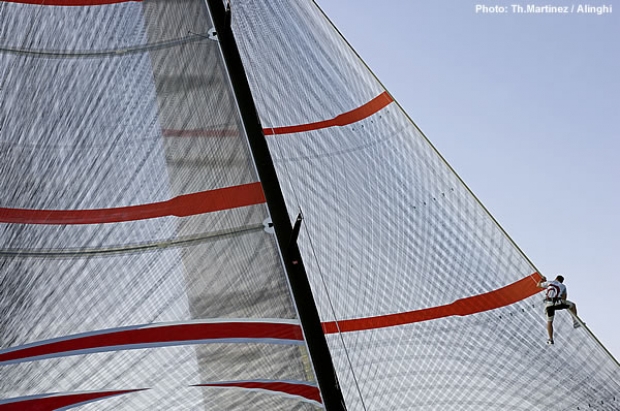
For much of the race the mid-bowman is to be found in the under deck, packing sails - the jib on the run and the spinnakers and staysails on the beats. When on deck they have a key role during the manoeuvres at the marks for the hoists and drops - they also back up the bowman, jump on the handles, go up the rig with the tools and generally do all the other jobs that no-one else on the crew really wants to do.
So what sort of person takes this on? The archetypal mid-bowman is perhaps Alinghi’s Canadian all round extreme sports dude Curtis Blewett who counts Freeriding (pointing a mountain bike down a snowless Black Run) as one of his hobbies. Blewett may already be familiar to readers as Paul Cayard’s bowman on The Black Pearl in the last Volvo Ocean Race – he won the race previous to this in 97/98 again with Cayard on EF Language. His America’s Cup history goes back to 2000 when he was with the AmericaOne syndicate before moving to Alinghi six years ago in 2001.
His experience as a rigger means that at Alinghi he is the rig-shop Foreman and when we speak to him he is preparing the boom and the spinnaker pole for the men-in-white coats from ACM Measurement.
It is Blewitt who does the rig check at the end of the day, usually when the boat is on the tow back into the harbour, and when it docked briefs the rig shore team on anything he has found and double checks the job list with them.

We first ask Blewett what are the main differences (apart from the obvious) as a professional sailor between the Volvo Ocean Race and the America's Cup: "I think that the Volvo is an expedition and you are always deciding what to compromise - what you chose to do, what options you take, do you cut your loses. There is too much to do. It is impossible to live on that boat and do all that work. Whereas here, we have more time, more resources and more people and so we can make everything important. So you end up with a very high, refined style of sailing with no excuses - rather than do a good job kicking ass in your prioritising."
Blewett is a no-nonsense type of guy, a trait one imagines is naturally at home within the Cup arena. No excuses, just get on and do it. Are their any lights under deck to help see in the pitch carbon black? "No, no lights. It just sucks," he says with characteristic bluntness. "You just have to grunt up. You can have all that trick stuff, but its just weight. All those pussy little things that you have to try and make your job easier - its weight out of the bulb."
The most exciting part of the race for the mid-bowman is the pre-start and with Alinghi that finds Blewett at the back of the boat on the starboard runner, or both runners or on the aft grinder depending on the conditions of the day. "You’re standing right amongst the afterguard and you know the game plan and its really great job down the back there," he says. From then on it all becomes a little less glamorous - they don’t call it the sewer for nothing.
Blewett’s day is dominated about predicting what sail they will want next and what the trend in the wind is doing. If it’s shifting does that mean a gybe set? If its building it may mean a symmetrical rather than asymmetrical, if its dropping that may result in the next jib down in the quiver being called for - and they are all kept down below in the sewer.
Generally they will race (on an average day) with four jibs and six spinnakers - if it’s windy they may double up on the key headsails and spinnakers in case of problems. The first call of the day is made on the dock and Blewett says that he talks with the weather team and the trimmers as to what is the most likely to be loaded into the boat: "I am very interested in the weather forecast and what will be our primary sails and our secondary sails and the back-ups," he says. "Really, getting the boat organised from the get-go."
A final call from the weather team comes in 15 minutes from the pre-start when they finalise their race sails for the next hour and half (the mainsail is a bigger task and the call on that would have been made earlier). "So we make the call and get the chase boat over," he explains. "We work like hell to get everything off we don’t want - so that is a full on, huge shuffle of the deck down below. At least one of those will be a last minute call, if you're changing for heavier, or the lighter end of the range."

At the end of the first beat Blewett does his disappearing act from the aft end of the boat, squeezing through a small hatch on the cockpit floor and making his way up to the forward end of the boat to get the primary kite hooked up and also ensuring the back-up is ready to go too. Wearing a headset he pre-empts the sail call: "I have a very good gauge on the trend of the wind against the course axis so I have a good idea if it’s a gybe set or bearaway set without screaming for information blindly. With the headsets I am listening to the aftergaurd all the time so I don’t have to wait and wait for a call, so they kind of confirm what we have guessed is going to happen...hopefully..!"
The bowman comes past him as the mark approaches with the halyard and the pole, and then the foredeck team are into the hoist. Once the jib is down Blewett gets it down the forehatch and the real hard work begins. Packing a jib takes him on average eight minutes. Packing a 150m 2 jib with huge battens in it - how does he keep in neat? "Ah, that’s the trick!" he laughs. "Sweat, blood and tears! I don’t use any fancy shit. You just have to work hard."
For the remainder of the run Blewett "makes sure he [the bowman] stays out of trouble! Just sharing the communication with him to make sure we are ahead of the game - what the plan is coming into the mark and how it’s shaping up."
At the bottom mark his advice is to keep clear of the string line during the drop - with this system the string line is normally hooked up to two or three anchor points on the middle of the kite and on drops the line comes down the forehatch and back to a winch below. When about half the halyard is released (depending upon wind strength) the winch is fired up by the grinders often in 1:1 gear allowing the kite to be whisked down below in as little as 6-7 seconds: "In she comes - the ‘Hoover’. Not too close for sure! That thing smokes!”
Blewett’s life is the drop line - taking it off the bowman and hooking it up to the drop system. The consequences are not nice if they have to do a ‘manual’ drop - taking guys out of their positions and up on the bow to pull in 5,000ft 2 of nylon. With the options now available at the leeward gate, things can get hairy he says when there is a late gybe or funny business with the competitor which means the drop line has to be led another route. His advice? "We're not trying to do anything too special - we’re just avoiding nightmares."
His second beat starts down below packing the kites. Big sails in the dark take some work as Blewett’s describes: "It can get a little confusing down there if you are doing a lot of tacks, but you know...a baboon could do it right!? It’s packing a triangle back into a bag with a bit of wool - it’s not magic. It’s the same deal as the jib, you just have to hussle."
The whole deal of packing the kite is slowed if he finds a rip. He may also be called upon by the grinders to look at any issues with the winches and linkages under the deck. His tools of the trade are a headlamp knife and Gerber - “I’m a Gerber man!” is the reply when we inquire about the brand of his mulitool (he’s on his third since the 1998 Volvo Ocean Race).
The day on the water finishes with the boat being craned out of the water 0 obviously the job involves Blewett as he drives the crane too…
The level of fitness the sailors require have matched the no-stone-unturned approach in the Cup and for Blewett when all is done at the end of the race day he does a 20 minute or half hour run on the treadmill to wind down. Most of the weight and fitness training is done away from the race days when gym time is around an hour and a half. Otherwise, if a match is on, it is a light warm up in the morning.
This fitness comes into play in an unusual way on the boat and one which is peculiar to the mid-bow position as Blewett explains: "On the deck you have the motion; you can see all the ups and downs, so you’re free to move with it. Inside, well there is so much spectator chop and it loses its rhythm and you kind of get knocked around." And did we mention the darkness and noise? "Yep, it’s quite loud down there - a rat in a can!" he confirms. "You don’t need sunscreen that’s for sure!"
Most Read
Most Commented
Comments
Businesses

Pro businesses
-
-
United Kingdom
-
United Kingdom
-
Italy
Editor's choice
Member blogs
-
 Ned Collier Wakefield: MOD70 round BarbadosWell that was intense. 12 hard fought for seconds for the win. In idyllic conditions, Tony Lawsons MOD ...
 -
 Mini Transat leg 2 reportThe second leg of the Mini Transat started on 31st October, just over a month after ...
 -
Leg 1 reportI’ve been working towards the Mini Transat now for three years. In 2013 I was part ...
Business blogs
-
 The Island Sailing Club in Cowes, Isle of Wight, is delighted that Prince Michael of Kent ...
 -
Peta Stuart-Hunt chats with the 25 year-old British solo sailor Lizzy Foreman before she sets sail ...
-
The 2015 Student Yachting World Cup (SYWoC), an ISAF-recognised event hosted and run by students for ...
Editor's Choice
All time favourites...
-
 Three legs down into Ian Walker’s
 -
 Winning all but two races at
 -
 For the first time in its
Latest Comments
Add a comment - Members log in