
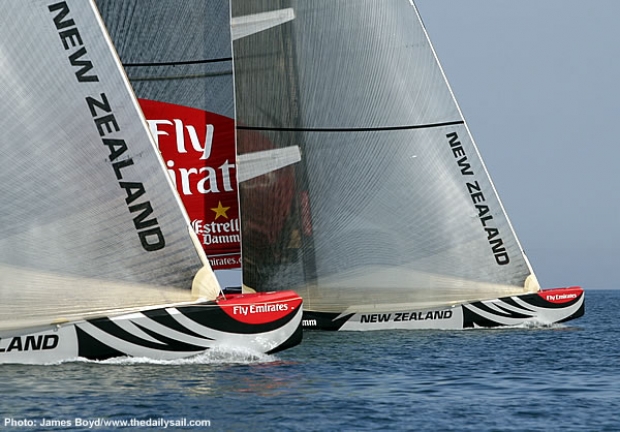
Let the action begin....
Monday April 16th 2007, Author: James Boyd, Location: United Kingdom
The largest sailing event ever held gets underway today with the first round robins of the Louis Vuitton Cup, to determine the best challenger to take on the defender Alinghi in the America’s Cup. With 11 teams racing this is one of the largest challenger line-ups and certainly the most international with South Africa, China and Germany all competing for the first time. Thanks to the new format for the competition, where the addition of the 13 ‘Acts’ has allowed teams, including the defender Alinghi, to race between Cups, the competition will be closer, the boats faster, the crew work slicker than it has ever been before in a Louis Vuitton Cup.
As Alinghi boss Ernesto Bertarelli said: "In order to prepare for the America’s Cup we went into the archives and we pulled out the semi-final, final and America’s Cup match. And the team reviewed those matches and it was quite surprising the steps forward that the whole game, all the teams around here have made, in manoeuvring and sailing and the performance. It is a little bit like looking at 1970s football and you have the impression that everyone is walking rather than running. If you look at the 2003 footage you realise what the pre-regattas have done to bring the level up to a completely different step."
Format
The format for the Louis Vuitton Cup challenger selection series has changed yet again. Whereas in 2000 there were three round robins (with each consecutive one counting for more) and a six boat semi-final, and in 2003 there was a convoluted repechage round enabling losing teams to pop back up in the quarter and semi-finals, this time the racing format is much simpler. There are two sets of round robins, during which each team will race every other challenger twice.
The round robins are scored on points, with two for a win, zero for a lose and when these are tallied up at the end, the points carried forward from the Acts (for what they’re worth) are added to each boat’s total. Thus the winner of the Acts, Emirates Team New Zealand, carries four points through from the Acts, equating to two Round Robin Race wins.
Immediately after the round robins seven teams get flicked - the largest culling at one time we have seen in the last three Cups - with the top four teams racing semi-finals starting on 14 May. There are no repechage rounds or quarter finals. From the semis, the winners go into the finals starting on 1 June, before the eventual Challenger is decided and goes on to have it out with the Defender, Alinghi in the America’s Cup starting on 23 June.
Challenger selection
In 1970 after a challenge had been made to the New York YC, the French Baron Bic (of Bic biro fame) complained that he didn’t want to wait until for the next Cup before he could have a go. The New York YC perhaps unwisely agreed and thus the first challenger selection series was staged. Since then it has become a valuable device to develop the pace of the winning challenger before meeting the defender. In 1983 the challenger selection series was sponsored for the first time by Louis Vuitton and perhaps it was no coincidence that this was the same year Australia II prised the America’s Cup off the New York YC. While the America’s Cup rested with the New York Yacht Club from 1851 through until 1983, since then Louis Vuitton Cups have helped the challenger lift the Cup off the defender on three out of five occasions.
This time the 13 Acts held since 2004 have not only allowed the teams to check out their form against the opposition but given us, the media, a fairly good idea of the pecking order of the competition before proceedings start in anger. Previously racing prior to the Louis Vuitton Cup has been a relatively secretive affair and it has often only been when teams have received a whipping in the LVC itself that they have found themselves to be off the pace resulting in frantic and often dramatic activity as they attempt to remedy the situation (remember Prada’s new bow being hurriedly fitted in Auckland). Drom a competitive perspective, this was very bad for the Louis Vuitton Cup. The teams this time round only had the chance to line up their new Version 5 hardware against the opposition in the very recent Act 13 fleet racing, although a considerable amount of informal racing has been taking place too off Valencia.
Another problem with the lack of knowledge about the competition prior to the main events is that it has led to very uneven America’s Cup racing. Looking back at the recent history of the America’s Cup, the last occasion it wasn’t a walkover, with one team winning all the races, was back in 1992 when Il Moro de Venezia did manage to take one race off Bill Koch’s otherwise invincible defender America3. But again this is not clear cut. This time around Alinghi is looking to be the class act with form suggesting she is capable of repeating her 5-0 demolition of whichever team the Louis Vuitton Cup produces as the challenger, as she did against Team New Zealand in 2003. However with the Acts followed by the Louis Vuitton Cup, there is little excuse for the ultimate challenger to allow Ernesto Bertarelli’s team to have a clear run. Most race pundits believe that while Alinghi is the dominant team this time around the preparation of the challengers will mean that the Swiss are unlikely to have it all their own way in the America’s Cup.
The form
While Alinghi is favourite to defend the 32nd America’s Cup for reasons we’ll cover at a later date, the most interesting grey areas in the form guide are which teams will end up in the semi-finals of the Louis Vuitton Cup and which of these will become the ultimate challenger.
The challengers fall neatly into the three groups – the ‘big three’, those jockeying for the all-important final spot in the semi-finals and the also-rans.
The big three
From the outset of this America’s Cup cycle there has been three big challengers: Larry Ellison’s mighty BMW Oracle Racing syndicate has been the biggest and fattest, with Emirates Team New Zealand smaller, highly talented and oh so hungry after their embarrassing defeat in 2003, while Luna Rossa Challenge is the big Italian team born of Patrizio Bertelli’s past two Prada campaigns. The first of these won the Louis Vuitton Cup in 2000 and Bertelli has never quite been able to walk away from the event since.

Over the last seasons the form between the ‘big three’ has emerged. Despite a fairly average showing in the Act 13 fleet racing, Emirates Team New Zealand is held up as the most likely Louis Vuitton Cup winner having came out on top of the pile, just, following the Louis Vuitton Acts.
Following their embarrassing defeat to Alinghi in 2003 Grant Dalton has brought some strong leadership to the campaign and the talented Marcellino Botin (of Botin & Carkeek) has bolstered up the design team. With backing from Emirates Airlines and the New Zealand government, but without a ‘rich individual’ behind it, of the ‘big three’ the Kiwis have the smallest budget, said to be in the 80 million Euros region, but Dalton is an accountant by training and will have spent their money wisely.
Some have questioned helmsman and skipper Dean Barker’s potential as a ‘winner’ able to go the extra mile when required, particularly should he find himself up against the old Team New Zealand guard at Alinghi. But for this reason Dalton cannily enrolled the talents for British triple Olympic medallist Ben Ainslie, who despite being new to match racing has been given Barker a run for his money around the race course in the Emirates Team NZ B-boat.

Most people would rank BMW Oracle Racing alongside the Kiwis and they are certainly every bit as advanced in the technology stakes and with almost as many New Zealanders on their race boat. Their management structure, as team spokesman Tom Ehman described to us, has changed since 2003 with Ellison no longer involved on a day to day basis. However Chris Dickson is very much the all-powerful autocrat within the team as CEO as well as skipper and helmsman of the race boat and there are those who wonder how the team will fare this time when they are under pressure.
Traditionally the team have been notorious for their hirings and firings - prior to the 2003 Cup Dicko himself was sidelined, then Paul Cayard, Peter Holmberg brought in on the helm, before Dickson was dramatically reinstated. In this cycle John Kostecki left, followed by Gavin Brady after he was replaced on the helm by Dickson, only to return quietly to the afterguard last autumn as tactician. If things go wrong during the Louis Vuitton Cup it is hard to predict what the outcome will be. Perhaps Paul Cayard will be recalled? BMW Oracle Racing is believed to be the most heavily funded America’s Cup team this time around but may prove to be an example of the richest team not necessarily winning.
It should be noted that Round Robin 1 will be the first race outing for both Emirates Team NZ and BMW Oracle Racing’s second boats, NZL 94 and USA 98.
On paper Luna Rossa Challenge should be right up there. Emirates Team New Zealand are the oldest Cup team taking part, dating back to the 1995 America’s Cup they won in San Diego (although most of the sailors dating back to this era are now with Alinghi or BMW Oracle Racing), but Luna Rossa follow among the big three, this being their third consecutive campaign.
Emirates Team New Zealand may be less Kiwi than it has traditionally has been with Ben Ainslie driving the B-boat and Americans Kevin Hall and Terry Hutchinson in the afterguard, similarly Luna Rossa is less Italian. This time around their aristocratic skipper Francesco de Angelis has relinquished the wheel in favour of the young talented Australian James Spithill who has brought with him a whole roster of talent from Paul Allen’s defunct OneWorld Challenge including the McKee brothers, Joe Newton, Andy Fethers, Ben John Durham, Grant Spanhake and Andrew Taylor.

Despite having a sailing team every bit as talented as their rivals within the big three, they have proved the disappointment of the trio, to the extent that some of the team’s harsher critics don’t believe they will even make it through to the semi-finals. Whereas the Kiwi and BMW Oracle boat are said to have a good all-round performance, their boats have shown an irregular performance and one of their lackings may be in their design team. In this department they lost the Frers to Victory Challenge for their 2003 campaign, during which one of their other heavyweight designers, Doug Peterson, was also fired. Their design team this time is almost as large as BMW Oracle Racing’s but largely comprises scientists rather than yacht designers and they may be suffering from the same problems as afflicted Team New Zealand in their defence in 2003 – too much technology, not enough creativity. Part of this uncertainty within the design team is perhaps reflected in their two new Version 5 boats where their second boat ITA 94 doesn’t appear to be an evolution of - or even in the same ballpark in terms of its hull shape - as their first lacklustre effort, ITA 86.
Mind you Spithill is considered to be at the top of the match racing game. This is his third Cup behind the wheel despite being an annoyingly young 27 years of age and regardless of the pace of the boat he sails he will put up a good fight.
Fight for fourth
With the new format of the Cup, for the challengers it is a case of make the semifinals or die. Thus one of the hottest competitions in the Cup and one of the hardest to call will be between the several teams jockeying for the one remaining place (or two if you don’t rate Luna Rossa).
Favourites for this slot we would say are the Spanish team Desafio Espanol 2007 and the Italian B-team Mascalzone Latino-Capitalia Team.

With three consecutive America’s Cup campaigns leading up to 2000 and with a highly competitive IMS circuit there are no shortage of good Spanish big keel boat sailors and behind the wheel of Desafio Espanol 2007’s they have Polish former match racing World Champion Karol Jablonski. Jablonski brings tremendous aggressive match racing ability to the team, countered in their afterguard by the calming influence of double Olympic Gold medallist Luis Doreste. They proved themselves to be in the same league as the big three when during Act 13 they won the penultimate race and were up with the front runners of the final race until they were penalised. The team have also benefited from two months of Paul Cayard having been with the team when their new Reichel Pugh designed boats, ESP 88 and 97 were launched.
“He has done a great job, he helped us a lot,” says Karol Jablonski of Cayard’s role. “He is one of the reasons we are at this level. He was coaching a bit. He is a guy who loves perfection and he is a detail man. He brought us up.”
The team in this category to have shown the most progress following the launch of their two new boats from former Farr and Reichel-Pugh man Harry Dunning are the near sisterships, ITA 90 and 99, of shipping magnate Vincenzo Onorato’s Mascalzone Latino-Capitalia Team. Skipper Vasco Vascotto and Flavio Flavini are renowned for their fleet racing skill – it was they who won the first Breitling MedCup season aboard Pisco Sour and perhaps for this reason they finished an impressive third in Act 13 ahead of even the mighty BMW Oracle Racing.

Their boats, with their high volume icebreaker bows, are not the prettiest but this could be a Cup where ugly proves fast among the contending weaponry. After the team’s dry run single boat campaign in Auckland with Paolo Cian driving (Cian now drives for Team Shosholoza), Onorato is serious about his campaign and if there is an example of a team that through good ‘spirit’ and smart management could prevail over larger budget teams, it is they. In this respect Mascalzone Latino Capitalia Team is like an 80% version of Emirates Team New Zealand, but with more children and animals running around the base and a better range of deserts in their canteen. They are unique among the teams for having Danish match racing specialist Jes Gram-Hansen behind the wheel for the pre-starts, handing over the Flavio Flavini for the rest of the race.
Sweden’s Victory Challenge also has a unique place in this America’s Cup. Like Mascalzone they are back for a second crack once again with Hugo Stenbeck, the 27 year old son of the late TV and media mogul Jan Stenbeck, running the show. Like many of the smaller teams, Victory Challenge has been on a financial rollercoaster ride in the build up to the 32nd America’s Cup, with crewmembers laid off for a while, until Formula 1 ‘energy drink’ sponsor Red Bull came on board as their principle backer. While this, unlike the Spanish and Mascalzone Latino, is a one boat team, with their new sponsor on board Victory Challenge suddenly began spending money in the second half of last year, reaching a personnel level similar to that of a two boat team and made some other expensive moves such as flying their two training boats by Antanov aircraft from Valencia to Dubai for training over the winter.

Their boat SWE 96 has been designed by the Frers, Mani and father German, and is believed to be quick. Its build has been immaculate but lengthy and because of this, the Swedes have had the least time to work up their new boat of all the teams in this category. Like Dickson at BMW Oracle Racing, Magnus Holmberg is the team’s CEO/skipper/helmsman and some wonder whether he has the depth of experience to fill all these roles. Holmberg and his Scandinavian crewman are highly skilled matchers on the international circuit, but their Cup experience is limited to Victory’s one boat participation in Auckland in 2003 while Dickson’s goes back to 1987. In Act 13 they showed a surprising green-ness fluffing relatively basic sailing manoeuvres and their performance so far in 2007 has been below par as demonstrated by their 7th place finish in Act 13, but if Holmberg and his largely Swedish afterguard can bring the team together then they have a tool capable of reaching the semi-finals. Yet there are agendas within the team greater than merely winning as demonstrated by some of the strongest members of their sailing team, not being on the race boat.

Alongside Mascalzone Latino-Capitalia Team, the South Africans on Team Shosholoza have been the greatest risers in the America’s Cup recent hit parade. Like the Italian B team, the South Africans have sailed more than most over the winter, despite staying in Valencia over this period. They were the first to launch a Version 5 boat and while there were plans to build a second, instead the team opted to make near maximum modifications on their existing 2007 generation boat RSA 83, changing the bow back to the mast and stern. The result is that their boat, designed by a team led by British naval architect Jason Ker, that is said to be extremely quick in sub-10 knot conditions. The sailing team, including several black crewmen, has come on dramatically over the last two years with more changes within the afterguard than even BMW Oracle Racing - leading South African sailor Geoff Meek moved off the wheel, handing over to Ian Ainslie. Today the final iteration of the Shosholoza afterguard sees Mark Sadler as skipper with Italian Paolo Cian on the helm and Tommaso Chieffi calling tactics. While it is unlikely Captain Salvatore Sarno’s Team Shosholoza will make the semi-finals, this is a team likely to show moments of brilliance in the right conditions and she is more than capable of taking occasional scalps from the semi-finallists.

Of the new campaigns for 2007 Areva Challenge (former K-Challenge), led by Stephane Kandler, were the first to announce their intention to compete while the 2003 Cup was on down in Auckland. France has a long association with the America’s Cup with Marc Pajot and subsequently le Defi, but this French challenge is completely new. Like Victory Challenge the campaign has been profoundly cash strapped until their nuclear power company sponsor, Areva, signed on the dotted line. With Dawn Riley at his side, Kandler has run the campaign in a smart way and scored a real coup acquiring the 2000 Cup winner (and the inspiration for the 2003 winner SUI 64) NZL 60 from Team New Zealand, although there appears to be little influence from her on their one new boat FRA 93.
Like Victory the French team don’t seem to have come together since the launch of their new boat and they too have gone through some recent upheaval in their afterguard with match racing veteran and Olympic medallist being first relegated from the helm, handing over to the young blade Sebastien Col and then being ousted from the afterguard altogether on Friday with Tanguy Cariou taking over tactician’s duties. Areva now have one of the youngest afterguards and whether this perks up their prospects we will only find out over the coming days.
Also-rans
The most terrible moment of Act 13 was when the two rigs on United Internet Team Germany’s GER 89 and +39 Challenge’s ITA 85 clashed, resulting in the Italian boat being dismasted, her spar breaking in two places. For Luca Devoti’s cash strapped team, the third from Italy, it might have sounded the death knell however over the last week they have been given a Version 4 mast by Alinghi, now fitted to the boat, while their own Version 5 mast has been painstakingly repaired and is expected to be fitted during the first round robin.

Luca Devoti’s team is unique with a crew largely comprising his mates from the Finn class led by Sydney Gold medallist Iain Percy, with former GBR Challenge skipper Ian Walker calling tactics and Bart Simpson navigating. Since the launch of ITA 85 last year there has been a major issue over the team’s finances including crew pay and as a result sailing time in the new boat has been distinctly limited. Despite all of these issues +39, with her skinny hull and ultra-rakeable mast came out of the blocks fast in the first race of Act 13 and Percy and his team led the fleet around the course until handling issues got the better of them. Once ITA 85 gets her Version 5 fitted again expect her to surprise some of the bigger teams.

Germany’s first America’s Cup challenger is still finding its feet, but as their Danish Olympic Soling medallist skipper Jesper Bank said at Saturday’s press conference “we are extremely proud of where we are at the moment. Two years ago from today there was no team, there was no boat, there was no nothing.” Fair enough. GER 89 hasn’t shown any real potential on the water to date, although this has certainly not been helped by the +39 incident in Act 13 in which the German rig was also damaged. However Bank remains one of the world’s most accomplished match racers and can never be discounted. If the team come together and they can find some more pace during the Round Robins then they too may be able to punch above their weight.

The wooden spoon entry in this Louis Vuitton Cup is certainly China Team. China’s first entry into the world of the America’s Cup has come about through the team’s acquisition of the perennially average Le Defi team from France. Ironically their new boat, CHN 95 - - built in China but believed to have an old keel - has a hull shape remarkably similar to Luna Rossa’s second new boat, ITA 94. With the piractical Pierre Mas helming, a largely French crew with Chinese sailors being brought on to gain Cup sailing experience, it is unlikely any teams will lose to China Team through any fault other than their own.
Racing begins to day with the first warning signal at 14:05 local time (13:05 BST, 12:05 GMT). Follow the action with us and match racing expert Ian Williams on our race blog!
Most Read
Most Commented
Comments
Businesses

Pro businesses
-
-
United Kingdom
-
-
United Kingdom
Editor's choice
Member blogs
-
 Ned Collier Wakefield: MOD70 round BarbadosWell that was intense. 12 hard fought for seconds for the win. In idyllic conditions, Tony Lawsons MOD ...
 -
 Mini Transat leg 2 reportThe second leg of the Mini Transat started on 31st October, just over a month after ...
 -
Leg 1 reportI’ve been working towards the Mini Transat now for three years. In 2013 I was part ...
Business blogs
-
 The Island Sailing Club in Cowes, Isle of Wight, is delighted that Prince Michael of Kent ...
 -
Peta Stuart-Hunt chats with the 25 year-old British solo sailor Lizzy Foreman before she sets sail ...
-
The 2015 Student Yachting World Cup (SYWoC), an ISAF-recognised event hosted and run by students for ...
Editor's Choice
All time favourites...
-
 Three legs down into Ian Walker’s
 -
 Winning all but two races at
 -
 For the first time in its
Latest Comments
Add a comment - Members log in