
String merchant
Friday March 16th 2007, Author: James Boyd, Location: United Kingdom
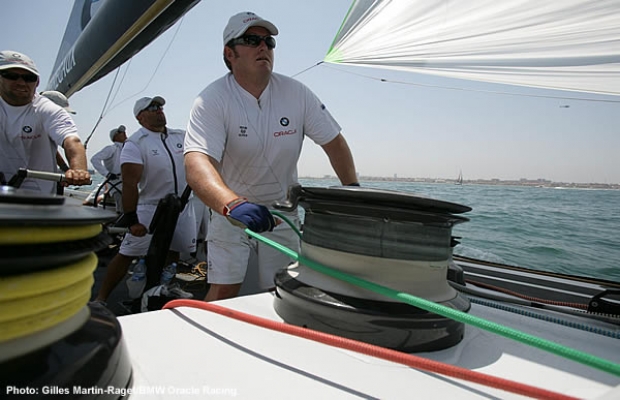
Located at the forward-most position in the cockpit, the pitman on an America's Cup boat is principally in charge of all the lines heading aft from the mast and often calls the timing on hoists and drops and other sail handling.
 Alinghi's scarily experienced pitman Josh Belsky, who sailed in this role on America3 in 1992, Stars & Stripes in 1995 and then AmericaOne before joining the Swiss team, describes the domain he is in charge of: "All of the halyards for the forward sails, spinnaker pole inboard and outboard end control lines lead to the pit, so there are about a dozen ropes that deal with the hoisting and setting and deploying and then taking down of spinnakers and jibs."
The pitman role is also one of liaison between the front and back of the boat. "During the racing I have dialogue with Brad [Butterworth, tactician] and the helmsman as to what they are thinking tactically. From that area in the boat you get a bird’s eye view both tactically and situationally of what is going in the race relative to the course itself and relative to the other boat. Often the guys at the forward end of the boat, the spinnaker or the jib is blocking their view and they are heads down working, so I am relaying the information tactically about what we are thinking which then relates to the type of manoeuvre we are going to do, depending upon whether we are at the weather mark or the leeward mark."
Belsky reckons that they have around 100 possible different manoeuvres in total and the important thing is that these are just practiced and practiced in order that they become second nature.
Belsky has obviously been involved with ACC boats since the first iteration of them in 1992 when they were about twice as wide as they are now. Boat handling has "gone millenniums past what we were doing then as far as simplifying manoeuvres and being able to do things with the sails and the boat and the pole and the ease of manoeuvring that you would never had thought possible 10-14 years ago," he says.
Today's playbook has become a lot more complex since the racing has got more competitive. Once upon a time the deltas between boats around a course averaged at around 1 minute 45 to two minutes and frankly there was rarely much pressure on - it was more of a parade.
"You’ve got A sails and S sails, a really long pole which you have to deal with," says Jamie Gale who runs the pit on BMW Oracle Racing, where the other pitman is David Blanchfield. This is Gale's fourth America's Cup after two with Team New Zealand and Young America in 2000, before being part of John Kostecki's Volvo Ocean Race winning illbruck crew, but it is his first Cup in the pit, having previously been mastman. "And the spinnaker pole is so long compared to say something like a Farr 40, so you really have to manage the spinnaker pole quite carefully because it is 40ft or so long and if you break it, it is very slow. And now the new one is this light air gybing where you leave the pole on in the gybe, and suddenly you have braces and sheets coming forward as well and you just end up with a lot of ropes in there at once."
By far the biggest headache for the crews is the gate at the bottom. Belsky describes what typically happens here: "Brad [Butterworth] is so comfortable with the combinations of people up forward that we get into that 'grey zone' [an equilateral triangle drawn between the gates to a point upwind] he says 'I don’t know what it is going to be right now. This is what we are going to try for, but I can’t guarantee it’.
"So it is our responsibility to come up with what we think is the most pro-active game plan and maybe we'll do two or three gybes in that grey zone, whereas in 1992 you’d set up on a layline two, three, four minutes out and you’d just straight line it in, the jib goes up, the kite comes down, you either gybe around the mark or not. Now we are pulling off four or five of those manoeuvres in the same amount of distance. The jib is going up with 40 seconds to go, the kite could be coming in on one side of the boat and you switch at the last minute so that it comes in on the other, that sort of flexibility."

Jamie Gale agrees that the approach to the leeward gate is the toughest moment of an America's Cup course lap. "It is one thing to do it on a smaller boat where you just have a spinnaker and you can easily take the pole off and you can sail with no pole comfortably. With these boats you really need the pole to keep the spinnaker set. Often when you are behind in a very close match the call will be 'whatever gate he goes to, we’ll go to the opposite one' and often you can’t really see where he’s going to until he’s within 30 seconds of it sometimes and this doesn’t leave you with much time. So you are hedging one way but you say ‘boys, if he gybes and goes to that gate, we are going to be gybing and going to that one'. So all the boys know what plan B is just in case."
The hardest leeward gate approach, according to Gale, is when you get caught outside a layline, with the spinnaker rather than A sail up. "You have been held outside and you are close to rolling the guy, close to gybing and crossing him and you think you are going to gybe and cross him and you set up to gybe, cross him and put the jib up on the other gybe... But then at the last minute you can’t gybe and he’s holding you outside the leeward mark and suddenly it changes very quickly from on layline, to being on a tight layline to being ‘jeez we’re not laying the mark’ to it being a two sail back to the mark. You have got to quickly change it around and get the spinnaker down and get the jib up the other side and that is about as hard as it gets for us."
And this is just at the leeward gate. Today boats regularly find themselves heading upwind overlapped, leebowing or ducking. "Every mark situation is going to be luffing rights or some rule coming into play," says Belsky. "So it is our job to be able to react to what these guys are doing at the back of the boat and to make them feel that they can put the boat anywhere at any time and we’ll sort the sails out."
The success of the pitman's role and that of the foredeck team is being able to work fluidly and instinctively without having to stop to make decisions. "Every situation you are coming into it is little bit like coming off the line for a bowman or a helmsman, time and distance gets so hammered into your head that you know what you are capable of doing in x number of boat lengths or x amount of time," says Belsky. "If you are taking the time to think and then react it is usually too late. I think the guys who have been doing it a lot, if they have any edge over guys who haven’t it is because they have seen so many situations that is just spurs this memory to instantly go to that. Because two seconds late on one line or on the pole going down or up you have a broken pole and the spinnaker under the bow. A flick of the wrist in the pit it is very easy to make the whole squad look really very bad. I actually enjoy that pressure. I don’t know if anyone else sees it that way…"

Gear
This frantic activity has only become possible because the gear has got so much lighter and crew work more refined. The pole is lighter, the sails are lighter, ropes are thinner and the whole pit layout has been refined losing at least one winch. In the mid-1990s the pit on a Cup boat would be fitted with five winches. Today both Alinghi and BMW Oracle use just three winches, having shed one over the last Cup cycle. And these winches are smaller. So it is up to the pitman to priorities the loads and work out what requires a full time winch and what doesn't.
Part of this winch reduction is also down to the venue says Jamie Gale: "In the light air you are predominantly sailing with A sails which means you can get away with three winches. If you were still sailing in Auckland or a heavy air venue and using a spinnaker every day, you might go back to four."
Another significant change is that the lines running into the pit are more often being winched from the grinders. Today on Alinghi Belsky says around 40% of the pit winching duties are carried out by the grinders, the remaining 60% tophandled. On BMW Oracle more like 90% is done on the grinders.
Jamie Gale expands: "Now the halyards get wound up, the jibs even get wound up sometimes, whereas before in the old days you’d have people bouncing at the mast, and the pitman would be tailing it away and then he’d put the handle in the top and tighten it up like you do on a small boat. Today you only have a handle in the top of the foreguy winch. The other thing is that with the gear ratios now you can’t tail fast enough to keep up anyway, so you use the self-tailer. For hoisting a spinnaker for example it comes off the winch faster than anyone can tail it."
Ropes have gone down in diameter with predominantly spectra being use, but for practical purposes they must remain reasonably large, says Gale. "The thing with rope is that they get to the point where they are so thin that you can’t handle them, jammers don’t work, self tailers on the winches don’t work and you simply can’t pull them hard enough, so you are little be limited at the moment but certainly in the future that is something that will change."
As far as jammers are concerned they typically use off the shelf Spinlock gear on the BMW Oracle boats.
On board Alinghi the afterguard and trimmers leave the calling of drops and hoists to Belsky. "Brad gives me a game plan and then the helmsman will say ‘I want a drop in two lengths’ and then he turns it over to me. I am looking at the mark and the time and I'm looking at how square the pole may be and it is then up to me, within the two lengths, of when I think the timing is right, to push it to the last minute but still be cleaned up and ready to tack right when we get to the mark. So it is a nice hand-off and the more we sail together the better it gets."
At BMW Oracle Racing it is the upwind trimmer who calls the jibs, the downwind trimmer who calls the spinnakers and the tactician will call whether it is a bear away set or a gybe set. "The tricky one is approaching the gate at the bottom mark and that is Chris more than anybody. Often you have a pretty fair idea of what is going to happen. We have done so many of them now, that you think you know how it is going to unfold, but occasionally you have got to keep you head up a little bit because that can change pretty quickly," says Gale.
At roundings and downwind, Belsky says he is fully on station in the pit. If he gets into a bind, there is another crewman who moves forward from the back of the boat who is on the forward handles and it becomes his job to help out in the pit.
Upwind Belsky mans the front port grinder (as does Gale on BMW Oracle) until they are around a minute and a half out of the mark. He'll typically work with the upwind trimmer Simon Daubney on the pole positioning. "We have done it enough together so that when he calls the sail (it’ll be like 'A2 squared back”) and I know exactly the pole height and where it needs to be. He has a couple of key words to me that dictate to tell me." This information is also fired down to the sewerman working below.
In addition to this all the wind instruments are there and Belsky is fully familiar himself with what will be needed when. "If you do it long enough, you can almost make the sail calls at the same time as the trimmer is looking upwind, you know from the wind speed and the waves and you have a 90% guess at what the sail is going to be, whether it is going to be at a square back angle or pole on the headstay and that sort of thing goes a long way because it reduces the amount of necessary communication which keeps the boat quieter."
Obviously in charge of so much string, the pitman has a great ability to cock things up in a most devasting way if they get their job wrong. Belsky recalls just such an occasion: "In 1995 it was too windy to go out of San Diego Harbour so we did short course racing in the harbour with 1.5 mile beats. It was up-down-up-down and we had a bad gybe, pole in the water, hits the side of the boat, comes back, snaps against the rig, as the boat was broaching. So the boat broaches with the kit over the side wrapped in about five different cruising boat’s mast. And Cayard is hanging on the steering wheel going ‘CUT THE HALYARD!”. And it was all on TV..."
Most Read
Most Commented
Comments
Businesses

Pro businesses
-
United Kingdom
-
France
-
-
United Kingdom
Editor's choice
Member blogs
-
 Ned Collier Wakefield: MOD70 round BarbadosWell that was intense. 12 hard fought for seconds for the win. In idyllic conditions, Tony Lawsons MOD ...
 -
 Mini Transat leg 2 reportThe second leg of the Mini Transat started on 31st October, just over a month after ...
 -
Leg 1 reportI’ve been working towards the Mini Transat now for three years. In 2013 I was part ...
Business blogs
-
 The Island Sailing Club in Cowes, Isle of Wight, is delighted that Prince Michael of Kent ...
 -
Peta Stuart-Hunt chats with the 25 year-old British solo sailor Lizzy Foreman before she sets sail ...
-
The 2015 Student Yachting World Cup (SYWoC), an ISAF-recognised event hosted and run by students for ...
Editor's Choice
All time favourites...
-
 Three legs down into Ian Walker’s
 -
 Winning all but two races at
 -
 For the first time in its
Latest Comments
Add a comment - Members log in