
America's Cup - helming
Friday March 2nd 2007, Author: James Boyd, Location: United Kingdom
While they may be heavyweight leadmines, America's Cup class yachts are among the most tweaky and refined race boats in existence. They may not be fast compared to modern yachts, but with a displacement of 24 tonnes the loads involved in the sail plan are massive and when things go wrong, they can do so in a catastrophic way. For these reasons there are few other examples in yachting where having all 17 crew working in harmony as a combined unit is so vital and this is probably the one compelling reason why Cup boat sailing is so challenging for those involved.
Over the next few weeks we will be looking in some depth at the roles of the various crew on board, how these differ on Cup boats compared to other more conventional yachts. Today we start with the most high profile job on board - the helmsman.

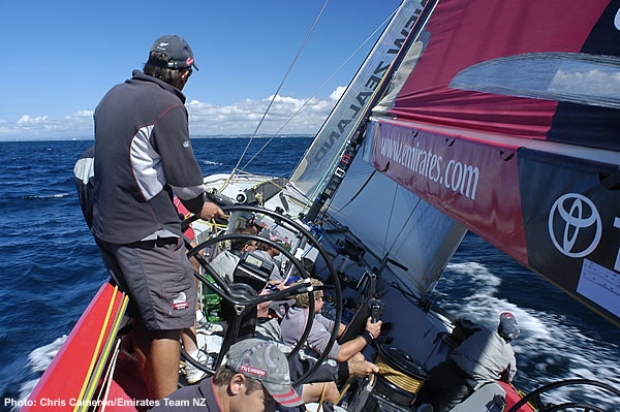
Dean Barker working with tactician Terry Hutchinson (back) and Ian Moore navigating (left)
Peter Holmberg was helmsman for Oracle BMW Racing in the last Louis Vuitton Challenge series in Auckland and since the departure of Russell Coutts has been one of the principle helmsman for the Swiss defenders at Alinghi, along with American Ed Baird. While Baird won both of the 'defender series' as the team was in Dubai, the anticipated decision over who would helm for the Act 13 fleet racing was not made.
According to Holmberg the decision was not solely over who won the series. "What they are looking at with Ed and I are starts, who won and lost, all the convergences - we’ve had leebows, slam dunks, etc - so who won those scrimmages, mark roundings, little situations. That’s when they want to be looking at because that’s when we direct the whole boat." This information is being collated by coach, Pierre-Yves Jorand.
'So what is so special about helming a Cup boat?' we put it to Holmberg. "Driving a Cup boat, it is not the raw speed, it is the intensity, the fined tuned-ness of the whole thing, the loads, the angles we get to and the orchestration of the whole crew. You have got the best sailors in the world here assisting you and taking you and the boat and putting it places that are hard to believe you can. Cup boats are just so powerful and so finely tuned, so to drive it is a thrill. It is like conducting the world’s biggest orchestra."
An interesting aspect of match racing, perhaps more obvious than it is in fleet racing due to there being more set moves involved, is that every skipper has their style, their favourite moves, their strengths and weaknesses.
At Emirates Team New Zealand Ben Ainslie says the job of assessing the opposition falls on the shoulders of veteran match racer Rod Davis. "On a race day Dean will run through the opposition with him and have a good idea of what he is about to face. Rod has a good eye..."
In the Alinghi camp Holmberg says they have made their own assessment of each of their opponent skippers. "I try to have a game plan for every opponent. If I am facing Spithill I think of what his strengths and weaknesses are and try and exploit his weaknesses and watch out for his strong points. If you think of tennis, that is how they would do it. They study the tapes. So if you can take him out of his game plan and have him sail in yours, then that is the goal."
As to his own strengths and weaknesses compared to Baird, Holmberg says he is more aggressive, perhaps too aggressive on occasion, particularly in the pre-starts. "Starting is what I love the most. I think it is such a great dynamic game there and there are multiple options and you get the formula right and you have the gut instinct and you react quickly and smartly. It is very even. To be honest Ed is a little more traditional and mainstream in terms of his pre-start and I would be a little more on the left. I would try things a little bit more, try for opportunities a little more, than he might. The downside of being aggressive is that when it works you look really brilliant and when it doesn’t…. He is probably not as high risk as me and I think that is a bit of a strength, so personally I’m trying to lower my risk taking a little and try and get the high percentage better."
With the Acts leading up to the America's Cup it is generally acknowledged that teams will start the Louis Vuitton Cup challenger selection series at a very much higher level than they have in past Cups. Because of this the all-important pre-start jousting will not be the only crucial part of the match race for the helmsmen.
"What you are going to see a lot of in this Cup are convergences," says Holmsberg. "The boats are going to be close and controlling the left or the right. You are going to see some leebows that are SO close and being able to put it in there at the right time and not foul and still protect which side you want - that will be the new heated moment of this Cup I would predict. There is a big technique there, being the right of way or give way boat and who is the strongest one."
With their tiny low-drag rudders, massive 22 tonne bulbs, slab-sided hulls and highly loaded rigs, Cup boats tend to be unusual bits of kit to steer. With the small rudders a team effort tends to be required to get the boat to turn corners. "It is a balance between drag and steering," continues Holmberg. "When you have got speed then the rudder works for you, but if you are not up to full speed and it is windy and the boat is loaded, you can’t do anything unless they trim the sails for you properly. When it is all balanced and fine, you have finger touch control. So it can be a balancing act there."
The manoeuvrability of a Cup boat obviously comes down to the design team. If a has an oversized rudder and particularly manoeuvrable , as BMW Oracle Racing's USA 87 appeared to be last season, then it potentially makes for a more powerful pre-start boat. The trade-off is having a more draggy underwater profile to haul around the race track and ultimately straight line speed upwind and downwind is the be-all and end-all of Cup boat design. Holmberg describes the approach: "The design team tends to throw us the smallest rudder they can and we just do our best with our sail trimmers to make it work for them. They tend to be about the right size, so it is a lot less drag than a big one and if it isn't then we just do a better job of turning the boat with our skills."
At Emirates Team New Zealand, Ben Ainslie says that the helming experience has changed considerably between their old generation boats and their new ones. "The old boats, NZL 81 and 82, were very finicky boats to sail. Just the hull shape meant they kind of wandered a lot. You had to really focus hard to keep them on their numbers. In some ways they felt more mechanical in that you had to force the boat to react through more trimming and helm movement whereas with the current boats we have got now, they are amazing. It is a bit like sailing a Thames barge - you point it is in the right direction and it just sails. It takes very small trim adjustment to keep the boat on the right numbers."
Ainslie adds about the unusual motion: "It has a very strange sensation going through the waves - it goes through them rather than going over them. That is a function of the hull shape because it is so square and because of the bow shape. It is a bit weird but they are good boats to sail and they are quite comfortable to steer. On the old boats, the cockpit was pretty high so you had nothing to balance against. It had like a quarter deck and you were up there like Nelson! Whereas with the new boats the cockpit is deeper and you can balance against the side decks and get locked in and so it is a really comfortable boat to steer particularly with the wheels being at a slight angle as well. That is quite a comfortable steering position."
Often boats that go well in a straight line tend not to turn corners too well, but this is not the case with the new Kiwi boats says Ainslie.
Like Holmberg, Ainslie acknowledges that on Cup boats there are times when you have to use the trimmers much more than you would on a normal race boat. "You have far more control over the rig - both with the headsail, in board and outboard and with the flippers, and with the mainsail with the jumpers (the boats that have them), with the checks - that is constantly going on. A fantastic part of the Cup boats is the fine tune that you have."

Trim tab on the trailing edge of Alinghi's keel
Another unique part (unless one includes ORMA 60 trimarans) of the Cup helming experience is that pretty much all the boats have trim tabs on the trailing edge of their keels. This creates an asymmetric profile of the foil and helps add lift, causing the boat to sail higher when going upwind.
"The trim tab makes a big different," says Ainslie. On board the Kiwi boats the tactician operates the trim tab in the pre-starts but otherwise it is the helmsman's job. "It makes a big difference to the feel of the boat, to the extent that you start putting it on a bit when you feel a gust coming on. They are amazingly responsive - it is like a dinghy feel. Eventually when you get used to it, you can sail it like a dinghy, without really looking at the numbers. You get a feel for the boat when you sail it enough. It is nice when you get that, it makes you feel like you are at home." On Alinghi tactician Brad Butterworth tends to operate the trim tab most of the time.

Peter Holmberg on this occasion working with tactician Peter Evans (gesticulating) and Juan Vila (left) navigator
An aspect where the helmsman's role varies from boat to boat is whether or not they are also skipper. On a majority of boats they are and Ainslie says this is the case with both the Emirates Team New Zealand afterguards. "I don’t know how you could run it any differently because the helmsman has to time when the sail is going to get dropped or when he is going to turn for the drop, because you have the best feel for the kind of manoeuvre you think you can pull off!"
On board Alinghi, the hierarchy is less clearly defined, with Brad Butterworth taking the role as skipper. "Right now Brad is skipper, he is the boss of our team," says Holmberg. "When I am on board with him it is a little bit of ‘are you going to speak, or am I?’ So it is still being sorted out. But the more time we spend together the more we know when each speaks. There is a moment when Brad leads the team and that is a relief for me, because then I’m just driving the boat. When it comes to executing something he’ll tell me what he wants and then I’ll drive the whole team. So it will become pretty clear cut."
As Ainslie says there are frequent occasions when lightning speed is required and only the helmsman can make the call. On Alinghi for example Holmberg calls the manoeuvres and the trim. "Brad’ll say in my ear 'we really want the right' and I’ll take it from there. I tell the crew, ‘we’re dialling up’ or ‘speed now’ or ‘I think I can push him, let’s do that’. He’ll only interject if he sees something I might have missed. That is completely handed off to me. If its a crossing situation upwind he'll say 'Pete, I want the right, do what you can' or 'I think you have enough strength to live on his hip, do what you can’. Then I take it on."
A lot of the success with this kind of interaction is one of timing. Cup boats are big powerful bits of kit with giant sails that must be operated as a cohesive machine by legions of crew and as Holmberg says you can't be getting instructions half way through a manoeuvre. "Brad has to paint a nice picture and know he can hand it off to us to execute it for him. You have to be smooth on that hand-off."

The inner wheel operates the trim tab (see more below)
Obviously input about what is going on or should happen comes from across the afterguard. On Alinghi there is the traveller man, either Murray Jones or Jordi Calafat, the strategist, either Grant Simmer or Jochen Schueman plus Brad or Peter Evans in the tacticians role. Typically Brad or Peter Evans will make the big decisions leaving the helmsman to focus on speed. "If I tried to do other things I'd do a poor job on speed," confirms Holmberg. "So when I know I have got a tactical team that is as good as can be, the best thing I can do for our boat is to go fast. But I have one ear tuned to it. I can hear if they are saying 'I think it is going right'. And if I start feeling little righties in the puffs then I can say ‘hey, yes it is’. If they are talking about doing this with the boat I can say ‘this is a tough one for me to execute for you’. So I can tune in and tune out." So the feminine multitasking gene is required.
On board the Emirates Team New Zealand boats they are big on the Janet Jackson-style comms links. As Ainslie puts it: "You are constantly talking with the trimmers and for the make roundings you are through the comms loop talking with the bow team. Then there is discussion going on at the back of the boat about where you want to be on the course and then when you get to the leeward mark the gate is normally the tricky one, trying to pick the gate and the manoeuvre around the gate, whether it is an early gybe or a Kiwi or a jib up and then a gybe."
Cup boats are obviously giant powerful sailing machines and thus on board crew co-ordination and management is critical to the success of any team in the heat of battle. Despite this Holmberg says that competing in small boats with small crews on the match race circuit is still relevant to Cup sailing. "There is a difference and so long as you know that difference it is a benefit to do small boat match racing. You can’t do in a big boat what we do with the little ones one boat length from the mark, but a lot of the manoeuvres, the boat handling, the ideas, the concept, the match racing manoeuvres are all very applicable. Personally we squeeze in as much small boat match racing as we can."
It is also good to get a break from in-house racing. "To race against other teams, to make calls and to be in a real race, to put your fighting gear on and be in the mind set – there is a big value in that. And I do think you bring it back into the team as well. We are very fortunate to have three helmsman and we could always keep our program here working and one guy can hop out and do a regatta."
And the fitness level required for helming? As Ainslie puts it: "Absolutely none! But mentally it is quite draining."

Most Read
Most Commented
Comments
Businesses

Pro businesses
-
-
-
Netherlands
-
United Kingdom
Editor's choice
Member blogs
-
 Ned Collier Wakefield: MOD70 round BarbadosWell that was intense. 12 hard fought for seconds for the win. In idyllic conditions, Tony Lawsons MOD ...
 -
 Mini Transat leg 2 reportThe second leg of the Mini Transat started on 31st October, just over a month after ...
 -
Leg 1 reportI’ve been working towards the Mini Transat now for three years. In 2013 I was part ...
Business blogs
-
 The Island Sailing Club in Cowes, Isle of Wight, is delighted that Prince Michael of Kent ...
 -
Peta Stuart-Hunt chats with the 25 year-old British solo sailor Lizzy Foreman before she sets sail ...
-
The 2015 Student Yachting World Cup (SYWoC), an ISAF-recognised event hosted and run by students for ...
Editor's Choice
All time favourites...
-
 Three legs down into Ian Walker’s
 -
 Winning all but two races at
 -
 For the first time in its
Latest Comments
Add a comment - Members log in