
Trial on two hulls
Friday June 2nd 2006, Author: James Boyd, Location: United Kingdom
By now most people will have studied the awesome pictures of the Volvo Extreme 40s pitchpoling during Tuesday's racing (if you have not they are
here.) I had been studying these images with perhaps more interest than most because I was lucky enough, I think, to be out on the
Volvo Ocean Race boat for two races on Thursday - and if you're wonder, yes that’s the same
Volvo Ocean Race boat that pitchpoled.)
By the time I made it down to the meeting point the boats were all out on the water and the wind was blowing about seven knots with a few double figure gusts coming down the course. As I sat in the RIB watching the first two races it was clear that the wind was picking up and the gusts were getting a little bit sharper. The racing up that close was pretty spectacular and the boats looked way bigger than 40ft.
The first two races came and went quickly and before I knew it, it was my turn to step onboard. The first thing that struck me about the boat was the simplicity of the controls. It was a lot like being on board any high performance dinghy with minimal ropes and everything set out in a considered and simple way.
When I stepped on board the crew had literally just finished their second race and were in deep conversation about their apparent lack of boat speed. As such the boat was sat more or less head to wind and the whole thing felt amazingly stable, with minimal movement from the waves. I should at this point tell you that I am not a big boat sailor, nor am I a cat sailor, I am a monohull dinghy sailor. So I apologise if some of this is familiar territory for any of you out there that regularly sail cats.
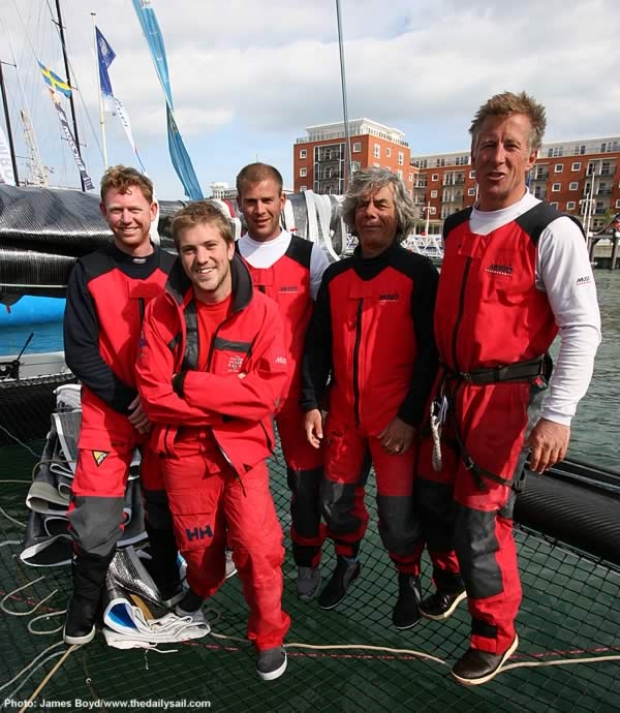
The crew finished their chat, having decided to change their upwind set-up, and we were off. Yves Loday, our helm for the day, chucked his cigarette over his shoulder (very French) and ripped the boat away downwind. This first bear away came as a bit of a shock to me as the bows seemed pretty keen to bury themselves, so I scurried to the back end of the boat. During this downwind ride to the start line I was taken through the extra person ‘rules’: essentially; stay as much out of the way as possible and as far back as possible downwind.
The pre-start did not feel too different from most and there was little to let you know you are actually screaming around the start area at high speed. With one minute to go we were looking okay but not great. We were sat just off Basilica’s aft quarter aiming for a committee boat start and I was getting a little bit fidgety because it didn’t look like we had much space. About half a minute out and boats were starting to wind on for their final approach. Basilica had borne away a little as it looked like they were going to be early but there was still hardly any space for us. 15 seconds to go and we had also cracked off a bit and were now screaming toward Basilica’s transoms. In the last five seconds Basilica started making some noise and it was obvious why, we were roaring towards them and I thought then a collision was unavoidable. I looked back at my team and realised mine was not the only worried face. At literally the last possible moment Loday luffed hard and we missed ramming Basilica by about three inches. That was close and there are a few nervous exhales as we started to hammer upwind.
Loday, the Tornado ace and designer of the VX 40 had made a cracking start, we had pace and were hard on the committee boat - clearly the place to be. We used a little of our speed to take some height, giving us some room on Basilica, however, it quickly became clear that we were falling into them so we held on as long as we could and tacked out to the right hand side.
What is amazing and odd about these boats is when you are on board racing it just doesn’t feel like a 40ft boat - it is like sailing a regular beach cat. They are smooth and silent and as Loday demonstrated at the start the helms chuck them around with wild abandon. There is also little sensation of speed as the boat silently knifes through the waves.
We reached the windward mark in second and the bear away was, as ever, frightening as the bows put all their effort into seeing what life was like as a submarine. The gennaker went up and it was a super quick hoist and set and the boys on our boat were very proud. We set off downwind pushing Basilica all the way to the layline. Again this did not feel as fast as I was expecting, although my position on tramp at the back is pretty soggy. I was starting to wonder if there was less wind than I thought and we were just going pretty slowly but a quick glance at the press RIB immediately erased this thought from my mind as they clearly have to go some to keep up with us.
We maintained our second position round the next lap and I am now getting used to the bows burying themselves and getting my sensation of speed from other boats and objects around us. What I can’t get used to is how small it feels. Occasionally I race with my parents on their Oyster 37 and I kept thinking to myself there is no way this is 3ft longer. The only way I could easily realise the size of the boat was to look up at the size of the main.

On the final beat we managed to lose a place and slipped back to third, the boys on my boat were not happy and it was all starting to feel pretty tense. We finished in third place in the end which was okay but we should have taken second really and the boys all knew it.
The second start went without a hitch and was much less scary than the first. Sadly half way up the first beat the rope that holds our mast rotating spanner to the boom snapped and a repair had to be made. This left us on the starboard layline with the battens all inverted but with more speed than I would have thought. The breeze had picked up by this point but we managed to miss a serious shift on the first downwind leg and this left us out of contention for another podium finish. The mast spanner was fixed by tying a line from it to the aft cross beam, which made tacking an interesting process as we all crossed the boat either rolling under or leaping over it.
It was clear our team was starting to get frustrated and this was interesting to watch. I say interesting because one of the things I found to be most odd when out on the boat was my lack of participation. I knew from the start that I was just a guest and had prepared myself for this but I actually found it quite a struggle. I don’t think I have ever been out racing and not been involved in some way and the temptation to try and help was huge. Having said this it was as I said earlier really interesting to see a racing team dynamic from the outside and it made me think if it would be a good training exercise for a crew.
I suppose the million dollar question is what is it like to race a VX40? Well it is an odd mixture of being aware that you are sailing an extremely fast high performance boat and feeling like someone just dropped you on a Dart 16 with some of the best sailors in the world. That is the best way I can describe it and even then it comes out wrong. So I will borrow a word from our American pals which fits the bill. It is awesome.
Most Read
Most Commented
Comments
Businesses

Pro businesses
-
France
-
United Kingdom
-
-
France
Editor's choice
Member blogs
-
 Ned Collier Wakefield: MOD70 round BarbadosWell that was intense. 12 hard fought for seconds for the win. In idyllic conditions, Tony Lawsons MOD ...
 -
 Mini Transat leg 2 reportThe second leg of the Mini Transat started on 31st October, just over a month after ...
 -
Leg 1 reportI’ve been working towards the Mini Transat now for three years. In 2013 I was part ...
Business blogs
-
 The Island Sailing Club in Cowes, Isle of Wight, is delighted that Prince Michael of Kent ...
 -
Peta Stuart-Hunt chats with the 25 year-old British solo sailor Lizzy Foreman before she sets sail ...
-
The 2015 Student Yachting World Cup (SYWoC), an ISAF-recognised event hosted and run by students for ...
Editor's Choice
All time favourites...
-
 Three legs down into Ian Walker’s
 -
 Winning all but two races at
 -
 For the first time in its
Latest Comments
Add a comment - Members log in