
Down to the detail
Thursday May 25th 2006, Author: James Boyd, Location: United Kingdom
Prominent design houses within the TP52 class for 2006 remain Farr Yacht Design, Botin & Carkeek and Judel Vrolijk, all of whom have new examples on the water in Punta Ala.
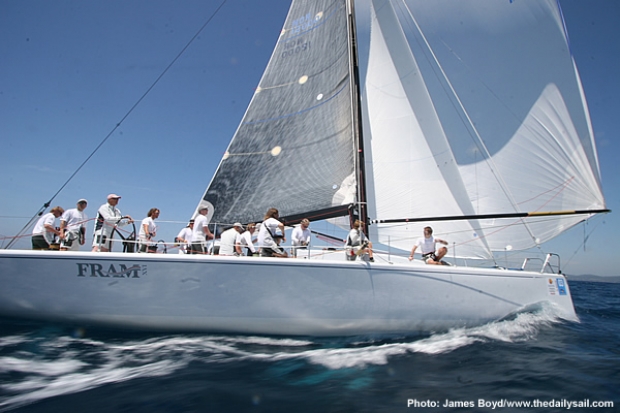
Of the new boats Judel Vrolijk are winning the 'designer wars' with an impressive five new boats for this season ( Anonimo, Cristabella, Mean Machine, Pinta and Platoon), while Botin & Carkeek after winning the 2005 championship have two ( Atalanti/Lexus and Warpath) and Farr have one brand new in King Harald of Norway's latest Fram and two others launched late last year in Stay Calm II/Santa Ana and Tom Stark's Rush.
Oddly after the success of Patches and Lexus there are no 2006 generation Reichel Pugh boats. We look forward to the arrival of the first Luca Brenta designed boat later this year . It is a shame more design houses aren't involved with this class.
Two of the most promising campaigns this year are Fred and Steve Howe's Warpath, helmed by Dean Barker with most of the Emirates Team New Zealand afterguard on board and George Andreadis' Lexus where Gavin Brady his helming, Russell Coutts is calling tactics with a crew that sailed with Coutts last year. Both boats have been designed by Botin & Carkeek. There is a further relationship in that one half of this design partnership, Marcellino Botin, is one of the designers for the Emirates Team New Zealand.
"Our new boats are definitely an evolution of last year’s boats," says Botin. "They are slightly narrower and slightly more upwind-orientated than last year, because there are more boats. It's not that I think downwind isn’t just as important as upwind, especially in this kind of fleet - you can do as much overtaking downwind as upwind - but it is very important that you can keep your track on the upwind legs. So we have slightly bigger foils." This is in terms of cord length.
Another feature of the B&C designs is a more elongated bulb shape. This, says Botin, is nowhere near as extreme as the Emirates TNZ torpedo bulb, simply because this isn't appropriate for the TP 52 rule. "The TNZ bulb is very long. This is a little bit longer, but not a huge amount. Basically the longer the bulb the lower the CoG is of the whole bulb, and in these boats since we have got to comply with a minimum VCG value the lower you put your bulb VCG the less lead you need in the bulb. So it is a little longer and has maybe more wetted surface because of that, but then it is smaller than it would be in terms of weight and volume on a bigger bulb. It is not like an AC boat where your bulb is basically a certain weight and it doesn’t really matter what shape you make it - it is always going to be the same weight. In this case if you have a bulb that is longer and the VCG is longer you can make it slightly smaller. So the trade off is not as clear cut as it is on an AC boat."
Because of the VCG rule most designers are heading for minimum bulb size, instead filling the foil itself with lead and having almost one tonne of internal ballast. Yet at the same time designing a boat with maximum stability is also crucial says Botin. Even in the light wind regattas they are sailing in the Med, due to their generous sail plan TP 52s are powered up in anything over 7 knots.
"In pretty light airs these boats are quite powered up, so there is a need for form stability and crew stability and all the stability you can get," says Botin. "So if you can design a boat that is pretty stable and at the same time can be reasonably fast in light airs then obviously in reaching conditions, you will have an advantage as you will upwind in any breeze or if you are flying code zeros or stuff like that. So it is a very fine line between one thing or the other. Obviously some boats are better in some conditions others are better in others. Our approach with last year’s boats and this year is to go a little bit wider in the waterline and try to make the boat reasonably fast in light airs through basic volume distribution and good lines design and hope the extra stability will pay off when it is 10 knots or over."
Stability is also the driver for the TP 52s to be on or close to maximum overall beam of 4.42m. "We have always gone from max beam allowed under the rule," continues Botin. "The trade off is between the stability you get from the crew, which in these boats it is pretty critical and some amount of heeled wave drag that you are going to pay for the wider you go. It seems that the stability factor is dominant in these shapes. We don’t sail the boats at more than 20 degrees or something like that so you want as much stability as possible." In other words being at maximum beam helps optimise the righting moment generated by the crew sitting out.
Where there is variation is in the amount of flair in the hull, waterline beam being unconstrained by the TP 52 rule. The variation here is based on each design house's guestimate for the stability required for the conditions the boats will experience (ie Med conditions) and the type of courses (mainly windward-leeward with some reaching ability required for coastal races)
"I got the impression that most boats are evolving towards being flatter at the front end," says Botin of how hull shapes are developing. "We were like that last year so in our case it is not a big change. The volume distribution in our boats is maybe slightly different to the rest, but it is much the same as we were doing last year, with less beam as we have gone a little narrower just to compensate for the bigger foils."
One signifcant difference between the 2006 Botin & Carkeek boats is that they now incorporate a chine in the 5m or so of the final run aft. "It is just a wave drag thing," says Botin. "It is not a sharp chine it is a hard bilge almost."
As the TP 52 is the class of the moment, results in this have a significant bearing on a design house's business. Thus Botin & Carkeek put considerable resource into the R&D of their boats. This comes both in the form of CFD time, but also time tank testing hull shapes. Last year they tested three models at the tank in Southampton.
From the deck down both Lexus and Warpath are more or less identical, but beyond this it is up to clients to select their rig and sail packages. There are two spar suppliers in the TP52 fleet - Southern Spars and Hall Spars. Both have new sections out for 2006, and the difference between them is easily discernible as the Hall rigs have two sets of spreaders while the Southern offerings have three. Generally we understand there has been a move reduce windage aloft in terms of section reduction, spreader end caps, etc.
While they have their two new boats competing in the MedCup Botin & Carkeek have a third in build at Cooksons - John Kilroy's new Samba Pa Ti. This will be slightly different as Kilroy's program will be more US-based where the circuit includes more offshore racing.
So does this mean we are already seeing a distinction between US and Mediterranean TP 52s? Botin reckons that due to the nature of the races in the States, US boats will have to do more reaching, but there is little reason why they should still not be competitive were they to line up in the Med too.
In addition to this there seems to be much variation between the boats in their sail handling systems, the mechanics for how these work mostly hidden below deck (see our interview with Paul Hakes about the magic wheel on his Judel-Vrolijk boats).
While the TP 52 class is nearing its zenith in terms of fleet numbers with many people reckoning it will max out at around 30 boats in a couple of years time, Botin says that they are now starting to get a similar, possibly even greater interest in the ORC 42. "We are getting a lot of interest in that class and I’m sure there will be just as many boats in a couple of years. It proves that if you do things right, even though these boats are pretty expensive you will always get owners who are interested. And good racing is what they want and that’s what they’re getting "
For the sailing anoraks among us over the next few pages we publish images of the transoms and bows of all the TP 52s currently competing in Punta Ala.
Most Read
Most Commented
Comments
Businesses


Pro businesses
-
-
United Kingdom
-
Italy
-
United Kingdom
Editor's choice
Member blogs
-
 Ned Collier Wakefield: MOD70 round BarbadosWell that was intense. 12 hard fought for seconds for the win. In idyllic conditions, Tony Lawsons MOD ...
 -
 Mini Transat leg 2 reportThe second leg of the Mini Transat started on 31st October, just over a month after ...
 -
Leg 1 reportI’ve been working towards the Mini Transat now for three years. In 2013 I was part ...
Business blogs
-
 The Island Sailing Club in Cowes, Isle of Wight, is delighted that Prince Michael of Kent ...
 -
Peta Stuart-Hunt chats with the 25 year-old British solo sailor Lizzy Foreman before she sets sail ...
-
The 2015 Student Yachting World Cup (SYWoC), an ISAF-recognised event hosted and run by students for ...
Editor's Choice
All time favourites...
-
 Three legs down into Ian Walker’s
 -
 Winning all but two races at
 -
 For the first time in its
Latest Comments
Add a comment - Members log in